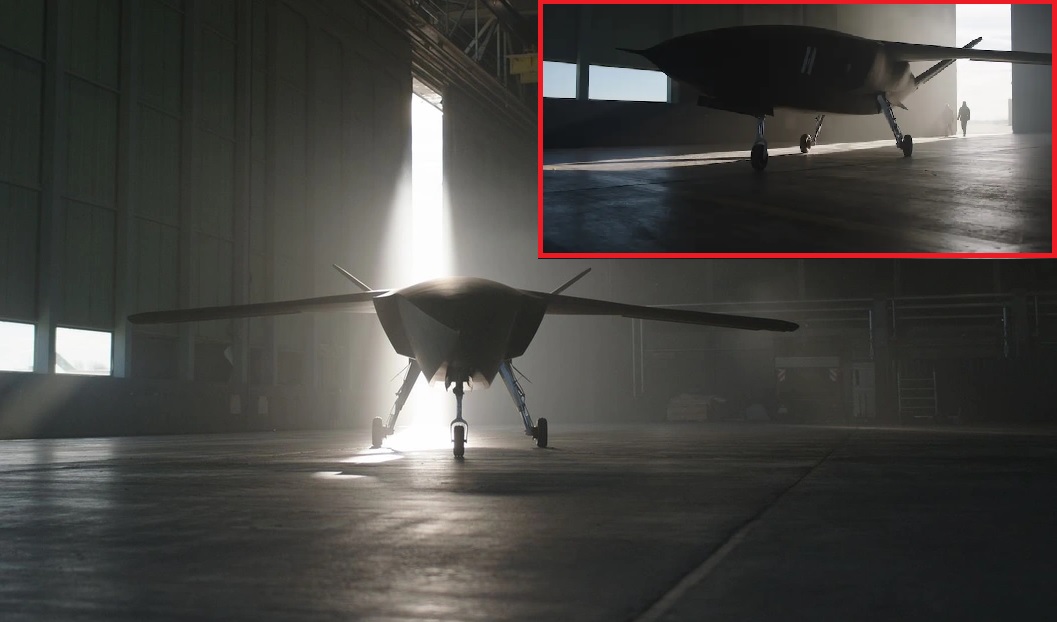
BERLIN, — June 11, 2026 : European defence technology company Helsing has officially unveiled the CA-1 Electronic Attack (CA-1EA), a new AI-powered autonomous aircraft developed specifically for electronic warfare missions. The aircraft was presented at the International Aerospace Exhibition (ILA Berlin 2026), marking a significant expansion of the company's CA-1 Europa autonomous combat aircraft program.
The introduction of the CA-1EA also formalizes a new designation for Helsing’s original combat-focused aircraft, which will now be known as the CA-1KA (Kinetic Attack). Both variants are designed to operate together as part of a modern loyal wingman concept, providing European air forces with a combination of kinetic strike and electronic warfare capabilities for operations against advanced air defence networks.
Electronic Warfare Role
Modern air defence systems rely heavily on ground-based radar networks to detect, track, and engage aircraft. The CA-1EA has been developed to counter these threats by conducting airborne electronic attack missions and disrupting hostile radar systems through advanced jamming capabilities.
According to Helsing, the aircraft can create safer operating corridors for friendly aircraft by suppressing or degrading enemy reconnaissance and air-defence sensors. The platform is designed to support a wide range of assets, including uncrewed systems such as the CA-1KA and crewed fighter aircraft including the Eurofighter Typhoon.
The aircraft can operate independently or alongside other platforms, allowing air forces to combine electronic attack and strike capabilities during complex missions.
AI and Mission Systems
The CA-1EA incorporates Helsing’s proprietary Centaur AI system, which serves as the core autonomy architecture for the aircraft. The artificial intelligence platform enables autonomous navigation, mission execution, coordination with other aircraft, and operation in contested environments.
The drone also integrates Cirra, Helsing’s deep-learning-based electronic warfare system. Cirra is designed to rapidly identify previously unknown electromagnetic emitters and assess the intent of adversary air-defence systems in real time, providing faster threat analysis during missions.
As part of a recently announced strategic partnership with Hensoldt, the aircraft is equipped with a Kaeletron broadband jammer integrated through Hensoldt’s Multi-Domain Operations Core (MDOcore) software architecture.
In comparison, the CA-1KA kinetic attack variant carries mission systems including electro-optical/infrared sensors, self-protection equipment, visual navigation systems, and a synthetic aperture radar/ground moving target indication (SAR/GMTI) payload supplied by Hensoldt. The aircraft also features an internal weapons bay and a payload capacity of approximately 500 kilograms for air-launched weapons.
Standardized Design and Specifications
Despite their different mission roles, the CA-1EA and CA-1KA share the same core architecture. Both variants utilize an identical airframe, propulsion system, autonomy software suite, and ground control infrastructure, with differences largely limited to their internal mission payloads.
Helsing stated that this modular design approach is intended to reduce production and maintenance costs while simplifying manufacturing processes and operator training requirements. The common architecture also allows the platform to be adapted for future mission requirements and additional variants.
The CA-1 Europa falls within the three-to-five-ton combat aircraft class and features the following specifications:
- Length: 11 meters
- Wingspan: 10 meters
- Maximum Takeoff Weight: Approximately 4 tons
- Speed: High-subsonic
- Configuration: Internal weapons bay and modular payload architecture
European Development and Production
Development and manufacturing of the CA-1 platform are being carried out by Grob Aircraft, Helsing’s subsidiary located in southern Germany.
Helsing has positioned the platform as a fully sovereign European solution for German and allied air forces, aimed at reducing dependence on non-European supply chains while addressing growing requirements for collaborative combat aircraft and autonomous air systems.
The company noted that the platform forms part of broader European efforts to strengthen indigenous defence capabilities through AI-enabled and scalable uncrewed aircraft systems.
Development Timeline
The CA-1 platform remains under active development, with several milestones planned over the coming years.
According to Helsing's roadmap, maiden flights for the CA-1KA kinetic attack variant are scheduled for early 2027. The company expects the aircraft to achieve Initial Operating Capability (IOC) in 2029.
For the electronic warfare variant, a pre-series CA-1EA configuration is planned for 2028, followed by an operationally representative system in 2029. The CA-1EA is expected to reach Initial Operating Capability (IOC) in 2031.
——— End of Article ———