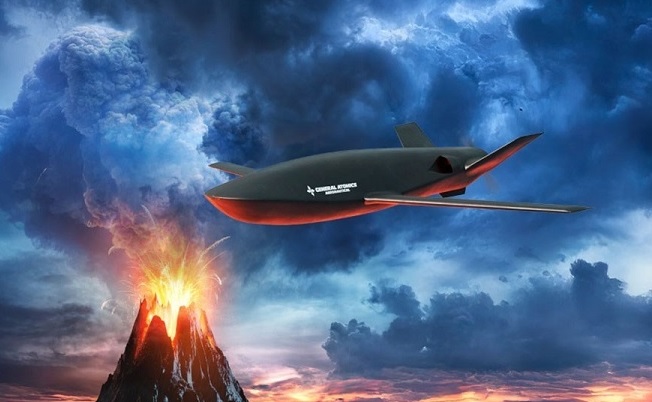
General Atomics Aeronautical Systems, Inc. (GA-ASI), a leading American defence and aerospace company known for its cutting-edge unmanned aircraft, has officially revealed a new small launched effect aircraft called PELE. Designed to expand the capabilities of uncrewed systems in the modern battlefield, PELE promises to play a vital role in multi-mission operations where versatility, endurance, and survivability are crucial.
Interestingly named after Pele, the Hawaiian goddess of natural forces and fire, the Precision Exportable Launched Effect (PELE) is a compact, lightweight, propeller-driven unmanned aircraft built for semi-autonomous operations. It’s designed to serve as an expendable asset that can safely extend the surveillance and operational reach of larger unmanned or manned aircraft, as well as ground forces, especially in highly contested or dangerous environments.
Key Specifications of PELE:
-
Wingspan: 11 feet
-
Length: 9 feet
-
Takeoff Weight: Up to 250 pounds
-
Engine: 16-horsepower
-
Endurance: Up to 7 hours
-
Operational Range: 500 nautical miles
-
Sensors: Electro-Optical Infrared (EO/IR) for real-time full-motion video
-
Launch Options: Can be launched from the air (from aircraft like MQ-9B SkyGuardian) or from ground-based platforms
Multi-Mission Capabilities
PELE has been specifically designed to integrate seamlessly with GA-ASI’s well-known MQ-9B SkyGuardian®, a medium-altitude, long-endurance unmanned aerial vehicle already in service with several countries worldwide. Thanks to its attrition-tolerant design, PELE can be deployed in high-risk areas where it might encounter enemy defences, taking on the more dangerous reconnaissance or targeting roles to protect its more valuable mothership aircraft.
With its onboard electro-optical infrared sensors, PELE can capture and relay live video, making it ideal for real-time intelligence, surveillance, and reconnaissance (ISR) missions. Additionally, it can carry internal mission payloads based on operational needs, providing flexibility to switch between different roles — from locating hostile air defence systems to identifying moving targets.
Operational Flexibility
One of PELE’s biggest advantages lies in its operational flexibility. On one day, an air force could deploy an MQ-9B for long-endurance patrols without external payloads to maximise time in the air. The next day, the same aircraft could launch several PELE units into hostile airspace, allowing them to scout, identify threats, or even act as decoys while keeping the mothership safely away from danger.
This system offers an effective, modern solution for situations where sending manned or high-value unmanned aircraft deep into contested airspace would be too risky. By operating from international airspace or safe stand-off distances, platforms like MQ-9B can extend their operational influence using launched effects like PELE.
A Step Toward the Future of Warfare
The introduction of PELE marks a significant development in how uncrewed aircraft can be utilised in future conflicts. It not only strengthens GA-ASI’s position as a leader in unmanned systems but also highlights a growing global trend towards attritable, expendable assets that can support frontline operations without risking valuable, high-cost platforms.
In modern warfare, where agility, survivability, and rapid, flexible response matter more than ever, systems like PELE represent a smart, tactical edge for armed forces worldwide.
——— End of Article ———