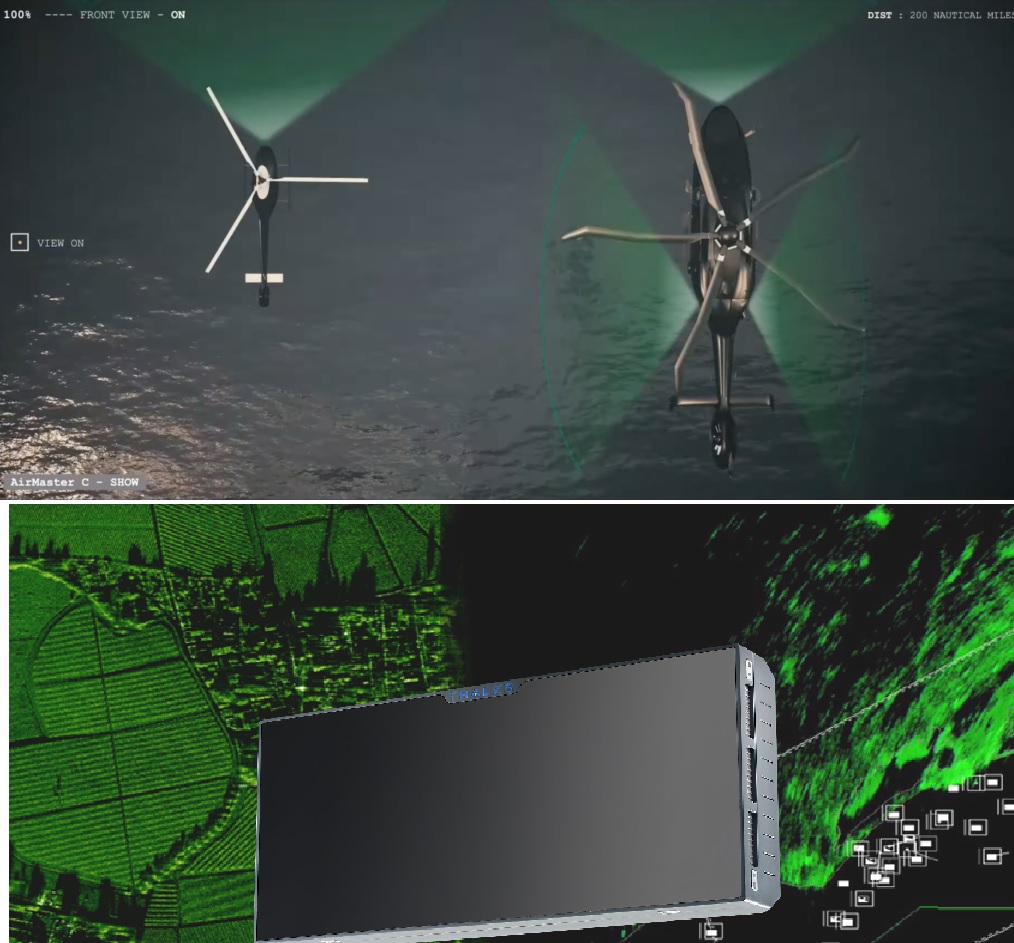
France has taken a major step forward in modernizing its light helicopter fleet by officially beginning flight trials of the new AirMaster C radar system, which will be installed on the upcoming H160M Guepard helicopters. Developed by Thales under the DRAGON program, this advanced radar promises to significantly boost the surveillance, detection, and targeting capabilities of the French Armed Forces.
What is the AirMaster C Radar?
The AirMaster C is a next-generation AESA (Active Electronically Scanned Array) radar, specifically designed for light, airborne platforms like helicopters and drones. It operates in the X-band frequency and uses cutting-edge Silicon-Germanium (SiGe) technology, which makes it highly compact, lightweight, and energy-efficient without sacrificing performance.
It’s built with a modular structure and open software architecture, meaning it can be easily upgraded and customized. The radar is also AI-ready, supporting artificial intelligence-driven features like:
-
Autonomous tactical analysis
-
Machine learning-based detection
-
Automatic target classification
This allows the radar to process large amounts of data, recognize different targets on its own, and assist operators in making faster, smarter decisions during missions.
Specifications of the AirMaster C Radar
| Feature | Details |
|---|---|
| Type | Active Electronically Scanned Array (AESA) |
| Frequency Band | X-band |
| Technology | Silicon-Germanium (SiGe) based |
| Key Modes | Tracking, SAR (Synthetic Aperture Radar), GMTI (Ground Moving Target Indicator), MTI (Moving Target Indicator), Mapping |
| Processing Capability | AI-driven, autonomous tactical analysis, machine learning-enabled target classification |
| Operation | Mode interleaving — multiple radar functions at once |
| Energy Consumption | Low power, high efficiency due to SiGe tech |
| Size & Weight | Compact, optimized for light airborne platforms |
| Integration | Modular, open software, compatible with military-standard data buses |
Testing and Trials
The French Defence Procurement Agency (DGA) confirmed that flight testing began in May 2025 at the DGA Flight Test Centre in Istres. A modified SA330 Puma helicopter is currently serving as the test platform.
These trials aim to evaluate:
-
Multi-target detection capabilities
-
Performance in degraded environments
-
Thermal stability and vibration resistance
-
Electromagnetic compatibility
-
Integration with onboard avionics and computers
Once these assessments are completed, the radar will be cleared for integration with the H160M Guepard fleet.
The Guepard Light Joint Helicopter
The H160M Guepard, developed by Airbus Helicopters, is part of France’s ambitious Light Joint Helicopter (HIL) program aimed at replacing multiple legacy helicopters in the Army, Navy, and Air & Space Force with a single, versatile platform.
Key Features of the H160M Guepard:
-
Modular airframe for multiple mission profiles
-
Reinforced survivability for contested environments
-
Advanced digital cockpit and avionics
-
Common operational configuration for all military services
-
Equipped with state-of-the-art sensors like the AirMaster C radar
Deployment Plans
Under France’s 2024–2030 Military Programming Law, the Armed Forces will induct 169 Guepard helicopters by 2030:
-
80 for the French Army (ALAT): Armed reconnaissance, fire support, special forces missions
-
49 for the French Navy: Maritime combat, special operations, anti-surface warfare
-
40 for the French Air & Space Force: Search and rescue (SAR), air surveillance, intelligence gathering
A New Chapter in French Aerial Modernization
The integration of the AirMaster C AESA radar with the Guepard helicopter marks a significant advancement for the French military’s airborne capabilities. It ensures better situational awareness, rapid multi-target detection, and AI-assisted decision-making for missions ranging from maritime surveillance to special operations.
Additionally, the successful development of this radar under the DRAGON program not only strengthens France’s domestic sensor technology but also opens up future export opportunities, offering a competitive, modern, multi-role helicopter system for international defense markets.
——— End of Article ———