China's recent space endeavors continue to captivate and puzzle the global space community. One of the most intriguing developments is its secretive space plane, which returned from orbit earlier this month, revealing a significant milestone in reusable space technology. The enigmatic craft touched down on September 6, 2024, after an impressive 268 days in orbit. Despite its public landing, very little is known about this spacecraft beyond a few details, but the new evidence suggests it carries advanced technology that could elevate China's position in space exploration.
The Launch and Mission
On December 14, 2023, China launched the space plane into orbit aboard a Long March 2F rocket from the Jiuquan Satellite Launch Center, nestled in the arid expanses of northwest China. The launch, like many of China’s space activities, was shrouded in secrecy, with limited details released about the mission or the spacecraft itself. However, according to the state-run China Global Television Network (CGTN), the space plane's mission was primarily aimed at "conducting reusable technology verification and space science experiments."
The focus of the mission highlights China's growing proficiency in space technology, especially in reusable spacecraft—an area long dominated by the U.S. and Russia. With this mission, China is evidently honing its capabilities in more cost-effective and efficient space travel, with peaceful applications touted as the end goal. The extended duration of the mission—lasting 268 days—suggests the success of China’s reusable technology, far surpassing the two-day mission it completed with a similar craft back in 2020.
The Mystery of the Delta-Wing Design
One of the most significant breakthroughs in understanding China’s secretive space plane came from amateur space watcher Felix Schöfbänker in Austria. Schöfbänker, who has a track record of observing orbital objects, captured images of the spacecraft on August 10, 2024. His imagery revealed a delta-wing design, a classic aerodynamic structure known for its stability and maneuverability at high speeds. This design has been a hallmark of various military and space planes, providing clues about the spacecraft's potential capabilities.
The delta-wing structure, with its broad, triangular shape, is particularly useful in atmospheric re-entry and high-speed flight, which suggests that China’s space plane is designed for not just long-term orbital operations but also rapid atmospheric re-entry—an essential feature for a reusable craft. Observers believe that the dark spot between the wings, visible in the images, could possibly indicate the location of a cargo bay, implying that the plane may also serve as a transport or supply vehicle for future missions.
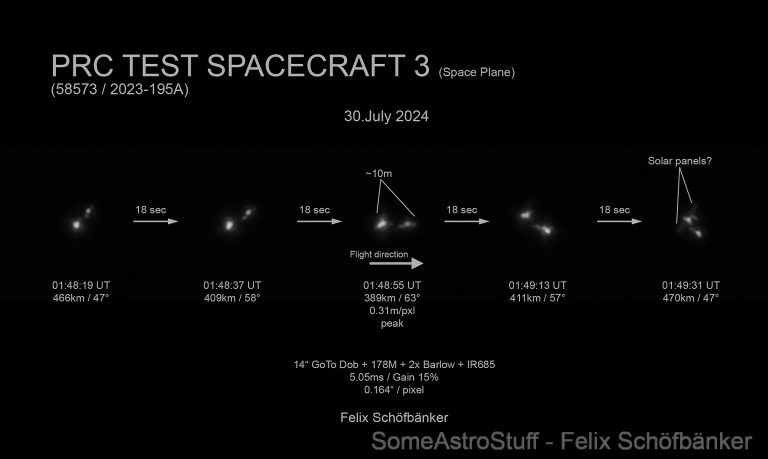
(Image credit: Felix Schöfbänker)
Comparisons to the U.S. X-37B
China's space plane has inevitably drawn comparisons to the U.S. Space Force’s X-37B, another reusable spacecraft that has been conducting classified missions since 2010. The X-37B, often referred to as an "orbital test vehicle," shares some conceptual similarities with China’s secretive spacecraft, including its small size, long mission duration, and the ability to re-enter the Earth's atmosphere. Both spacecraft are capable of carrying experimental payloads and conducting covert missions, leading to speculation that China’s plane might be part of a broader effort to compete with or mirror U.S. advancements in space.
Interestingly, the U.S. X-37B is also currently in orbit, having launched just 15 days after China’s space plane, on December 29, 2023. It remains unclear whether there is any direct relationship between the two missions, but the timing and similarities are notable, underscoring the increasing militarization of space.
A Glimpse of China’s Space Ambitions
While the Chinese government continues to release minimal information about its space plane, the success of this mission is indicative of China’s broader space ambitions. Over the past few years, China has aggressively expanded its space program, achieving a number of firsts, including landing a rover on the far side of the moon and sending a probe to Mars. The development of reusable space vehicles is another step toward solidifying its position as a global space power, aiming for both scientific advancements and potentially military applications.
China’s progress in reusable technology not only offers economic advantages but also points toward future missions that could involve more frequent access to space. The ability to reuse spacecraft cuts down on costs, accelerates mission timelines, and opens new doors for scientific exploration and potentially commercial space activities.
As more details about the design and mission of China’s space plane come to light, the world watches closely, knowing that this is likely just the beginning of a new chapter in the space race. With both China and the U.S. pushing forward with highly secretive, long-duration space plane missions, the coming years could see significant advancements in space technology, as well as an increasing focus on the strategic use of space.
The delta-wing design and the success of the 268-day mission underscore the progress China is making, positioning the nation to be a formidable competitor in the growing field of reusable space vehicles.
——— End of Article ———