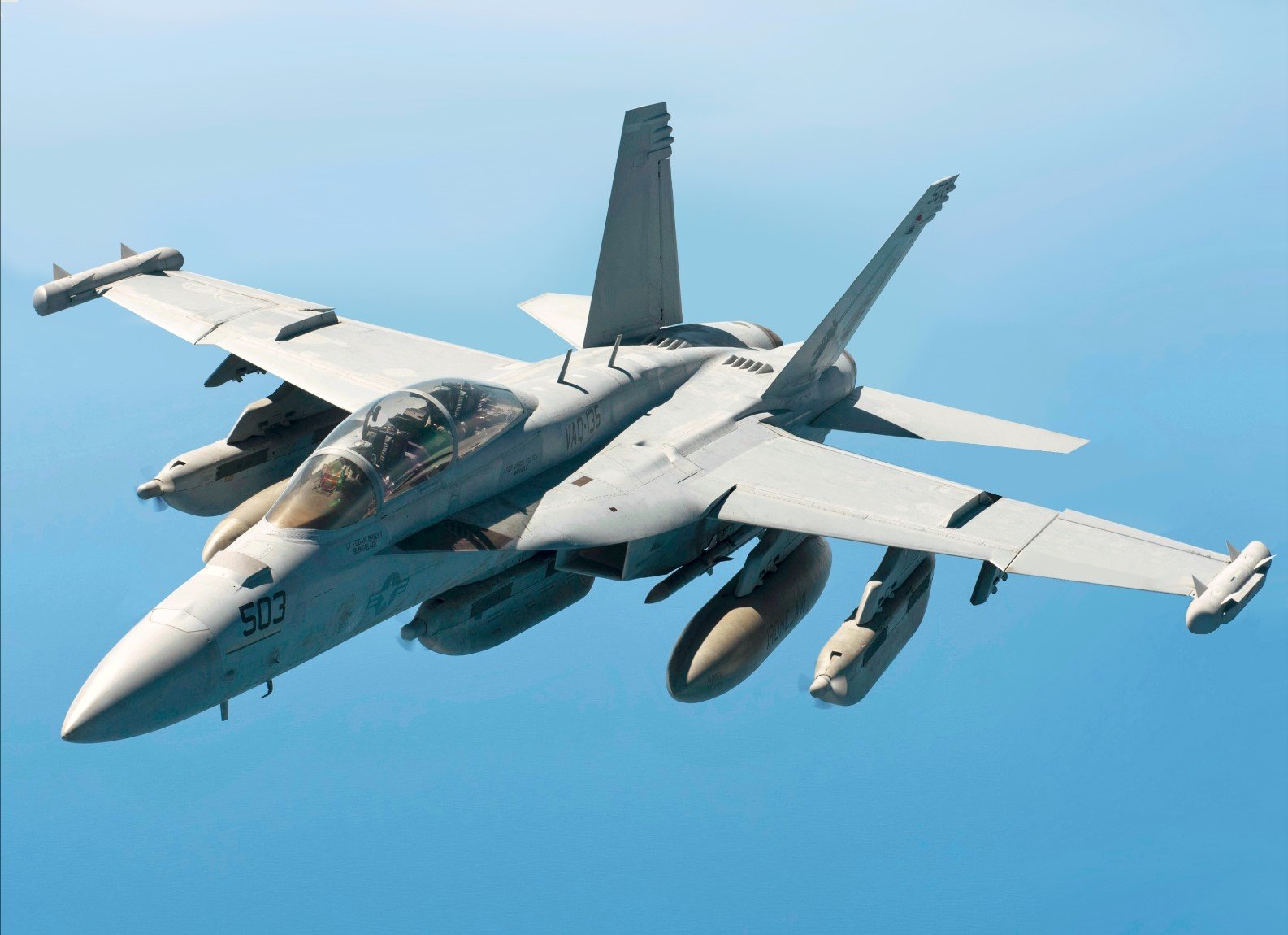
ST. LOUIS — Boeing is marking 20 years since the first flight of the EA-18G Growler, the U.S. Navy’s carrier-based airborne electronic attack aircraft. The anniversary comes as Boeing and the U.S. Navy continue upgrading the aircraft’s processing, detection and jamming systems to address modern electromagnetic threats.
The first Growler, designated EA-1, flew from Lambert International Airport in St. Louis, Missouri, on August 15, 2006. Boeing test pilot Ricardo Traven and chief weapons system operator Rick Junkin were at the controls.
“From the first flight, that I had the pleasure to pilot with my WSO Rick Junkin, it was obvious to us what a terrific capability and future this aircraft would blaze in the years that followed,” Traven said.
From the EA-6B Prowler to the Growler
Development of the EA-18G formally began in December 2003 under a five-year System Development and Demonstration contract between Boeing and the U.S. Navy. The aircraft was developed to replace the Northrop Grumman EA-6B Prowler.
Based on the F/A-18 Super Hornet, the Growler is designed for electronic warfare missions including surveillance, jamming and suppression of enemy air defenses. It can operate from aircraft carriers and conduct both stand-off and escort jamming missions.
Former U.S. Navy Growler pilot Paul “Disco” Ritter described the transition from the EA-6B to the EA-18G as a major change.
“I started my career flying the EA-6B Prowler,” Ritter said. “It was an amazing machine — it was fun, like flying a farm truck. Transitioning to the Growler was like upgrading to a Ferrari.”
The first EA-18G was delivered to the Naval Air Test Center at Patuxent River, Maryland, in September 2006. The first fleet aircraft went to Electronic Attack Squadron VAQ-129 in June 2008, and Growlers completed their first combat deployment in 2011. Boeing delivered the 100th aircraft to the U.S. Navy in May 2014.
Combat Operations
The Growler has supported U.S. and allied operations in several regions, including the Red Sea and the Middle East. During recent operations against Houthi forces, a Growler achieved a confirmed kinetic combat success by destroying a Houthi Mi-24 helicopter on the ground using an Advanced Anti-Radiation Guided Missile.
The same deployment also saw a Growler achieve an air-to-air victory by shooting down a Houthi drone, marking an air-to-air combat success for a U.S. electronic warfare aircraft.
The aircraft can collect threat information and provide targeting data, threat warnings and protection to other aircraft, including the F/A-18 and F-35.
“The Growler provides added layers of protection for the entire air wing by gathering information on threats not seen in real time and provides that target data, threat warning, and protection to other aircraft like the F/A-18 or the F-35,” Ritter said.
Next Generation Jamming
Boeing is developing the Growler Block II capability suite to extend the aircraft’s electronic warfare capabilities. The modernization effort includes an Advanced Cockpit System, enhanced avionics, improved processing and detection capabilities, and support for Next Generation Jammer systems.
The Next Generation Jammer, developed by Raytheon, is being introduced to replace the legacy ALQ-99 jamming pods. The system is designed to provide improved jamming capabilities and allow the Growler to engage multiple targets at the same time and operate at longer ranges.
Boeing inducted the first EA-18G into its Growler Modification Program in March 2021. The program increases processing power, improves detection capabilities and enables compatibility with Next Generation Jamming capabilities.
Australia Operates the Growler
Australia became the first country outside the United States to operate the EA-18G. Boeing unveiled the first Royal Australian Air Force Growler in July 2015, and Australia acquired 12 aircraft.
The EA-18G remains in service with both the U.S. Navy and Royal Australian Air Force as Boeing and the Navy continue modernization work aimed at improving the aircraft’s electronic warfare, detection, processing and jamming capabilities.
——— End of Article ———