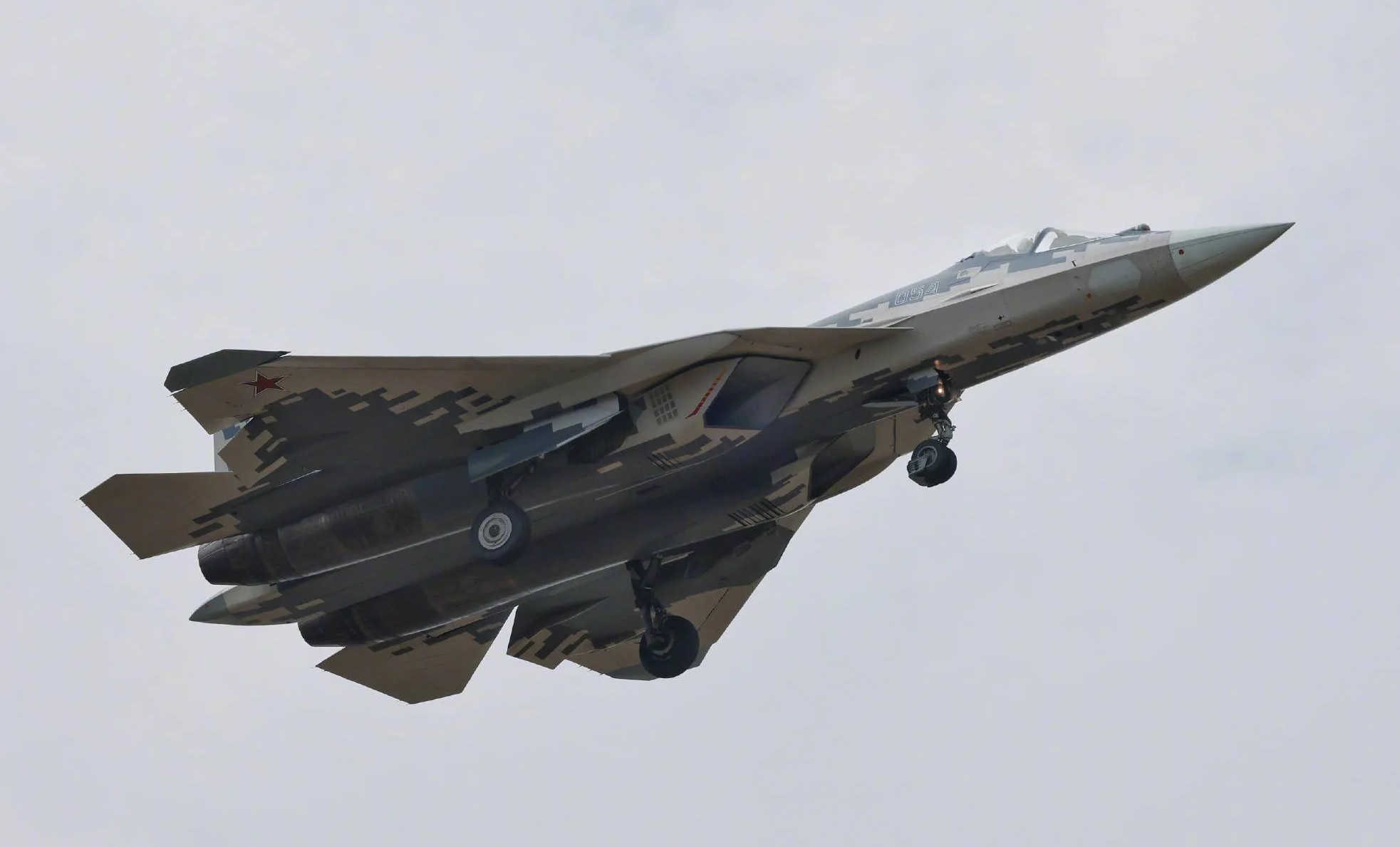
ALGIERS — Algeria has formally inducted the Russian-built Sukhoi Su-57E into operational service, marking the country’s entry into fifth-generation combat aviation. Recent visual evidence and regional defense reporting confirm that the first batch of Su-57E aircraft has arrived in Algeria, accompanied by Russian instructors and test pilots who are overseeing conversion training and initial operational familiarization with Algerian Air Force personnel.
The induction represents a significant step in Algeria’s long-term air force modernization program and reflects a deepening of defense cooperation with Russia, alongside reported technical coordination involving India for advanced missile integration.
Platform and Weapons Integration
The aircraft delivered to Algeria are the export variant of the Sukhoi Su-57, designated Su-57E. The platform is Russia’s most advanced multirole stealth fighter, designed for air superiority, deep-strike missions, and contested-environment operations. It incorporates reduced radar cross-section shaping, internal weapons bays, advanced electronic warfare systems, and an active electronically scanned array (AESA) radar integrated with multispectral sensors.
Defense sources indicate that the Algerian Su-57E fleet is being configured to support the air-launched version of the BrahMos supersonic cruise missile. The BrahMos-A, developed jointly by India’s Defence Research and Development Organisation (DRDO) and Russia’s NPO Mashinostroyeniya, is capable of speeds approaching Mach 3 and is designed for long-range precision strikes against high-value land and maritime targets. Integration work is reported to involve avionics compatibility, flight profile testing, and targeting data fusion with the Su-57’s onboard sensor suite.
If fully operationalized, the combination would provide Algeria with a standoff strike capability that significantly extends its operational reach beyond national airspace and enhances maritime denial options in the Mediterranean.
Training and Operational Preparation
Training activities are currently underway at multiple Algerian air bases, where new hardened aircraft shelters (HAS) have been constructed to accommodate the Su-57’s stealth coatings and specialized maintenance requirements. Russian pilots and engineers are supporting conversion training, focusing on flight control systems, three-dimensional thrust-vectoring engines, and glass-cockpit avionics unique to the fifth-generation platform.
Exercises observed during the initial phase emphasize long-range strike coordination, sensor fusion, and cooperative operations with Algeria’s existing Su-30MKA multirole fighters. These drills are intended to ensure interoperability across the fleet and to integrate the Su-57 into Algeria’s broader air defense and strike doctrine.
Fleet Modernization and Replacement Program
Algeria’s acquisition of 14 Su-57 aircraft forms part of a broader defense modernization initiative valued at approximately $2 billion. The new fighters are scheduled to replace the aging MiG-25PD Foxbat interceptors, which have served as Algeria’s primary high-altitude defense aircraft for decades but are increasingly limited by maintenance demands and technological obsolescence.
The transition from the MiG-25 to the Su-57 represents a substantial technological shift, introducing stealth characteristics, internal weapons carriage, advanced sensors, and network-centric combat capabilities absent from previous-generation platforms.
With this induction, Algeria becomes the first country outside Russia to operate the Su-57 and the first nation in Africa and the Arab world to field an operational fifth-generation stealth fighter.
Regional and International Context
The deployment of the Su-57 in North Africa has attracted close attention from regional states and Western defense analysts. The United States has previously raised concerns over major Russian arms transactions under the Countering America’s Adversaries Through Sanctions Act (CAATSA), though Algerian authorities have reiterated their policy of strategic autonomy and diversified defense procurement.
The presence of Russian personnel in Algeria and the reported integration of Indo-Russian missile technology underscore a widening defense relationship that extends beyond traditional supplier-customer dynamics. For Algeria, the program is intended to preserve a qualitative edge in airpower and to adapt its force structure to emerging aerial and maritime threats.
As training progresses and weapons integration advances, the Su-57 fleet is expected to become a central component of Algeria’s air combat and long-range strike capabilities in the coming years.
——— End of Article ———