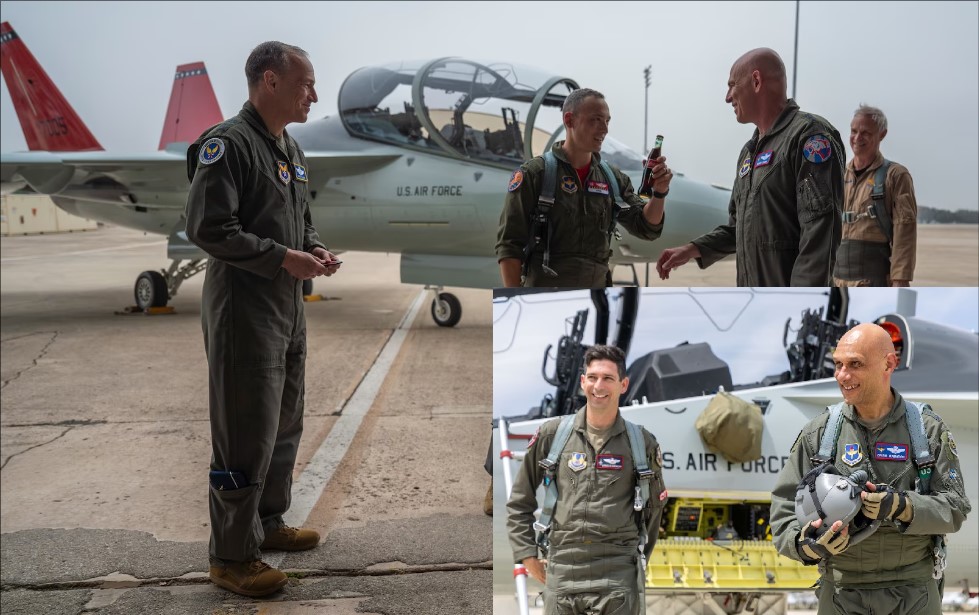
JOINT BASE SAN ANTONIO–RANDOLPH, Texas : Lt. Gen. Clark J. Quinn, commander of the Air Education and Training Command (AETC), has completed a multi-day program review of the T-7A Red Hawk, the U.S. Air Force’s next-generation advanced trainer aircraft, as the service prepares for its gradual introduction into undergraduate pilot training.
The review, conducted from January 26 through January 30, focused on aircraft development, testing progress, production readiness, and long-term sustainment planning. The visit marked Quinn’s first opportunity to fly the T-7A, giving the AETC commander direct, hands-on insight into the aircraft that will eventually replace the aging T-38 Talon fleet.
Program Review and Command Visit
Quinn’s tour included engagements with the Air Force Test Center and the 412th Test Wing, where developmental testing of the T-7A is being conducted. He also met with industry partners Boeing and Saab, which jointly developed the aircraft under a U.S. Air Force contract.
Discussions during the visit centered on production schedules, certification timelines, maintenance concepts, training devices, and the logistics infrastructure required to support the aircraft once it enters operational service. Officials reviewed how the T-7A’s digital design architecture and open-systems approach are expected to support software updates, sustainment efficiency, and future capability growth.
First Flight in the T-7A
During his visit to the test center, Quinn flew the T-7A Red Hawk for the first time, evaluating the aircraft’s handling qualities, cockpit layout, and training-focused systems. The flight was conducted as part of his broader effort to better understand the platform that will be used to prepare student pilots for fifth-generation fighter and bomber aircraft.
Following the sortie, Quinn emphasized the importance of aligning training aircraft performance with modern combat aviation requirements. He said the T-7A is designed to provide realistic training environments that reflect the operational demands pilots will face later in their careers.
Quinn’s flight aligns with guidance from Air Force Chief of Staff Gen. Ken Wilsbach, who has encouraged senior commanders to maintain or regain flying proficiency in order to remain closely connected to operational realities across the force.
Aircraft Overview and Training Role
The T-7A Red Hawk is a twin-engine, supersonic-capable trainer designed specifically for the U.S. Air Force’s undergraduate pilot training mission. Developed using a digital engineering approach, the aircraft integrates advanced avionics, embedded training systems, and ground-based simulators intended to reduce overall training time and cost while improving instructional effectiveness.
The platform is expected to play a central role in preparing pilots for advanced aircraft such as the F-35, F-22, and B-21, bridging the gap between initial flight training and operational conversion units.
Recent Milestones and Fleet Plans
AETC formally accepted its first T-7A aircraft during a ceremony on January 9, marking a key milestone in the program. The command has now received two aircraft as part of the early delivery phase. The U.S. Air Force plans to procure a total of 351 T-7A aircraft to support pilot training requirements across multiple bases.
During the visit, Quinn participated in an Executive Test Summit, where test pilots, engineers, and program officials reviewed early flight-test results, certification pathways, and simulator integration. He also toured test facilities supporting both live-flight and synthetic training environments.
Production and Sustainment Planning
Quinn’s itinerary included inspections of Boeing and Saab production facilities, where the T-7A airframes are manufactured and assembled. These visits provided insight into workforce readiness, quality-assurance processes, and the supply-chain framework supporting the program.
Officials briefed the commander on sustainment concepts, spare-parts availability, and maintenance training plans designed to support the aircraft throughout its service life. Establishing a reliable logistics and support structure remains a priority as the program transitions from testing to operational fielding.
Integration Into Pilot Training
As commander of AETC, Quinn oversees all undergraduate pilot training for the Department of the Air Force. The integration of the T-7A into the training enterprise is expected to be phased, with continued testing and evaluation informing how the aircraft is introduced into training syllabi and pipelines.
According to AETC officials, the program review was intended to ensure that aircraft performance, training systems, production capacity, and sustainment planning remain aligned with the Air Force’s long-term pilot production goals and evolving operational requirements.
——— End of Article ———