The United States is preparing a forceful military response in Syria after a deadly ambush by a suspected Islamic State (ISIS) gunman killed two American service members and a US civilian, marking the first fatal attack on US troops in the country since the fall of former Syrian President Bashar al-Assad a year ago.
US officials said the attack took place on Saturday near the historic city of Palmyra, a strategically sensitive region in central Syria where ISIS sleeper cells have remained active despite the group’s territorial defeat. According to the US military’s Central Command (CENTCOM), a lone gunman opened fire on US personnel, killing two service members and a civilian interpreter. Three other individuals were wounded in the shooting.
The casualties were evacuated by helicopter to the al-Tanf garrison, a key US military base near the border junction of Syria, Iraq and Jordan. Pentagon officials said the wounded were in stable condition.
Trump Confirms ISIS Role
“This is an ISIS attack,” former President Donald Trump told reporters at the White House before departing for the Army–Navy football game in Baltimore. He expressed condolences to the families of those killed and said the injured “seem to be doing pretty well.”
In a subsequent post on his Truth Social platform, Mr Trump warned that the United States would respond decisively. “There will be very serious retaliation,” he wrote, signaling an imminent military response.
US defence officials said the attacker was killed at the scene. CENTCOM added that the identities of the fallen service members would not be released until 24 hours after next of kin notification.
Conflicting Accounts in Syria
The incident has prompted conflicting accounts from Syrian and independent sources. Syria’s state-run SANA news agency confirmed the location of the attack near Palmyra, while the UK-based Syrian Observatory for Human Rights claimed the gunman was a member of Syrian security forces.
Syria’s Interior Ministry rejected that assertion. Spokesman Nour al Din al Baba said authorities were investigating whether the attacker was an ISIS operative or an individual inspired by the group’s extremist ideology, and denied reports that he was part of official security units.
Strong Warnings From US Leadership
Pentagon chief spokesman Sean Parnell confirmed that the civilian killed in the attack was a US interpreter supporting American forces. US Defence Secretary Pete Hegseth issued a stark warning in a message posted on X, saying that anyone who targets Americans anywhere in the world would be hunted down and killed.
Mr Trump later said that Syria’s interim president, Ahmad al Sharaa, was “extremely angry and disturbed” by the attack, describing it as a threat not only to US forces but also to Syria’s fragile post-war stability.
Large-Scale Airstrikes Expected
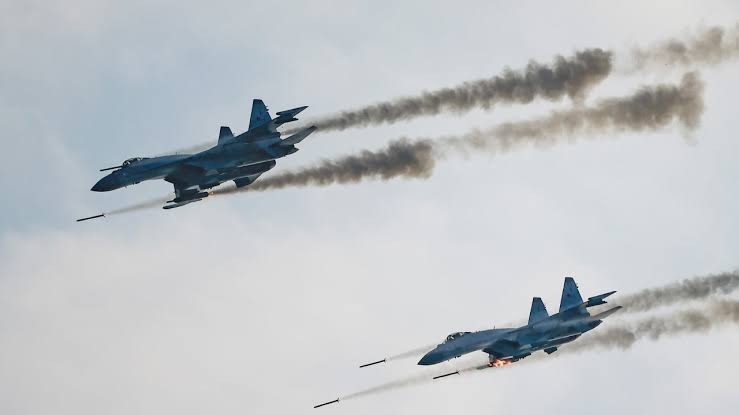
US officials indicated that the response would likely involve large-scale, coordinated airstrikes by the US Air Force against ISIS-linked targets in Syria. Military planners are expected to focus on militant hideouts, logistics routes and sleeper-cell networks operating in central and eastern Syria.
The United States currently has several hundred troops deployed in eastern Syria as part of a US-led international coalition formed to combat ISIS. While the group was defeated on the battlefield in 2019, the United Nations estimates that ISIS still has 5,000 to 7,000 fighters in Syria and Iraq, capable of carrying out deadly attacks.
A Sensitive Moment for US–Syria Relations
The attack comes at a delicate moment in US–Syria relations. Last month, President Ahmad al Sharaa made a historic visit to Washington, where Syria signed a political and security cooperation agreement with the US-led coalition aimed at preventing an ISIS resurgence.
Despite those efforts, large swathes of Syria remain unstable, with militant groups exploiting weak security and governance gaps.
“This was an ISIS attack against the US and Syria, in a very dangerous part of the country that is not fully controlled,” Mr Trump wrote in a social media post. As Washington prepares its response, US officials have made clear that the killing of American personnel will bring a swift and uncompromising military reaction, underscoring the continuing threat posed by ISIS in the region.
——— End of Article ———