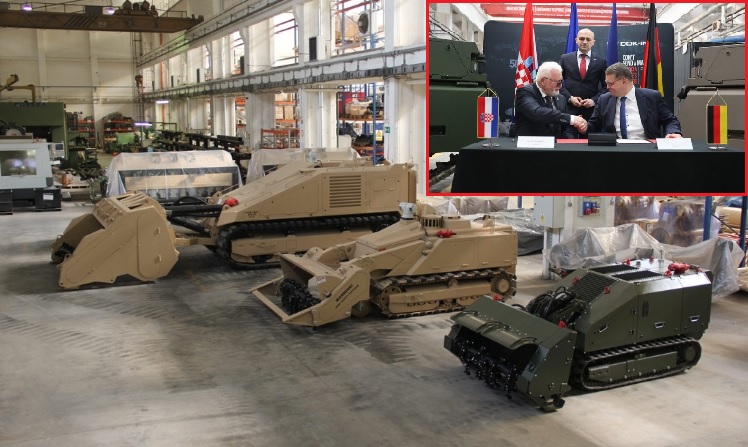
ZAGREB, Croatia, July 1, 2026 — German defense company Rheinmetall has completed the acquisition of a 51 percent majority stake in Croatian unmanned ground vehicle (UGV) developer DOK-ING, finalizing a transaction that was originally signed in March 2026 after receiving all required regulatory approvals. The acquisition establishes a new joint venture operating under the name Rheinmetall Unmanned Vehicles d.o.o., strengthening Rheinmetall's position in the rapidly expanding market for autonomous land systems.
Under the terms of the agreement, DOK-ING founder Vjekoslav Majetić retains a 49 percent ownership stake in the company, while Rheinmetall holds the majority share. The companies have not disclosed the financial value of the transaction.
Following confirmation that the acquisition had been completed, Rheinmetall's shares rose nearly 5.5 percent on the Frankfurt Stock Exchange, reflecting positive investor sentiment toward the company's expansion in autonomous military technologies.
The acquisition establishes Croatia as a key center for Rheinmetall's autonomous ground vehicle activities. According to Dr. Björn Bernhard, Chief Executive Officer of Rheinmetall Vehicle Systems Europe, the new joint venture will serve as a competence center for heavy autonomous vehicles while maintaining DOK-ING's engineering and development capabilities in Zagreb. The partnership also provides Rheinmetall with direct access to Croatia's defense industry and engineering expertise.
The collaboration combines Rheinmetall's experience in integrating tactical military vehicle systems with DOK-ING's specialization in unmanned ground platforms. At the center of the partnership is DOK-ING's Komodo platform, a modular heavy-duty hybrid unmanned ground vehicle capable of carrying payloads exceeding 8.5 tonnes.
Rheinmetall plans to enhance the Komodo platform by integrating advanced mission modules and equipment packages, including autonomous driving capabilities, reconnaissance sensors, logistics support systems, direct and indirect fire modules, as well as mine-clearing and mine-laying equipment. Originally designed for operations in hazardous environments, including nuclear, biological and chemical scenarios, the Komodo platform provides a flexible foundation for a wide range of military and engineering missions.
The companies are also jointly developing a new unmanned armed support system known as Wingman, designed to operate alongside main battle tanks (MBTs) and infantry fighting vehicles (IFVs). The system is intended to provide reconnaissance, forward observation, and fire support while reducing risks to personnel during high-threat operations.
Rheinmetall plans to integrate the Wingman concept with several of its existing armored vehicle platforms, including the Panther KF51 main battle tank, the Büffel armoured recovery vehicle, and the AEV 3 Kodiak armoured engineer vehicle. The company expects these autonomous support vehicles to expand the operational capabilities of armored formations by conducting reconnaissance, combat support, engineering, and logistics missions.
Founded in 1991 and headquartered in Zagreb, DOK-ING has built a strong reputation in robotic mine-clearing systems and unmanned vehicles for hazardous environments. Before joining Rheinmetall, the company had delivered approximately 500 remotely operated platforms to customers in more than 40 countries. Its unmanned demining systems are currently being used in Ukraine, where they have supported mine clearance operations in areas affected by the ongoing conflict.
The acquisition follows earlier cooperation between the two companies, including a memorandum of understanding signed in late 2024, and reflects growing European investment in autonomous land systems and robotic combat support technologies.
For Rheinmetall, the acquisition supports its broader strategy of expanding its portfolio of uncrewed and autonomous military systems. The company, which generated €9.8 billion in revenue during 2024 and employs approximately 44,000 people worldwide, has increasingly invested in next-generation land warfare technologies to meet evolving defense requirements.
Both Rheinmetall and DOK-ING stated that the partnership is based on a fully European supply chain, ensuring that research, development, manufacturing, and key technologies remain within European Union and NATO member states. Majetić said the partnership will provide DOK-ING with greater industrial capacity and global market access while preserving the company's engineering expertise and development activities in Croatia.
——— End of Article ———