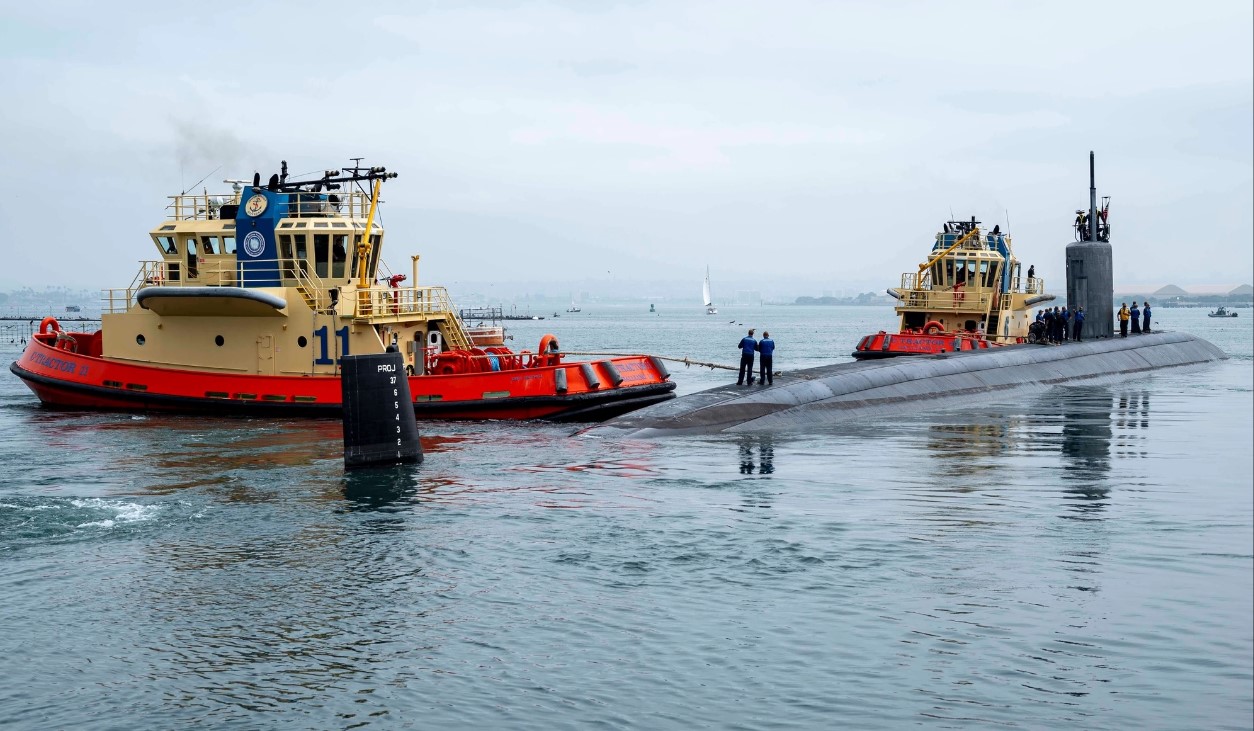
SAN DIEGO, July 1, 2026 — The United States Navy has held an inactivation ceremony for the USS Alexandria (SSN-757), marking the end of 35 years of service for the Improved Los Angeles-class fast-attack submarine. The ceremony took place on June 29 at Naval Base Point Loma in San Diego, exactly 35 years after the submarine was commissioned on June 29, 1991.
The submarine is scheduled to be formally decommissioned on August 4, 2026, before beginning a multi-year dismantlement and nuclear recycling process at the Puget Sound Naval Shipyard and Intermediate Maintenance Facility in Washington.
Navy Honors 35 Years of Service
The ceremony brought together current and former crew members, including original "plankowners" from the 1991 commissioning crew. Attendees included Rear Adm. Todd Weeks, Director of In-Service Submarines and Industrial Base and a former commanding officer of Alexandria; Capt. Phillip Sylvia Jr., Commander of Submarine Squadron 11; and Cmdr. Donald Coomes, the submarine's 14th and final commanding officer.
Eight former commanding officers and several former Chiefs of the Boat also attended, including retired Capt. Paul Normand, the submarine's first commanding officer, and retired Master Chief Machinist's Mate Douglas Muller, its first Chief of the Boat. Navy officials recognized the submarine's operational readiness and the service of its crews throughout its career.
Global Operational History
Named after Alexandria, Virginia, and Alexandria, Louisiana, the submarine served under the motto "Twice as Strong." During its career, USS Alexandria traveled more than one million nautical miles, completed 14 overseas deployments, and operated across four geographic combatant command areas.
Its first major deployment came in 1993 in support of Operation Sharp Guard, the NATO maritime enforcement mission in the Adriatic Sea during the conflicts in the former Yugoslavia. The submarine later supported Operations Enduring Freedom and Iraqi Freedom, conducting intelligence collection, surveillance, and Tomahawk strike missions in the U.S. Fifth Fleet area.
USS Alexandria also conducted extensive Arctic operations through Ice Exercises (ICEX), testing under-ice navigation, acoustic performance, and surfacing procedures in polar conditions.
In 2004, it became the first Improved Los Angeles-class submarine to complete a global circumnavigation, sailing through the Arctic, Pacific, U.S. Central Command, and European operating areas. The deployment also included the first visit by a U.S. nuclear-powered submarine to Goa, India.
Indo-Pacific Operations
In 2015, USS Alexandria shifted its homeport from Naval Submarine Base New London, Connecticut, to Naval Base Point Loma, San Diego, supporting the Navy's growing operational focus on the Indo-Pacific.
Operating under Submarine Squadron 11, the submarine participated in exercises with the Republic of Korea Navy, the Japan Maritime Self-Defense Force, and the USS Carl Vinson Carrier Strike Group. Its final seven-month deployment in the Western Pacific concluded on May 15, 2025, followed by local operations off Southern California until early 2026.
Submarine Design
USS Alexandria was the 46th Los Angeles-class nuclear-powered attack submarine built for the U.S. Navy and one of the 23 Improved Los Angeles (688i) subclass boats. The improved design featured quieter machinery, retractable bow planes, and reinforced structures for under-ice operations.
The submarine measured 110.3 meters in length, displaced approximately 6,930 tonnes while submerged, and was powered by a General Electric S6G nuclear reactor driving two steam turbines. It could achieve submerged speeds of more than 25 knots.
Decommissioning and Recycling
Following its decommissioning, USS Alexandria will move to the Puget Sound Naval Shipyard and Intermediate Maintenance Facility for dismantlement under the Navy's Ship-Submarine Recycling Program.
Before reactor defueling begins, personnel will remove operational systems, including Mk 48 ADCAP heavyweight torpedoes, Tomahawk and Harpoon missile systems, mine warfare equipment, classified mission systems, cryptographic equipment, and sonar processors.
The submarine's S6G pressurized-water reactor will then be defueled, propulsion systems deactivated, and the reactor compartment separated from the pressure hull in accordance with Naval Reactors procedures. Because nuclear-powered submarines require specialized dismantlement, the process involves radiological controls, dry-dock facilities, regulatory oversight, and skilled shipyard personnel over several years.
Fleet Modernization
The retirement of USS Alexandria leaves 23 Los Angeles-class submarines in active U.S. Navy service and supports the Navy's ongoing fleet modernization effort. As the Los Angeles-class fleet is gradually retired, it is being replaced by Virginia-class attack submarines equipped with improved stealth, advanced sensors, enhanced strike capabilities, and greater operational flexibility for future undersea missions.
——— End of Article ———