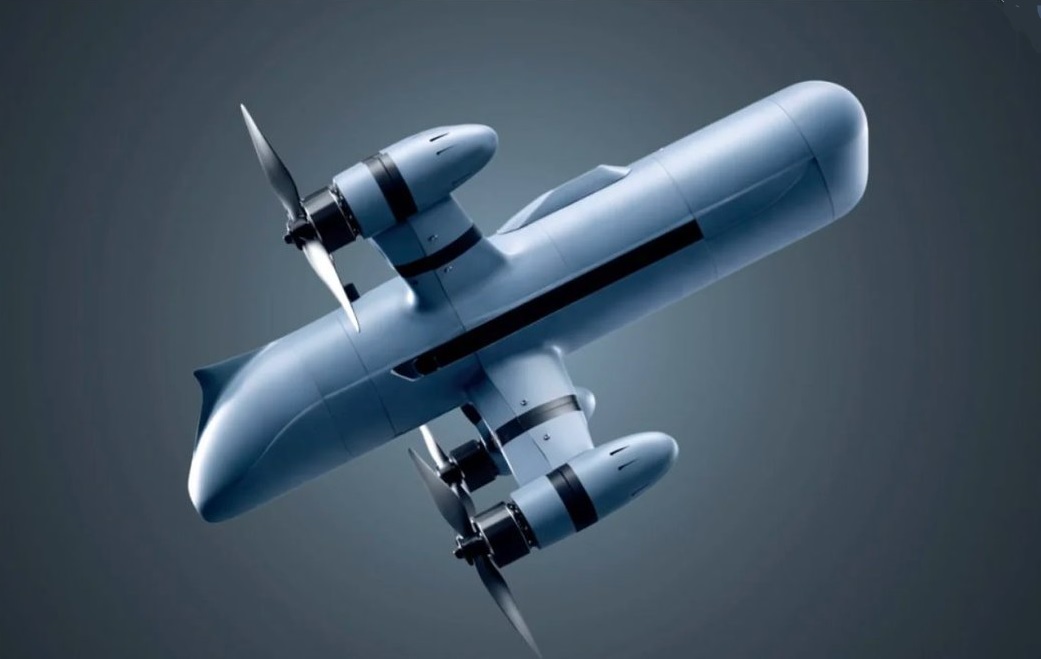
KYIV / DÜSSELDORF — March 2026 : Ukrainian defense-technology startup OSIRIS AI has introduced its new high-speed interceptor drone, the OSIRIS UEB-1, during the Xponential Europe 2026 international forum in Düsseldorf, Germany. The platform represents a dedicated counter-UAV solution designed to address the increasing demand for cost-effective interception of aerial threats in modern conflict environments.
The UEB-1 is positioned as a tactical interceptor rather than a conventional First-Person View (FPV) drone. It is engineered for rapid acceleration and stable control under sustained high-thrust loads, enabling it to physically intercept hostile unmanned aerial vehicles (UAVs) and other airborne targets.
Platform Design and Technical Characteristics
The OSIRIS UEB-1 is built as a compact and lightweight system optimized for speed and agility, particularly during the terminal phase of interception. The drone is capable of reaching a maximum speed of up to 315 kilometers per hour (196 mph), placing it among the faster interceptor-class UAVs currently under development.
The airframe measures 370 × 370 × 550 millimeters and weighs slightly over 3 kilograms. It is designed to carry a modular payload, including a warhead of up to 0.5 kilograms, allowing flexibility depending on mission requirements.
Power is supplied by a 10,000 mAh battery, supporting an operational endurance of more than 10 minutes. The system can operate at a range of up to 18 kilometers under line-of-sight conditions, with performance influenced by terrain and environmental factors.
AI-Based Guidance and Control Architecture
A key feature of the UEB-1 is its integration of artificial intelligence for predictive target tracking. The onboard software calculates the projected flight path of a target drone and autonomously adjusts the interceptor’s trajectory to enable a direct strike with reduced operator input.
The drone operates within OSIRIS AI’s proprietary DroneOS ecosystem, a modular software architecture that allows integration of hardware platforms, AI tracking modules, and cloud-based services into a unified operational network. This approach enables adaptability across different mission profiles and facilitates rapid updates to system capabilities.
For terminal guidance, the UEB-1 employs an analog video transmission system operating at 5.8 GHz. While digital links typically offer higher image quality, OSIRIS AI selected analog transmission to ensure a continuous video feed with minimal latency, which is critical during high-speed interception. The platform is equipped with a standard daytime camera and offers an optional low-light configuration for operations in reduced visibility conditions.
Company representatives stated that field testing conducted in eastern Ukraine demonstrated stable video transmission even in environments affected by electronic interference.
Operational Roles and Deployment Concepts
The UEB-1 is designed for multiple operational scenarios, including counter-UAV missions, interception of high-speed aerial targets, tactical strike operations, perimeter security, and rapid deployment in frontline conditions. The platform has already undergone testing in combat environments, according to the company.
OSIRIS AI positions the system as a response to the cost imbalance in air defense, where expensive missile systems are often used to counter relatively low-cost drones. By deploying interceptor UAVs, the company aims to provide a more sustainable and scalable approach to frequent aerial threat engagement.
Production, Investment, and Industrial Structure
OSIRIS AI operates a distributed infrastructure model. Production is split between facilities in Ukraine and Poland, while the company’s primary research and development (R&D) center is located in Kraków, Poland. This structure allows the firm to combine European engineering resources with operational feedback from Ukrainian defense applications.
The company secured funding from a United States-based investor in late 2025 to expand production and technological development. Following this investment, OSIRIS AI initiated integration partnerships with two Ukrainian drone manufacturers to further develop its unmanned systems ecosystem.
In addition to the UEB-1 platform, OSIRIS AI continues to advance its broader portfolio of hardware and software solutions, including previous cooperation agreements such as its partnership with DefDrones focused on next-generation unmanned systems.
Demonstration and Future Development
The presentation at Xponential Europe 2026 included demonstrations of the UEB-1’s capabilities and highlighted OSIRIS AI’s approach to autonomous interception systems. The company indicated that development will continue within its integrated ecosystem, with further enhancements expected in AI-driven targeting, modular payload configurations, and networked drone operations.
The UEB-1’s unveiling reflects ongoing efforts within Ukraine’s defense technology sector to develop indigenous solutions tailored to evolving battlefield requirements, particularly in the domain of countering unmanned aerial threats.
——— End of Article ———