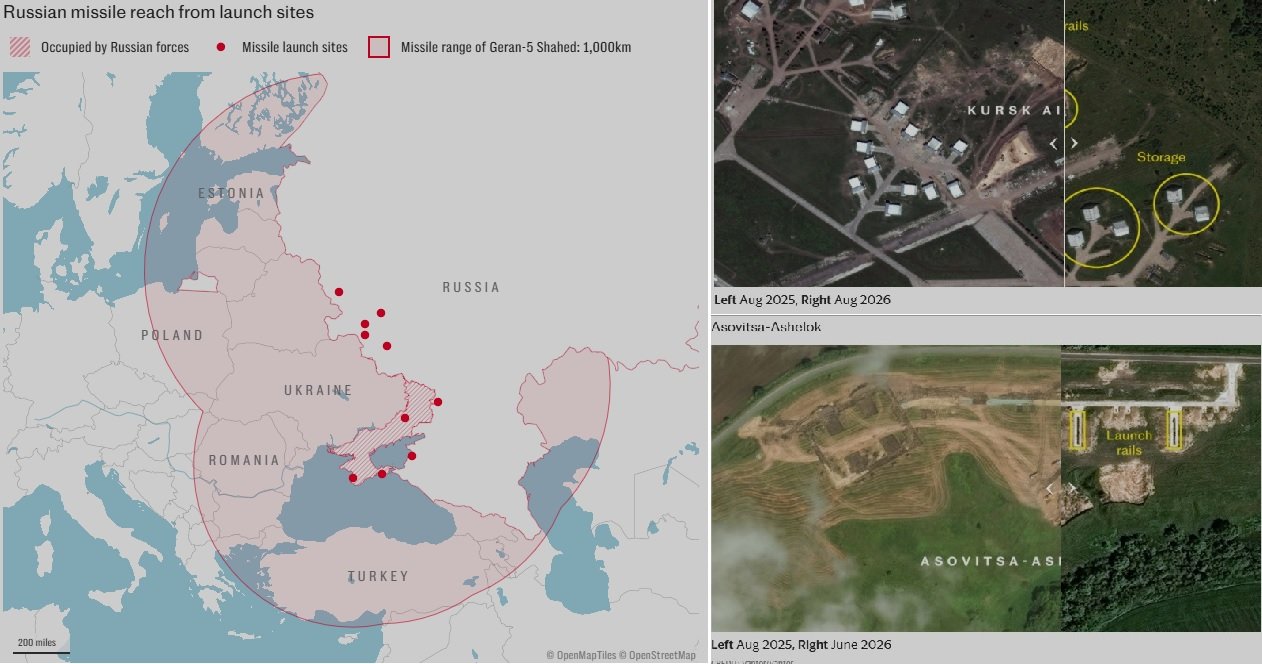
Moscow, Russia — Russia has built or expanded at least 10 drone bases along its borders with Ukraine and Belarus, with the sites equipped with new launch rails for long-range fixed-wing attack drones, according to an investigation by The Telegraph based on satellite imagery, leaked documents and analysis by drone-intelligence firm DroneSec.
The investigation identified at least 59 newly installed launch rails across the locations. Seven of the 10 sites have reportedly been used in recent Russian drone attacks against Kyiv, according to open-source tracking data cited in the reporting.
Expansion of Drone Launch Infrastructure
The identified facilities include existing military airfields, civilian airports and newly constructed positions in rural areas. Some sites have been developed by expanding existing military infrastructure, while others have been established as standalone launch facilities.
The launch rails are mechanical guide tracks used to launch fixed-wing drones without a conventional runway. DroneSec's analysis of satellite imagery identified about 20 rails that are longer than standard designs, indicating that they may be intended for newer long-range drones in the Geran family.
Russia is also expanding storage and launch infrastructure at several locations. Analysts estimate that storage and hangar facilities at one of the bases could accommodate more than 1,000 drones at a time. Construction of additional launch positions is continuing at multiple sites.
The sites are also linked through reporting to Russia's wider drone-production network, including facilities in the Alabuga Special Economic Zone, where large numbers of drones are produced.
Newer Geran Drone Variants
The longer launch rails are assessed by DroneSec as being suitable for newer jet-powered Geran variants, including the Geran-4 and Geran-5.
These drones represent a development of the Geran family of Russian attack drones derived from the Iranian-designed Shahed-136. Unlike earlier propeller-powered versions, the newer variants use jet propulsion and are designed to operate at higher speeds.
Leaked Ukrainian documents cited in the investigation describe the newer variants as capable of carrying warheads of up to 90 kilograms. The Geran-5 has been reported in some assessments as having a range of up to approximately 1,000 kilometers.
The higher speed of the jet-powered drones can reduce the time available for air-defense systems to detect, track and engage them. The Institute for Science and International Security has also documented the increasing scale of Russia's use of Shahed/Geran-type drones against Ukraine in 2026.
DroneSec CEO Mike Monnik said the expansion demonstrates Russia's increased ability to launch larger numbers of drones while introducing designs that are more difficult to intercept.
Potential Reach Into NATO Territory
The location of the new bases and the reported range of the longer-range Geran variants have raised concerns about their potential reach beyond Ukraine.
A range of around 1,000 kilometers would place parts of NATO's eastern flank within potential operating range, including areas of Poland, Latvia, Lithuania, Estonia, Finland and Romania. Warsaw is also within the reported potential range of some of the launch locations.
However, the reporting does not provide evidence that Russia is currently preparing an attack on NATO territory. The identified facilities are already being used primarily in the ongoing war against Ukraine, while their location provides Russia with additional launch infrastructure close to the Ukrainian border.
European and US intelligence officials have raised concerns about possible future provocations, attacks on critical infrastructure or false-flag operations involving drones. These remain assessments of potential scenarios rather than confirmed Russian plans.
NATO Response
NATO has continued to strengthen its readiness against aerial and drone threats. A NATO official told The Telegraph that the alliance remains ready to defend allied territory and will continue enhancing its readiness against threats, including drones.
The newly identified infrastructure therefore represents both an expansion of Russia's current drone-launch capacity against Ukraine and an additional network of facilities positioned close to NATO's eastern flank.
The continued construction of launch rails, expansion of storage facilities and development of faster long-range Geran variants indicate that Russia is continuing to invest in the infrastructure needed for large-scale drone operations.
——— End of Article ———