MOSCOW — Russia is expanding its air defense infrastructure with specialized 35-meter-high towers designed to host Pantsir-family short-range air defense systems against unmanned aerial vehicles (UAVs).
A recent Russian report showed a Pantsir-S1M mounted on one such tower. Construction of these elevated positions began in 2023, initially forming several defensive rings around Moscow. Similar towers are now being built in other Russian regions.
The Pantsir-S1M is equipped with the 1RS-ZE multifunctional phased-array radar, which has a reported detection range of approximately 50–70 kilometers, compared with around 30–40 kilometers for the radar of the earlier Pantsir-S1. The longer detection range provides the upgraded system with greater distance for detecting and tracking aerial targets.
— 🪖MilitaryNewsUA🇺🇦 (@front_ukrainian) August 17, 2026
The elevated platforms raise the system above surrounding terrain and buildings, improving its radar horizon and helping detect and track low-flying drones that can be difficult to detect from ground level. Earlier, Russia also placed Pantsir systems on rooftops of government and commercial buildings, as well as on other elevated positions.
Open-source satellite imagery and visual analysis have identified multiple Pantsir positions around Moscow, including locations roughly 40–50 kilometers from the capital, as well as positions near energy facilities, airports and other high-value sites. By the end of 2025, researchers had identified around 100 additional Pantsir positions across European Russia, including dozens around Moscow. Mid-2026 assessments placed the number of known short-range air defense positions in and around Moscow at more than 100, with roughly two dozen new towers observed earlier this year.
New TKB-1055 “Gvozd” Missiles
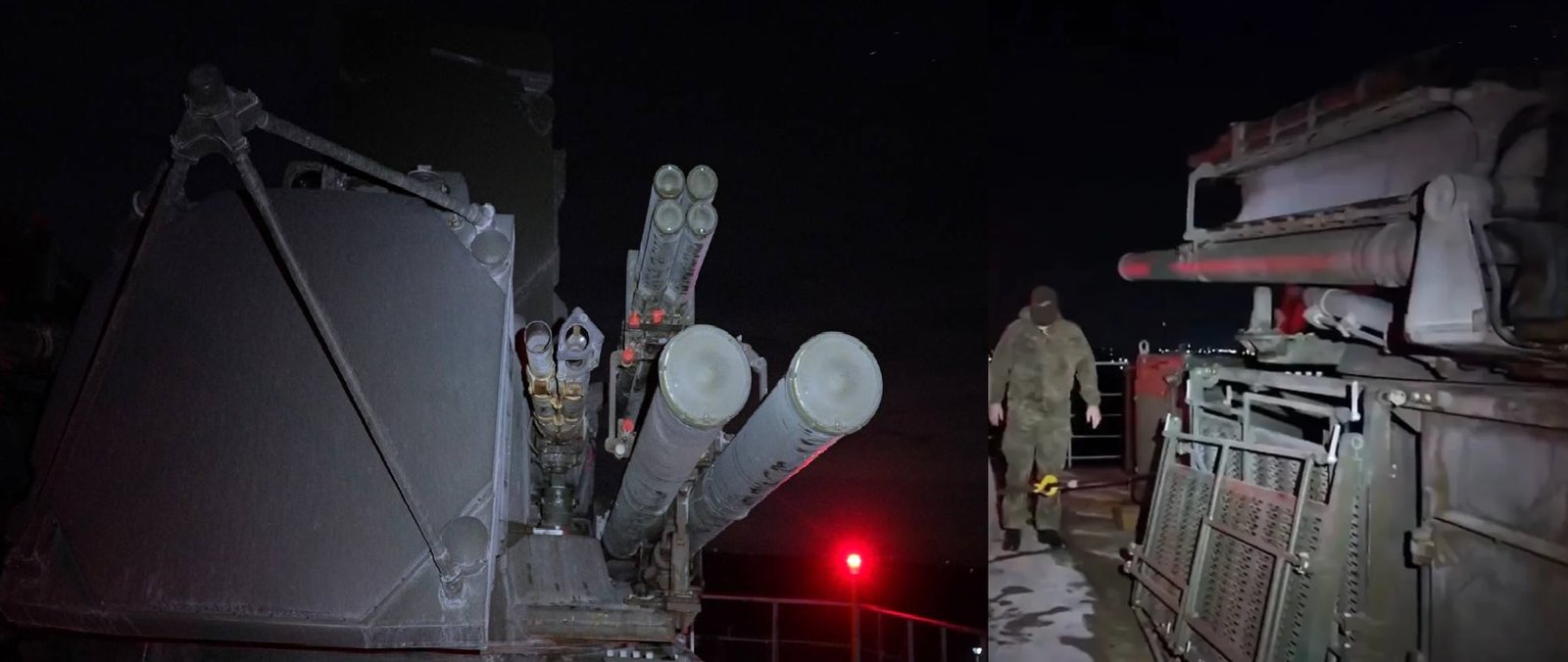
The tower-based Pantsir systems can use conventional missiles as well as the smaller TKB-1055 “Gvozd” interceptor developed for counter-drone operations.
The Gvozd is considerably smaller than the standard Pantsir missile. Four Gvozd missiles can be placed in a container occupying the space of one standard missile, allowing a Pantsir system to carry up to 48 compact interceptors, compared with 12 standard missiles, depending on configuration.
The TKB-1055 has a reported engagement range of 500 meters to 7 kilometers and can engage targets at altitudes from 15 meters to 5 kilometers. It uses radio-command guidance rather than an active radar or infrared seeker.
Russian state corporation Rostec has confirmed that the miniature missiles completed state testing and entered serial production, with deliveries to Russian forces underway. Debris consistent with TKB-1055 missiles has also been documented after reported interceptions.
The launchers can use mixed ammunition, allowing operators to combine the smaller Gvozd missiles with standard missiles for different types of aerial targets.
Expansion Beyond Moscow
The elevated towers are part of a broader layered air defense network around Moscow that also includes S-300 and S-400 systems. Russia has increasingly adjusted its air defense deployment since 2023 in response to the use of Ukrainian UAVs.
The exact number of operational systems, prepared positions and towers, as well as their precise coverage and performance, remains limited in publicly available information.
——— End of Article ———