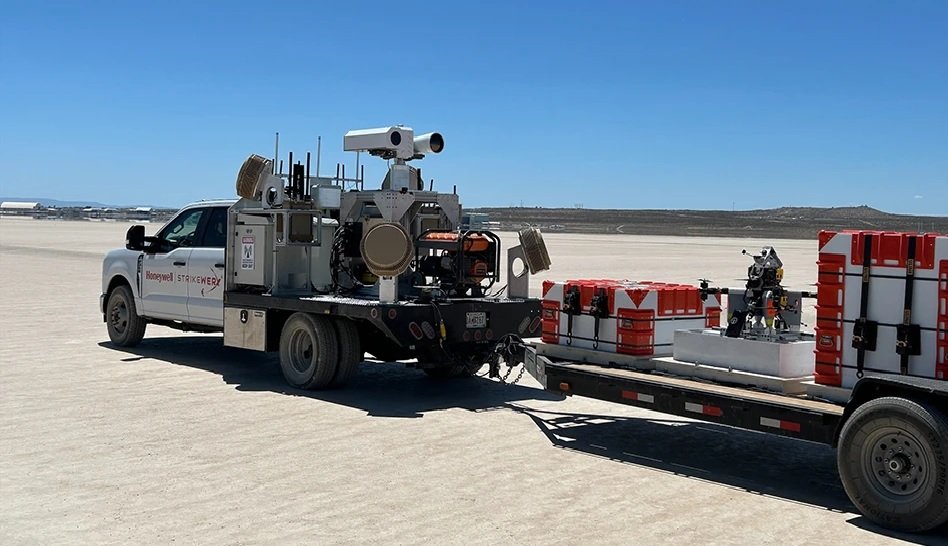
PHOENIX, Arizona — Honeywell Aerospace has demonstrated its latest counter-unmanned aircraft system (C-UAS) during the U.S. military’s Experimentation: Transforming in Contact (EXTiC) 26-2 event, testing the technology against simulated drone threats in an operationally relevant environment.
The event, organized by U.S. Central Command (CENTCOM) in coordination with the Defense Innovation Unit, was held from July 27-29, 2026, at the Playas Training and Research Center in New Mexico. Twenty-one companies were selected from 149 industry submissions. The scenarios included electronic warfare, GPS-denied conditions, autonomous systems and coordinated drone swarms.
Honeywell served as the lead systems integrator, combining sensors and effectors with its AI-driven C-UAS software to detect, track and mitigate simulated drones while defending a simulated airfield. The system was demonstrated in both stationary and mobile configurations.
“As a lead systems integrator, we combined best-in-class sensors and effectors with our AI-driven C-UAS software to detect, track, and mitigate simulated drone threats while defending an airfield,” said Shannon Bowman, senior customer marketing specialist for defense and space at Honeywell Aerospace. “Our system proved effective across both static and on-the-move operations, highlighting an open, adaptable and layered approach to countering rapidly evolving UAS threats.”
SAMURAI Counter-UAS System
At the center of Honeywell’s demonstration was its Stationary and Mobile UAS Reveal and Intercept system, known as SAMURAI. It uses a Modular Open Systems Approach (MOSA) architecture, allowing operators to combine customer-selected detectors and effectors from multiple defense manufacturers.
Honeywell has integrated components from BlueHalo, Leonardo DRS, Silent Sentinel, Pierce Aerospace, Walaris, Rocky Research and Versatol.
SAMURAI serves as a battle-management layer that fuses information from radio-frequency sensors, electro-optical and infrared trackers and other detectors. Its AI-based software helps distinguish threats and supports kinetic and non-kinetic effectors, including interceptor drones.
The system is designed to counter Group 1 through 3 drone swarms, including low-signature “dark” drones that can be difficult to detect. It can operate from a vehicle traveling at up to 70 mph (113 km/h), from a fixed position, or through sensors installed on an aerostat flying more than 1,000 feet (305 meters) above the ground.
Airborne SAMURAI Development
Since March 2026, Honeywell has worked with Odys Aviation to adapt an airborne version of SAMURAI for the company’s long-range Laila unmanned aircraft.
Laila is a hybrid-electric vertical take-off and landing aircraft with a flight time of up to eight hours and a range of approximately 450 miles. The aircraft does not require a traditional runway and is intended to carry SAMURAI as an airborne counter-drone layer.
The configuration is being developed to help protect infrastructure such as pipelines, refineries and offshore energy platforms by providing counter-UAS coverage farther from high-value assets.
Matt Milas, president of Defense and Space at Honeywell Aerospace, said SAMURAI provides counter-UAS capabilities with scalability and integration with existing defense architectures.
Other Counter-Drone Technology at EXTiC
EagleNXT’s joint venture, ThirdEye USA, was separately selected in July 2026 to demonstrate its MeduzaX passive electro-optical counter-drone sensor at EXTiC 26-2.
MeduzaX uses AI and passive electro-optical technology to detect, track and classify hostile drones. It is designed to provide 360-degree coverage, can be set up in less than 10 minutes and operates without emitting radiation.
The EXTiC event allowed multiple technologies to be tested in scenarios involving contested conditions and drone threats, with Honeywell focusing on an integrated architecture that connects sensors, AI-based software and effectors.
Bowman summarized Honeywell’s approach: “One integrated system. Built to stay ahead of the drone threat.”
——— End of Article ———