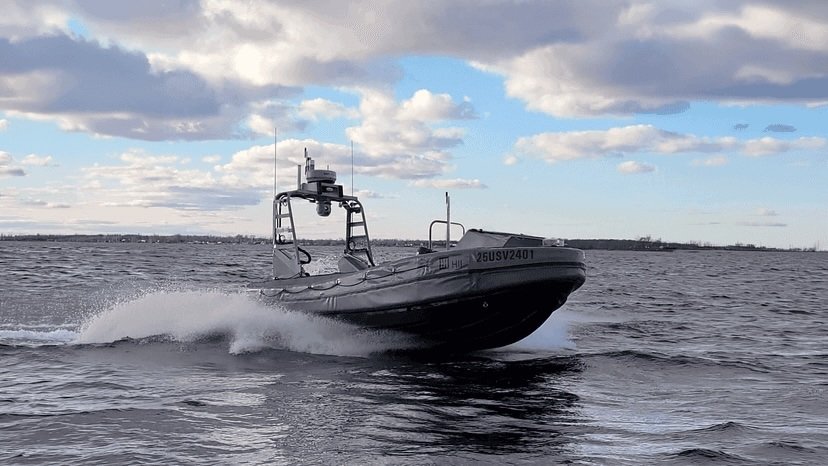
NEWPORT NEWS, Virginia — Huntington Ingalls Industries (HII) has successfully completed the U.S. Defense Innovation Unit’s (DIU) Production-Ready, Inexpensive, Maritime Expeditionary (PRIME) prototype project for its Watcher small unmanned surface vessel (sUSV), moving the system closer to a potential transition to production.
The PRIME initiative was launched to identify commercially available, production-ready autonomous surface vessels for maritime expeditionary operations. HII was selected after a full and open competition that received 116 solution briefs to design, build and demonstrate its solution.
The Watcher is based on HII’s ROMULUS-25 unmanned surface vessel and was developed with MetalCraft Marine. Two Watcher ROMULUS-25 vessels were delivered in December 2025 under a DIU contract supporting smaller-form-factor autonomous surface vessels for the U.S. Marine Corps.
The two vessels underwent extensive government-led testing covering autonomy, seakeeping, performance and operations in degraded environments. They also demonstrated autonomous mission behaviors during at-sea testing that included contractor demonstrations and government autonomy evaluations.
In a memorandum to HII, DIU said the Watcher demonstrated the ability to autonomously travel hundreds of miles through contested waters, loiter in an assigned operating area while monitoring maritime surface threats, and sprint to intercept a noncooperative maneuvering vessel. DIU confirmed that HII achieved the prototype’s key technical objectives and success metrics, supporting a potential transition to production under Other Transaction Authority (OTA) prototype agreements.
The 27-foot ROMULUS-25 is a high-speed unmanned surface interceptor capable of carrying payloads of up to 1,000 pounds and operating at ranges of up to 1,000 nautical miles. Its navigation and mission execution are managed by HII’s Odyssey Autonomous Control System.
Odyssey uses a modular open systems architecture for navigation, mission planning, collaborative behaviors and autonomous operations across different vehicle types. HII said the system can also support AI-enabled contact recognition, identification and edge-based decision-making. Its service-based software architecture allows additional mission technologies to be integrated as requirements change.
HII said Odyssey has previously accumulated more than 2,200 hours of autonomous operations in government-led tests and exercises over five years. It has also been deployed on more than 30 platforms, recording more than 12,000 hours of successful at-sea operations.
Duane Fotheringham, president of HII’s Unmanned Systems group within its Mission Technologies division, said the milestone reflects the company’s strategy of moving autonomous technologies from concept toward operational capability and providing greater flexibility for naval operations.
Mike Reed, general manager of MetalCraft Marine, said the Watcher was engineered for the speed, seakeeping, strength and reliability required by the mission. He added that completing the government-led assessments confirmed the quality of the aluminum platform and its construction.
HII plans to position the Watcher and ROMULUS platforms alongside its REMUS unmanned underwater vehicles and Odyssey autonomy software as part of an integrated maritime systems portfolio. The company said these platforms can operate independently or collaboratively to extend fleet reach, improve maritime awareness and support naval operations across surface and undersea domains.
The completion of the PRIME prototype provides a potential path toward follow-on production while confirming the Watcher’s performance against the stated operational requirements for autonomous small surface interceptors.
——— End of Article ———