KYIV — May 16, 2026 : Ukrainian defense technology companies HIMERA and Tencore have jointly developed a domestic digital radio communication module for unmanned ground vehicles (UGVs), as part of Ukraine’s broader effort to localize critical military technologies and reduce dependence on foreign electronic components.
The new communication system will be integrated into Tencore’s TerMIT 2.0 tracked robotic platform under a government contract scheduled for delivery later in 2026. The project is intended to provide Ukrainian military units with domestically produced, electronic warfare-resistant communication systems designed for frontline operations.
“Chayna na Fri” Localization Initiative
The development was publicly confirmed by Maksym Vasylchenko, co-founder and chief executive officer of Tencore, during an appearance on the Militarnyi podcast Zbroya. According to Vasylchenko, Tencore began investing in Ukrainian suppliers while fulfilling its first major government contract, launching an internal localization initiative referred to as “Chayna na Fri” (“China Free”).
The initiative aims to gradually eliminate the use of Chinese-made electronic components in military equipment and establish secure domestic supply chains for critical battlefield systems.
Vasylchenko stated that HIMERA was selected to develop a Ukrainian-made digital communication solution for the program and confirmed that the system is already operational.
The partnership between HIMERA and Tencore was formally established in June 2025. At the time, both companies stated that combining technical expertise and conducting joint development work enabled the creation of communication systems adapted to active combat conditions and resistant to interference from electronic warfare systems.
Integration Into the TerMIT 2.0 Platform
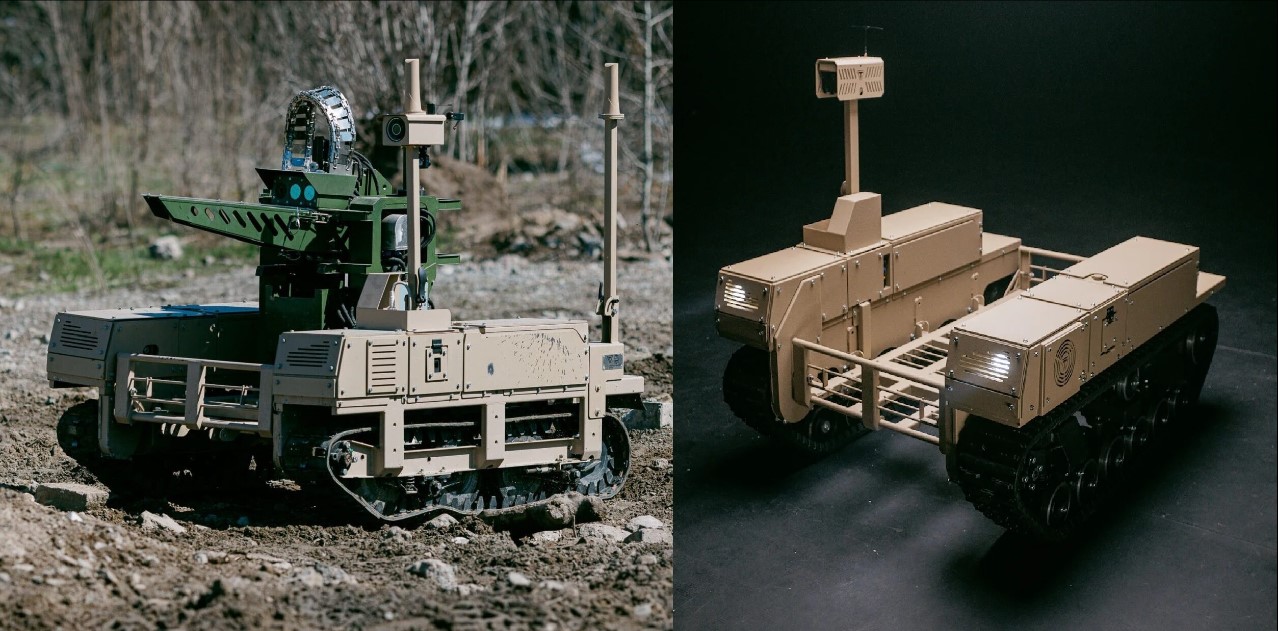
The newly developed communication modules will be integrated into Tencore’s upgraded TerMIT 2.0 unmanned ground vehicle platform.
The TerMIT 2.0 is a modular tracked robotic vehicle designed for multiple battlefield roles, including logistics support, engineering operations, casualty evacuation, remote mining missions, and fire support tasks.
Compared with earlier versions, the upgraded platform incorporates expanded operational capabilities, including:
- An operational communication range of up to 40 kilometers.
- A maximum speed of 15 kilometers per hour.
- Twin electric motors with integrated cooling systems.
- Payload capacity of up to 300 kilograms.
- Support for interchangeable mission modules.
One of the primary mission systems integrated into the TerMIT 2.0 is Tencore’s mine-laying module, which is capable of deploying TM-62 anti-tank mines during remote operations. The system allows robotic mine placement without exposing personnel directly to frontline combat zones.
Tencore has stated that more than 2,000 TerMIT-series unmanned ground vehicles have already been delivered to Ukrainian military units. The addition of domestically developed communication systems is expected to improve operational independence and reduce reliance on imported electronics.
Expansion of HIMERA’s Tactical Communication Ecosystem
Alongside the UGV communications project, HIMERA has continued expanding its wider tactical communications infrastructure for ground and aerial systems.
In early May 2026, the company launched serial production of its R1 repeater systems. The R1 is designed to relay communications between distant radio stations and can operate autonomously for up to 24 hours on battery power.
The repeater supports secure radio data transmission over internet protocols, allowing local battlefield networks to connect through satellite communication systems such as Starlink. The system also enables wireless configuration of deployed communication networks.
HIMERA additionally introduced the E1 IP network extender, a tactical Wi-Fi bridge designed to connect separate IP-based systems through secure radio data channels. The E1 is used for data exchange between drones, unmanned ground vehicles, cameras, sensors, and other battlefield systems.
For expanded operational coverage, the E1 and R1 systems can operate together with HIMERA’s autonomous B1-101E network extenders.
Electronic Warfare Protection and Encryption
HIMERA’s tactical communication systems are designed specifically for operations in electronic warfare environments.
The company’s equipment uses pseudo-random frequency hopping technology, which continuously changes operating frequencies in order to complicate enemy detection, interception, and jamming attempts by electronic warfare and electronic countermeasure systems.
The systems also employ AES-256 encryption, recently reinforced through the introduction of an additional quantum-protected encryption layer utilizing 1024-bit key protection.
As part of a recent software update to version 3.0, HIMERA introduced a remote wipe capability for its G1 PRO tactical radios. The feature enables operators to remotely erase network data if communication devices are captured during combat operations.
The G1 PRO handheld radio platform supports voice communication, text messaging, positional coordinate sharing, and battlefield data transmission while operating within mesh and MANET networking architectures developed for contested environments.
According to the company, HIMERA systems have undergone testing during NATO-standard exercises and have been integrated with battlefield management systems including ATAK and Kropyva. The company has also completed international deliveries to a European NATO member state, while additional testing has reportedly been conducted by the U.S. Air Force.
Partnership With Swarmer for UAV Swarm Operations
HIMERA has also expanded its activities into autonomous aerial operations.
In late April 2026, the company signed a strategic partnership agreement with Ukrainian software developer Swarmer, which specializes in autonomous drone technologies.
The agreement focuses on integrating HIMERA’s resilient mesh-network communication systems into Swarmer’s next-generation autonomous software architecture for unmanned aerial vehicle (UAV) swarms.
The partnership is intended to provide secure communication, coordination, and network resilience for UAV swarm operations conducted in contested electronic warfare environments.
Domestic Defense Production Efforts
The cooperation between HIMERA and Tencore reflects Ukraine’s broader effort to increase domestic production of tactical communications equipment, unmanned systems, and electronic warfare-resistant technologies.
The TerMIT 2.0 equipped with HIMERA’s domestic digital communication modules is expected to enter wider operational service with Ukrainian military units later in 2026.
——— End of Article ———