FARNBOROUGH, UK — Raytheon is significantly increasing production of its Coyote counter-unmanned aircraft system (C-UAS) interceptor to meet growing demand under the U.S. Army's Low, Slow, Small Unmanned Aircraft Integrated Defeat System (LIDS) program following the system's operational success in the Middle East.
The production expansion comes after the U.S. Army approved the disclosure of 600 successful combat intercepts achieved by the Coyote system during its deployment as part of Operation Epic Fury, highlighting its role in countering drone threats in active operations.
Speaking during a media briefing at the Farnborough International Airshow, Tom Laliberty, president of Raytheon's Land and Air Defense Systems business, said integrated air and missile defense remains one of the military's highest priorities as the use of unmanned aerial systems continues to increase.
"The system is now in wide use, and it has been significantly successful combating Class 1 through 3 drones," Laliberty said. He added that Raytheon has tripled Coyote production over the past year and plans to double output again by the end of next year, reaching a production rate of approximately 300 missiles per month.
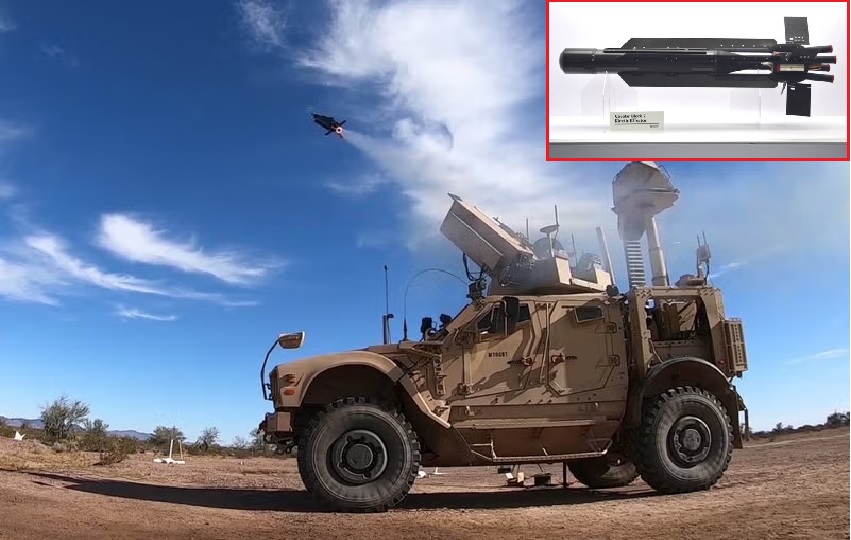
The Coyote interceptor operates together with Raytheon's Ku-band Radio Frequency Sensor (KuRFS) radar, which provides 360-degree detection, tracking and identification of small airborne targets. Integrated within the Army's LIDS architecture, the combined system is designed to detect and defeat unmanned aerial threats in both fixed-site and mobile configurations.
Raytheon currently offers two interchangeable Coyote variants that can be launched from the same launcher depending on mission requirements.
The Coyote Block 2 is an expendable interceptor equipped with a kinetic warhead that physically destroys individual drones during interception.
The Coyote Block 3NK is a reusable and rechargeable variant fitted with a high-power microwave (HPM) payload designed primarily to defeat drone swarms using non-kinetic effects. After completing its mission, the interceptor can be recovered, recharged and redeployed.
Raytheon recently demonstrated the Block 3NK's capabilities during a U.S. Army exercise in Tucson, Arizona, where the system successfully defeated multiple drone swarms before completing its full mission cycle of launch, engagement, recovery and reuse.
The company is also evaluating upgrades to the Coyote family, including improvements to its seeker and propulsion systems, to enable faster engagements and interceptions at greater altitudes as drone threats continue to evolve.
Laliberty said recent conflicts have highlighted the growing importance of layered air defense systems capable of handling large-scale attacks involving different types of weapons.
He pointed to operations in the Middle East and the ongoing war between Ukraine and Russia, where attackers have increasingly combined expensive precision-guided weapons with large numbers of lower-cost drones launched from multiple directions.
According to Laliberty, defending against these attacks requires military forces to protect numerous assets simultaneously while selecting the most appropriate interceptor for each threat.
He emphasized that effective command-and-control systems are essential for coordinating multiple layers of air defense and ensuring that different systems work together efficiently.
"As you bring these lower-cost technologies together, the other thing that's really important is the ability to have command and control that spans these layers so that you do the appropriate target or threat to weapon assignment," Laliberty said.
He added that integrated air defense allows operators to use a Coyote interceptor against lower-cost drone threats, such as a Shahed unmanned aircraft, while preserving higher-value systems like the Patriot missile for more advanced threats.
Raytheon's production expansion also aligns with broader U.S. Army procurement efforts. In September 2025, the Pentagon awarded the company a $5.04 billion contract covering Coyote systems, launchers and KuRFS radars, with work scheduled to continue through 2033. Earlier contracts also included additional orders for hundreds of Coyote interceptors to support operational requirements.
The continued increase in production reflects the U.S. Army's focus on expanding affordable, scalable counter-drone capabilities as unmanned aerial threats become a larger component of modern military operations. By integrating Coyote interceptors, KuRFS radars, command-and-control networks and electronic warfare capabilities within the LIDS architecture, the Army aims to provide comprehensive protection against a wide range of drone threats while improving the cost-effectiveness of layered air defense.
Source : nationaldefensemagazine
——— End of Article ———