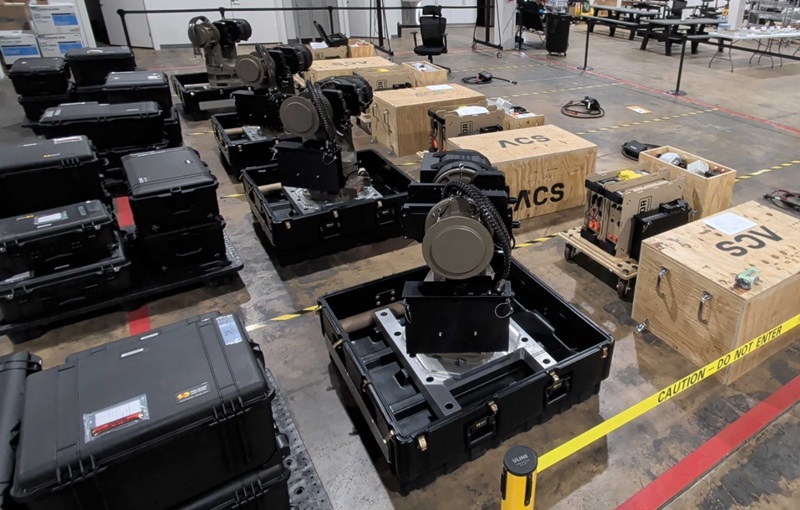
WASHINGTON — The United States Marine Corps has selected the Bullfrog autonomous weapon station, developed by Texas-based Allen Control Systems (ACS), for integration into its Light Marine Air Defense Integrated System (L-MADIS), strengthening the service's expeditionary counter-unmanned aerial system (C-UAS) capability.
The selection was made under a prototype Other Transaction Agreement (OTA) as part of the Marine Corps' Ground Based Air Defense (GBAD) program. The initial contract is valued at approximately $6.2 million, while the Marine Corps has requested $1.27 billion for GBAD capabilities in its fiscal year 2027 budget.
AI-Guided Robotic Mount for Existing Weapons
Rather than introducing a new firearm, Bullfrog is a robotic weapon station designed to convert existing military weapons into AI-assisted precision systems. The version selected by the Marine Corps is configured around the M240 machine gun, enabling it to detect, track and engage aerial targets with significantly reduced operator workload.
The system weighs approximately 300 pounds (136 kilograms) without ammunition and fires standard 7.62×51mm NATO ammunition at a maximum cyclic rate of 850 rounds per minute.
Bullfrog uses computer vision and artificial intelligence to manage target detection, tracking and engagement. It relies on a fully passive sensor suite, using optical cameras and onboard data processing instead of radar or other active emissions. This approach allows the system to track targets without broadcasting signals that could reveal its position to enemy electronic warfare systems.
Despite its high level of automation, Bullfrog operates under a human-in-the-loop model. The system performs target tracking and firing calculations, but a human operator must authorize every engagement before the weapon fires.
According to Allen Control Systems, Bullfrog is designed to engage Group 1 through Group 3 unmanned aerial systems, ranging from small commercial quadcopters to tactical fixed-wing drones weighing up to 1,320 pounds (599 kilograms). Depending on the installed weapon, the system has a maximum effective range of up to 1,500 meters against point targets.
Integration with L-MADIS
The Bullfrog weapon station will be integrated into the Marine Corps' Light Marine Air Defense Integrated System (L-MADIS), the service's most expeditionary counter-drone platform currently in operation.
L-MADIS consists of two Polaris MRZR all-terrain vehicles operating together. One vehicle serves as a command-and-control platform, while the second carries an electronic warfare suite designed to detect, jam and disrupt hostile drones.
The addition of Bullfrog provides L-MADIS with a kinetic counter-drone capability, allowing Marines to physically engage drones if electronic jamming is ineffective, particularly against autonomous drones operating without active radio links.
"The Marine Corps requires the most sophisticated and accurate possible capabilities to carry out its critical missions," said Mike Wior, co-founder and Chief Executive Officer of Allen Control Systems.
"We are honored to support Marines with fast, scalable, and cost-effective counter-drone solutions that integrate seamlessly into existing platforms," he added.
Lower-Cost Drone Interception
The system is intended to provide a lower-cost method of defeating drones by using standard machine gun ammunition instead of missile interceptors.
According to Allen Control Systems, using conventional ammunition can reduce the cost of intercepting drones to as little as $10 per engagement, allowing forces to respond to multiple drone threats without relying on limited stocks of more expensive interceptor missiles.
Previous Testing and Military Adoption
Bullfrog attracted attention during the Department of Defense's Technology Readiness Experimentation event at Camp Atterbury, Indiana, in August 2024, where it successfully engaged drone targets during a two-week evaluation attended by military officials, including former Undersecretary of Defense for Research and Engineering Heidi Shyu and representatives from U.S. Special Operations Command.
The system has also been validated by Joint Interagency Task Force 401, the Pentagon's counter-drone coordination unit.
In December 2025, the U.S. Army Applications Lab awarded Allen Control Systems a $4.5 million contract to evaluate Bullfrog integration across five Army combat vehicles. The company also confirmed that Bullfrog systems have already been deployed with U.S. Army and U.S. Navy units.
Internationally, Allen Control Systems has secured export contracts with South Korea and the United Arab Emirates, and has signed a memorandum of understanding for local co-production in Romania.
Multiple Weapon Configurations
In addition to the M240 variant selected by the Marine Corps, Allen Control Systems manufactures Bullfrog configurations designed for the M2 machine gun, M230 30mm automatic cannon, and M134 Gatling-style rotary gun, allowing the system to be adapted for different operational requirements.
Company Background
Allen Control Systems is headquartered in Austin, Texas, and was founded by Mike Wior, Steven Simoni, and Luke Allen, two of whom previously served as U.S. Navy nuclear engineers.
The company recently completed a $200 million Series B funding round in June 2026 at a $2.2 billion valuation, with plans to expand its manufacturing capacity to support growing defense demand.
Source : breakingdefense
——— End of Article ———