CINCINNATI — GE Aerospace and Shield AI have successfully completed integration, actuation, and engine light-off testing of the propulsion system for the X-BAT autonomous vertical take-off and landing (VTOL) strike fighter, marking an important milestone ahead of the aircraft's planned flight tests later this year.
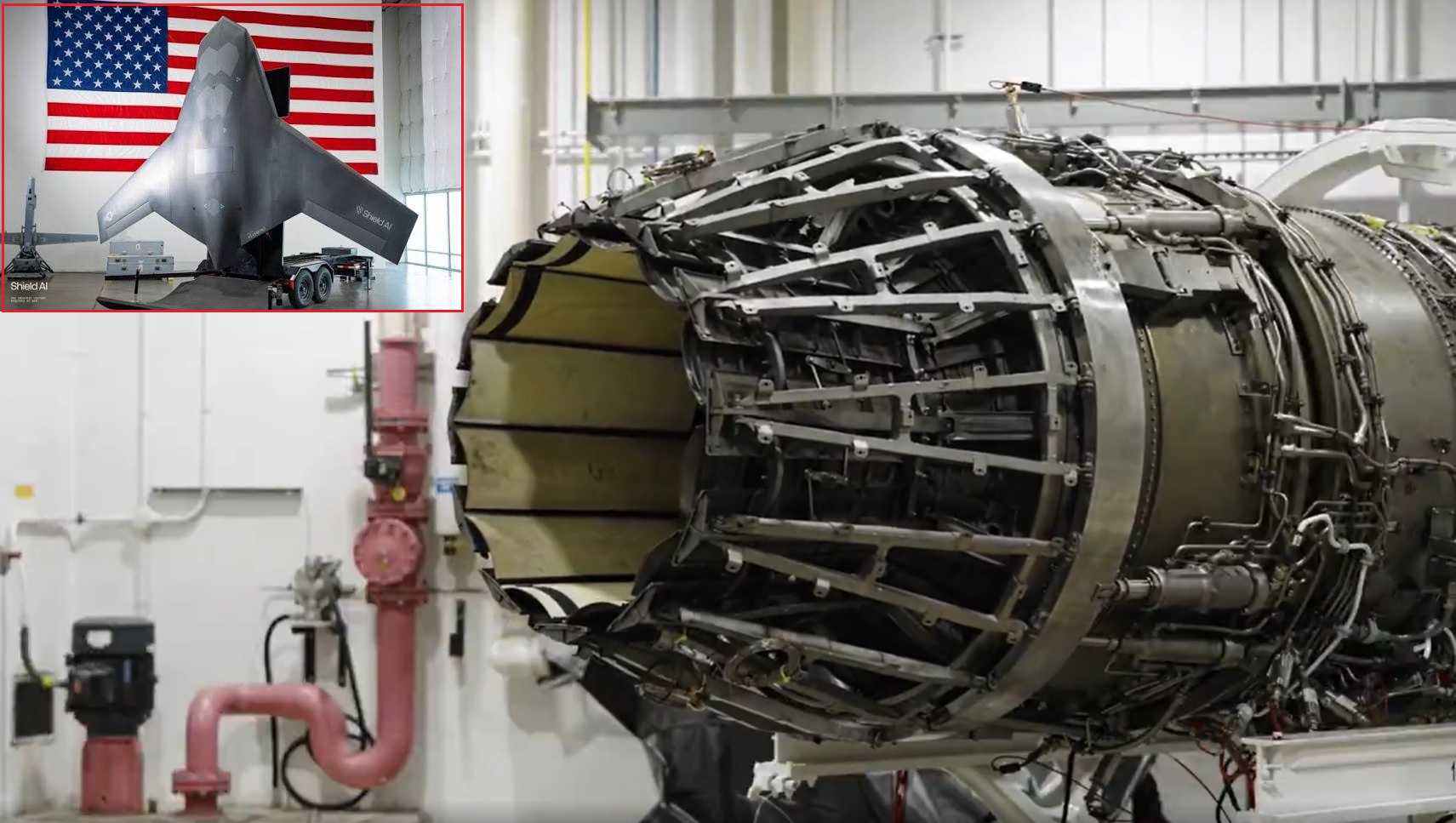
The testing was conducted at GE Aerospace's Peebles, Ohio, facility and focused on integrating the Axisymmetric Vectoring Exhaust Nozzle (AVEN) with the F110-GE-129E fighter engine. Engineers from both companies modified the AVEN hardware, integrated it with the engine, completed functional system checks, and successfully performed an engine light-off to verify the propulsion system's operation.
The campaign represents the first fully integrated test combining the AVEN's hardware, controls, and engine systems to execute coordinated thrust-vectoring nozzle movements since the technology was originally developed in the 1990s.
Flight-Proven AVEN Nozzle Adapted for X-BAT
The AVEN nozzle provides the thrust vectoring required for the X-BAT to perform vertical take-off, landing, and transition between vertical and conventional flight.
The technology was originally developed for a multi-axis thrust-vectoring program using the experimental F-16 VISTA (Variable-stability In-flight Simulator Test Aircraft) during the 1990s. During that program, the nozzle accumulated 73 hours of ground testing and 135 flight hours across 95 flights.
Rather than developing a new nozzle from the beginning, Shield AI refurbished the flight-tested AVEN hardware for the X-BAT program. However, the company said the aircraft's tail-sitting design requires significantly faster nozzle gimbaling to maintain stability during vertical flight than was required in the original F-16 program.
Armor Harris, Senior Vice President of Aircraft Engineering at Shield AI, said the AVEN system is central to the aircraft's ability to operate without runways.
"X-BAT is designed to take off and land vertically from anywhere—no airbase, no runway—and that capability lives or dies with propulsion. The AVEN is what makes vertical flight possible on a platform this size and this capable. Taking hardware with a flight-proven track record and adapting it for that mission has let us move through development at an incredible pace instead of starting from zero."
Designed for Runway-Independent Operations
Shield AI publicly unveiled the X-BAT in late 2025 as a long-range Collaborative Combat Aircraft (CCA) powered by the company's Hivemind autonomy software.
The aircraft is designed to operate independently or alongside crewed aircraft in contested environments where traditional airbases and runways may not be available.
Unlike conventional fighter aircraft, the X-BAT launches vertically from a trailer-mounted platform and requires a clearing of approximately 100 by 100 feet. The aircraft uses the F110 engine's afterburner during vertical take-off to generate maximum thrust, while landings are performed using military power.
Despite its runway-independent design, the aircraft has dimensions comparable to a fighter aircraft, measuring about 26 feet (7.9 meters) in length with a 39-foot (11.9-meter) wingspan.
Its twin internal weapons bays are similar in size to those of the F-35 and are designed to carry up to 2,000-pound-class weapons internally.
The X-BAT has a combat radius of 1,000 nautical miles, a maximum range exceeding 2,000 nautical miles, and is capable of operating at altitudes of up to 50,000 feet.
The aircraft also generates 80 kilowatts of onboard electrical power, supporting electronic warfare (EW) systems, intelligence, surveillance and reconnaissance (ISR) payloads, and both active and passive radar capabilities.
F110 Engine Powers the X-BAT Program
The successful engine light-off follows Shield AI's selection of GE Aerospace in November 2025 to provide propulsion and testing support for the X-BAT program.
The F110 engine family, which recently marked 40 years of continuous production, has accumulated more than 11 million flight hours in operational service and remains one of the most widely used high-thrust fighter engines.
Doogie Russell, Vice President of Edison Works at GE Aerospace, said the testing combines proven propulsion technology with a new autonomous aircraft design.
"The integration of AVEN into our F110-GE-129E engine and a successful light off represents a full-circle moment for our GE Aerospace team. By combining our proven experience in developing propulsion systems with Shield AI's next-generation vehicle development, we are integrating the best of past, present, and future products to create a revolutionary aircraft."
Flight Testing Planned Later This Year
Following completion of the ground testing campaign at Peebles, the integrated AVEN propulsion system is entering final preparations for flight evaluation.
The X-BAT prototype is scheduled to begin flight testing later in 2026, with the recent propulsion tests validating a key system required for the aircraft's vertical flight capability. The program is intended to demonstrate a runway-independent autonomous strike aircraft capable of operating from ships, islands, trailers, and other remote locations while carrying fighter-sized payloads over long distances.
Source : shield.ai
——— End of Article ———