KYIV, Ukraine — May 2, 2026 : The Ukrainian Air Force has introduced a previously undisclosed short-range air defense system, designated STASH, into operational service, according to official footage released on May 1 by Air Command West. The system was shown actively intercepting a Russian Shahed-type loitering munition during a large-scale drone attack targeting western regions of the country.
Combat Deployment During Mass Drone Strike
The public debut of the STASH system coincided with a coordinated Russian offensive involving more than 400 strike unmanned aerial vehicles (UAVs). Ukrainian military reports indicate that air defense units operating in the western sector intercepted and destroyed at least 58 drones during the attack.
The released footage confirms that STASH units were engaged as part of Ukraine’s layered air defense network, contributing to the interception of Shahed-type drones. The system employed AGM-114 Hellfire missiles to engage aerial targets during the operation.
System Configuration and Technical Features
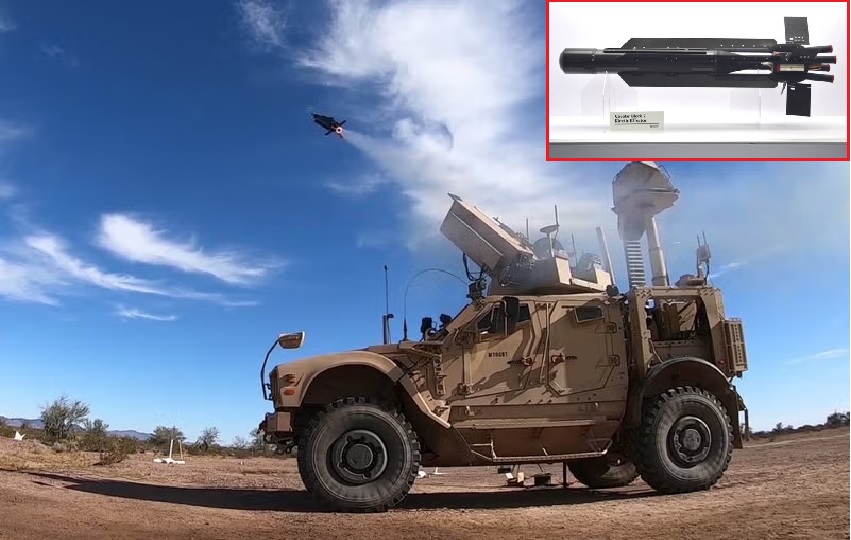
Analysis of the published video material indicates that STASH is a trailer-mounted, short-range air defense platform designed for mobility and rapid deployment. The system integrates missile launch capability with a compact radar unit for target acquisition and tracking.
The launcher is equipped with two AGM-114L Longbow Hellfire missiles. This missile variant uses an active millimeter-wave radar seeker, allowing engagement under “fire-and-forget” conditions without continuous operator guidance after launch.
A radar system, identified as either an Israeli RADA radar or the Leonardo DRS RPS-42 Multi-Mission Hemispheric Radar, is mounted on the platform. The radar supports continuous surveillance, target tracking, and fire control functions required for engaging low-altitude aerial threats.
The system is installed on a four-wheeled trailer, enabling it to be towed by light vehicles. This configuration allows rapid repositioning for the protection of critical infrastructure or adaptation to changing operational requirements.
Development and Relation to Tempest System
Defense analysts assess that STASH is a derivative of the Tempest air defense system developed by the U.S.-based company V2X. The Tempest system, also known as DASH (Denied Area Sprinter-Hellfire), was publicly unveiled in October 2025 at the Association of the United States Army (AUSA) Annual Meeting and Exposition.
The original Tempest configuration is mounted on a mobile chassis based on the commercial Can-Am Maverick X3 platform and incorporates the Leonardo DRS Multi-Mission Hemispheric Radar. In contrast, the STASH variant replaces the self-propelled buggy platform with a towable trailer configuration, indicating a design adaptation for different deployment scenarios.
Capabilities and Performance Parameters
Available data suggests that both Tempest and STASH systems are designed to engage drones, helicopters, and low-flying aircraft under various weather conditions. Reported performance characteristics include an engagement range of approximately 8 to 11 kilometers and a maximum engagement altitude of up to 5 kilometers.
The onboard radar system is assessed to have a detection range of around 10 kilometers. The platform supports “shoot-and-scoot” tactics, allowing operators to relocate quickly after firing to reduce vulnerability to counterfire.
Operational Integration in Ukraine
The presence of Tempest-family systems in Ukrainian service was first observed in late 2025. In January 2026, footage released by an Air Command Center showed a vehicle-mounted Tempest system engaging aerial threats during a nighttime operation. Neither U.S. nor Ukrainian authorities formally announced the transfer of these systems.
The May 1 footage represents the first official confirmation of the STASH variant in combat use. The system is now integrated into Ukraine’s broader air defense architecture, providing short-range coverage against low-altitude and high-volume drone threats.
The deployment of STASH reflects ongoing efforts to expand and adapt air defense capabilities in response to sustained use of loitering munitions in the conflict.
——— End of Article ———