Washington — April 17, 2026 : The United States, in coordination with Israel and select allied nations, has deployed a force of more than 500 combat aircraft across the Middle East, with approximately 250 configured specifically for close air support (CAS) missions, according to U.S. military assessments released on April 17, 2026.
The aircraft are distributed across a network of regional air bases and naval platforms, including land-based installations and multiple carrier strike groups operating in adjacent waters. The deployment falls within the U.S. Central Command (CENTCOM) area of responsibility and is part of an ongoing reinforcement posture amid heightened tensions with Iran and continued military operations in the region.
Close Air Support Configuration and Role
Of the total aircraft deployed, roughly half are assigned to close air support (CAS) missions. CAS operations are designed to provide direct air assistance to ground forces, requiring aircraft capable of operating at low altitudes and reduced speeds. These missions involve targeting enemy personnel, armored vehicles, small boats, and fortified positions located near friendly troops.
The CAS-configured fleet includes a mix of dedicated attack aircraft and multirole fighters:
-
The A-10 Thunderbolt II (Warthog) remains a central component of the CAS force. Designed specifically for ground attack, the aircraft is equipped with a 30-millimeter GAU-8/A Avenger rotary cannon and reinforced with a titanium armor structure to withstand significant battlefield damage. The U.S. Air Force has recently expanded its A-10 presence in the Middle East, deploying an additional 18 aircraft to join approximately a dozen already operating in the theater. These aircraft are equipped with systems such as 70mm APKWS II guided rockets and AGM-65 Maverick missiles, enabling engagement of both land and maritime targets, including small vessels operating in areas such as the Strait of Hormuz.
-
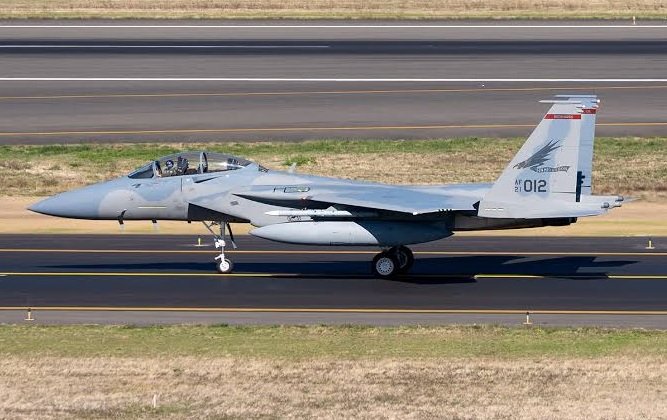
The F-15E Strike Eagle is being utilized for both precision strike and direct support missions. With its high payload capacity and extended range, the aircraft is capable of delivering a wide range of air-to-ground munitions in support of ground forces over sustained operations.
-
Variants of the F-16 Fighting Falcon are also assigned to CAS roles. These aircraft are configured to carry precision-guided munitions and are deployed at multiple regional bases, allowing for rapid response to developing ground situations.
-
Carrier-based F/A-18E/F Super Hornet aircraft contribute to CAS and strike operations from U.S. Navy carrier strike groups. These aircraft are equipped with air-to-ground weapons and are used to engage both inland and coastal targets, supporting ground and amphibious operations.
Broader Airpower Composition
Beyond the CAS-designated aircraft, the broader deployment includes additional advanced platforms focused on air superiority and strike missions. These include F-22 Raptor and F-35 Lightning II fighters operated by the U.S. Air Force, as well as F-35C variants assigned to carrier air wings. Electronic warfare support is provided by EA-18G Growler aircraft, while allied contributions include platforms such as Eurofighter Typhoons from the United Kingdom.
The aircraft are positioned across key regional installations, including Muwaffaq Salti Air Base in Jordan, Al Udeid Air Base in Qatar, and multiple facilities in Israel. These locations provide geographic coverage across the eastern Mediterranean, Red Sea, Arabian Sea, and the Persian Gulf.
Naval and Logistical Support Structure
The air deployment is supported by a large naval presence, including three U.S. carrier strike groups operating in the region. These are led by the USS Abraham Lincoln, USS Gerald R. Ford, and USS George H.W. Bush. Each carrier group provides a combination of strike aircraft, airborne early warning systems, electronic warfare capabilities, and logistical support required to sustain continuous air operations.
Additional support is provided by aerial refueling tankers and intelligence, surveillance, and reconnaissance (ISR) platforms, enabling extended mission durations and real-time battlefield awareness.
Integration With Ground and Amphibious Forces
The configuration of approximately 250 aircraft for CAS roles corresponds with the presence of deployed ground and amphibious units. These include the 11th Marine Expeditionary Unit (MEU) and the 31st Marine Expeditionary Unit, as well as elements of the 82nd Airborne Division. These forces include personnel, landing craft, and equipment designed for rapid deployment and expeditionary operations.
The integration of air and ground assets reflects a combined operational structure capable of supporting a range of scenarios, including maritime security operations, enforcement measures near strategic waterways such as the Strait of Hormuz, and potential ground maneuver support.
Operational Context
The deployment represents one of the largest concentrations of U.S. and allied airpower in the Middle East in recent years. U.S. officials have stated that the force posture is intended to maintain operational flexibility and readiness across multiple mission sets, including deterrence, defensive operations, and support for ongoing regional security objectives.
The U.S. Department of Defense has not released a detailed breakdown of aircraft numbers by type or precise basing arrangements, citing operational security considerations.
——— End of Article ———