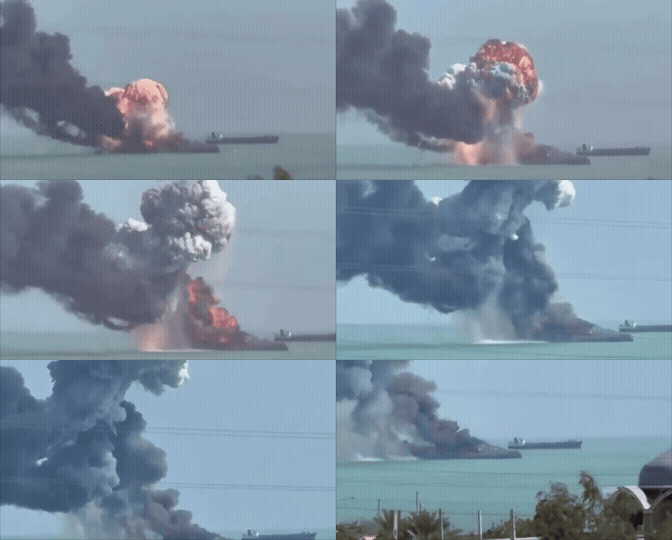
BANDAR LENGEH / WASHINGTON — March 9, 2026 : A missile corvette operated by the naval branch of the Islamic Revolutionary Guard Corps (IRGCN) was destroyed on Monday following a strike attributed to United States forces off the coast of Bandar Lengeh in southern Iran. Iranian authorities confirmed that the vessel belonged to the Shahid Soleimani-class of guided-missile corvettes.
The incident occurred in waters near Bandar Lengeh, a strategic port city in Hormozgan Province located along the northern approaches to the Strait of Hormuz. Open-source video circulating online shows a large explosion followed by fire and smoke engulfing the vessel shortly after the strike. U.S. Central Command has not released operational details about the specific engagement, though the incident is reported to be part of broader maritime operations targeting Iranian naval assets in the Persian Gulf.
Iranian officials have not disclosed the number of casualties or confirmed the exact hull number of the destroyed vessel.
Shahid Soleimani-Class Missile Corvette
The destroyed ship belonged to the Shahid Soleimani-class, a line of domestically developed guided-missile corvettes built for coastal defense and multi-domain operations in the Persian Gulf. The class represents a key element of the IRGC Navy’s modernization effort and was designed to support asymmetric maritime warfare in confined littoral waters.
The lead ship of the class, Shahid Soleimani, entered service with the IRGC Navy on September 5, 2022. At least four vessels of this class are believed to be operational.
A defining feature of the class is its catamaran, or twin-hull, configuration. The hull structure is constructed primarily from lightweight aluminum rather than conventional steel, reducing overall displacement and lowering radar cross-section. The superstructure incorporates angled surfaces intended to deflect radar signals and improve survivability in contested environments.
The twin-hull configuration provides additional stability in rough seas and allows the ship to carry a large weapons payload relative to its size.
Technical Characteristics
The Shahid Soleimani-class corvette measures approximately 65 to 67 meters in length, with a beam ranging between 14.5 and 20 meters depending on the specific configuration.
The vessel has a standard displacement of around 600 tonnes, which can exceed 1,000 tonnes when fully loaded with weapons, fuel, and operational equipment.
Propulsion is provided by four domestically produced diesel engines, enabling the ship to reach a maximum speed of about 32 knots (59 km/h). The propulsion system allows the vessel to operate across long distances in the Persian Gulf and adjacent waters.
The ship’s operational range is estimated at approximately 5,000 nautical miles (about 9,300 kilometers) when traveling at cruising speed, allowing it to conduct extended maritime patrols and escort missions without frequent refueling.
Missile Systems and Armament
The Shahid Soleimani-class corvette is designed as a heavily armed missile platform. One of its most notable features is the integration of Iran’s first naval vertical launching system (VLS) installed on a catamaran-type vessel.
The vertical launch system includes six large launch cells intended for surface-to-surface cruise missiles, including the Abu-Mahdi long-range anti-ship missile. In addition, the ship carries up to 16 smaller VLS cells designed for surface-to-air missiles used for air defense.
These air-defense missiles include variants such as the Navvab, Sayyad-2, and Sayyad-3 systems.
In addition to the vertical launch system, the corvette is equipped with six box launchers for anti-ship cruise missiles. These typically include four longer-range missiles, such as the Noor, Ghadir, or Qader, and two shorter-range missiles of the Nasir type.
Close-range defensive armament includes a 30 mm automatic cannon mounted forward and multiple Gatling-style guns ranging from 20 mm to 23 mm, typically between four and six units depending on configuration. These weapons are intended to defend against small boats, drones, and incoming threats at short range.
The ship is also equipped with electronic warfare systems, including two chaff dispensers designed to counter radar-guided missiles.
Aviation and Support Capabilities
The vessel incorporates a large helicopter deck approximately 14 meters wide, enabling operations with light and medium helicopters as well as unmanned aerial vehicles.
Helicopters capable of operating from the deck include the Bell 412 and Bell 206, while the platform is also capable of supporting various Shahed-series drones used for reconnaissance or strike missions.
Beneath the helipad is a crane and launch system used to deploy fast attack boats. This mechanism allows the vessel to launch, retrieve, and rearm up to three fast boats during operations. These smaller craft are commonly used by the IRGC Navy in swarm tactics in the confined waters of the Persian Gulf.
Operational Role in the Persian Gulf
The Shahid Soleimani-class vessels serve as multi-role command and missile platforms within the IRGC Navy. Their mission set includes anti-ship warfare, coastal defense, air defense, and coordination of fast attack craft operations.
Designed specifically for operations in the Strait of Hormuz and the Persian Gulf, the ships combine missile strike capability with support functions for smaller patrol boats and drones.
The class represents one of the IRGC Navy’s most modern surface combatants and reflects Iran’s emphasis on precision-guided missile systems and distributed naval warfare.
Ongoing Conflict Context
The destruction of the corvette adds to reported Iranian naval losses since the current conflict began on February 28, 2026, when large-scale strikes targeting Iranian military infrastructure were initiated.
Details about the exact weapon system used in the strike, the number of personnel aboard the vessel, and the extent of associated damage to nearby assets have not been released by U.S. officials or Iranian authorities.
——— End of Article ———