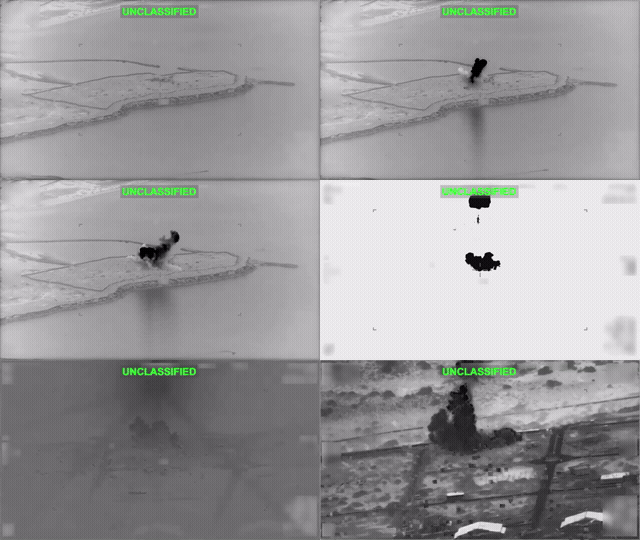
WASHINGTON / TEHRAN, — June 6, 2026 : The United States has released footage showing recent military strikes against Iranian facilities on Sirik and Qeshm Island, as tensions between Washington and Tehran continue to test a fragile ceasefire that has been in place since April.
According to U.S. Central Command (CENTCOM), the operations were conducted on June 5 and 6 following a series of security incidents in and around the Strait of Hormuz. The newly released footage shows strikes targeting Iranian surveillance and communications infrastructure, which U.S. officials described as defensive actions intended to prevent further attacks on regional maritime traffic.
In Sirik, located on Iran’s southern coast, a surveillance building was struck. U.S. officials stated that one person inside the facility was killed. On Qeshm Island, a telecommunications tower was targeted, with no casualties reported.
CENTCOM said the strikes followed the interception of four Iranian one-way attack drones that were allegedly heading toward the Strait of Hormuz and posed an immediate threat to shipping in the area. The U.S. military also reported that an Iranian surface-to-air missile had previously shot down an American MQ-1 drone operating over what Washington described as international waters.
The U.S. military stated that the strikes on Sirik, Qeshm Island, and nearby coastal surveillance sites around Goruk were intended to degrade Iran’s ability to conduct further attacks against maritime targets.
Iran rejected the U.S. account of events. The Islamic Revolutionary Guard Corps (IRGC) said the MQ-1 drone had entered Iranian airspace and defended the actions taken against it. Iranian officials also claimed that regional military facilities connected to earlier U.S. operations had been targeted in retaliation.
Following the U.S. strikes, Iran launched ballistic missiles toward U.S. military facilities in Kuwait and Bahrain. Iranian state media reported that the attacks were carried out in response to American operations against Iranian infrastructure.
CENTCOM reported that seven ballistic missiles were fired toward Gulf targets. According to the U.S. military, six missiles were intercepted by air defense systems while the seventh failed to reach its intended target. No U.S. casualties were reported.
The missile launches followed a separate incident earlier in the week involving Kuwait International Airport. Kuwaiti authorities said a drone strike killed one person and injured more than 60 others. The IRGC denied responsibility, claiming the damage resulted from a malfunctioning U.S. interceptor missile. CENTCOM rejected that explanation, describing the airport strike as a deliberate attack. Kuwait’s Foreign Ministry condemned the incident as a violation of the country's sovereignty.
Military analysts have generally assessed the recent strikes on Sirik and Qeshm Island as having limited operational significance. The targeted facilities were not considered major strategic assets, and the attacks are widely viewed as symbolic actions intended to signal resolve while avoiding a broader escalation. Analysts noted that the exchanges appear to be testing the limits of restraint under the existing ceasefire framework.
The latest developments come as diplomatic efforts to extend and formalize the ceasefire remain stalled. The wider conflict began on February 28, when the United States and Israel launched large-scale strikes against Iranian military infrastructure. Iran subsequently carried out attacks against Israel and U.S.-aligned targets in the region and effectively closed the Strait of Hormuz.
The strategic waterway handles approximately 20 percent of global seaborne oil and liquefied natural gas shipments, making any disruption a major concern for international energy markets. Restrictions on traffic through the strait contributed to higher global oil prices and significant disruptions to commercial shipping.
Following the April ceasefire, the United States established a naval blockade around Iranian ports. U.S. media reports indicate that President Donald Trump has sought revisions to the terms of a proposed permanent agreement and has stated that the blockade will remain in effect until a final deal is reached and formally certified.
Iran has criticized the pace and direction of negotiations. On Monday, the Iranian Foreign Ministry said the United States was introducing new and sometimes contradictory demands during discussions aimed at securing a longer-term settlement.
The geographic importance of the Strait of Hormuz continues to place islands such as Qeshm, Hormuz, Larak, and Hengam at the center of regional security concerns. The area also includes disputed territories such as Greater Tunb, Lesser Tunb, and Abu Musa, while overlapping maritime boundaries and Exclusive Economic Zones (EEZs) add to the region's strategic complexity.
Despite ongoing tensions, limited diplomatic engagement continues in other areas. The United States has granted visas to Iran’s national football team for the 2026 FIFA World Cup. Iran is scheduled to play its opening match in Los Angeles on June 15, marking the first known instance of a World Cup host nation receiving the team of a country with which it is engaged in an active military conflict.
While the recent military exchanges have remained limited in scale, they underscore the continuing tensions between the United States and Iran and the challenges facing efforts to transform the current ceasefire into a lasting agreement.
——— End of Article ———