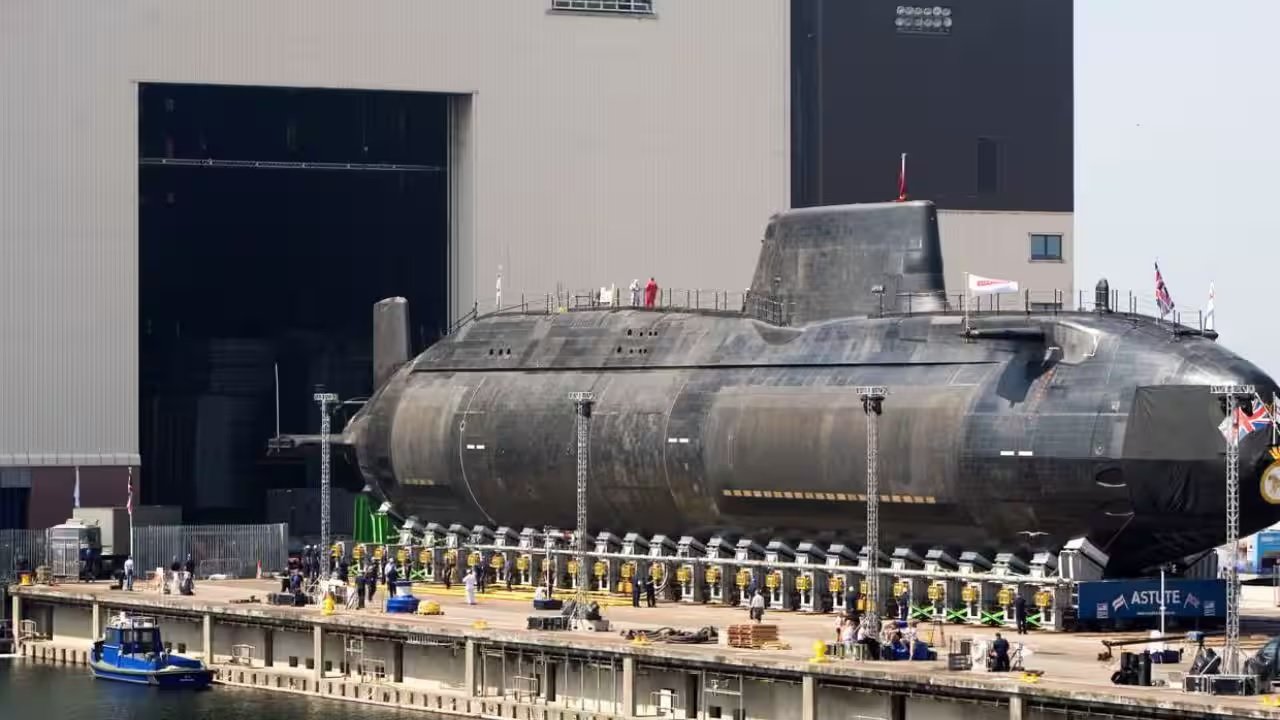
GIBRALTAR, — May 11, 2026 : A United States Navy Ohio-class ballistic missile submarine arrived at the naval base in Gibraltar on Sunday evening amid heightened military readiness and ongoing diplomatic tensions surrounding the Middle East.
The vessel, identified in local reports as the USS Alaska (SSBN-732), entered the Bay of Gibraltar under extensive security arrangements. Naval units from the Royal Navy’s Gibraltar Squadron, the Gibraltar Defence Police, and Royal Marines escorted the submarine through the Strait of Gibraltar before it docked at the South Mole with support from two tugboats.
Local authorities established a 200-meter maritime exclusion zone around the berth, while additional ground security measures were implemented across Gibraltar ahead of the submarine’s arrival. Reports also indicated that Royal Marines were deployed to secure the docking area prior to the vessel entering port.
The U.S. Department of Defense and the UK Ministry of Defence have not issued official statements regarding the purpose or duration of the deployment. However, the timing of the visit has drawn international attention as tensions between the United States and Iran continue to increase following disagreements over a proposed Middle East ceasefire framework.
Military analysts note that operational ballistic missile submarines rarely make public port visits due to their strategic role and stealth-based operations. Public appearances of such vessels are generally viewed as demonstrations of military readiness, deterrence capability, and alliance coordination during periods of geopolitical uncertainty.
Strategic Nuclear Deterrence Platform
The Ohio-class fleet forms the sea-based component of the United States’ nuclear triad and represents one of the most survivable elements of the country’s strategic deterrence force. Designed for extended patrol operations, the submarines are capable of remaining submerged for several months while conducting global strategic missions.
Ohio-class submarines measure approximately 171 meters in length and displace nearly 18,750 tonnes when submerged, making them the largest submarines ever constructed for the U.S. Navy. The vessels are powered by a single S8G pressurized-water nuclear reactor driving steam turbines, enabling submerged speeds exceeding 20 knots.
In their ballistic missile submarine configuration, the vessels carry up to 20 Trident II D5 submarine-launched ballistic missiles in compliance with New START treaty limitations. The missiles possess operational ranges exceeding 12,000 kilometers and are capable of carrying multiple independently targetable reentry vehicles (MIRVs).
For tactical and defensive operations, the submarines are equipped with four 533-millimeter bow-mounted torpedo tubes armed with Mk 48 Advanced Capability heavyweight torpedoes.
Each submarine operates with a crew of approximately 155 personnel under the U.S. Navy’s dual-crew “Blue” and “Gold” rotation system, allowing continuous deployment cycles and patrols typically lasting between 70 and 90 days.
Gibraltar’s Strategic Importance
Gibraltar remains one of the world’s most strategically significant maritime chokepoints, connecting the Atlantic Ocean to the Mediterranean Sea. The British Overseas Territory regularly supports NATO and U.S. Sixth Fleet operations due to its geographic position and naval infrastructure.
Public visits by operational U.S. ballistic missile submarines to Gibraltar are considered relatively uncommon. The latest arrival marks one of the few publicly observed Ohio-class SSBN port calls to the territory in recent decades, highlighting the continued strategic importance of the region amid ongoing international security concerns.
——— End of Article ———