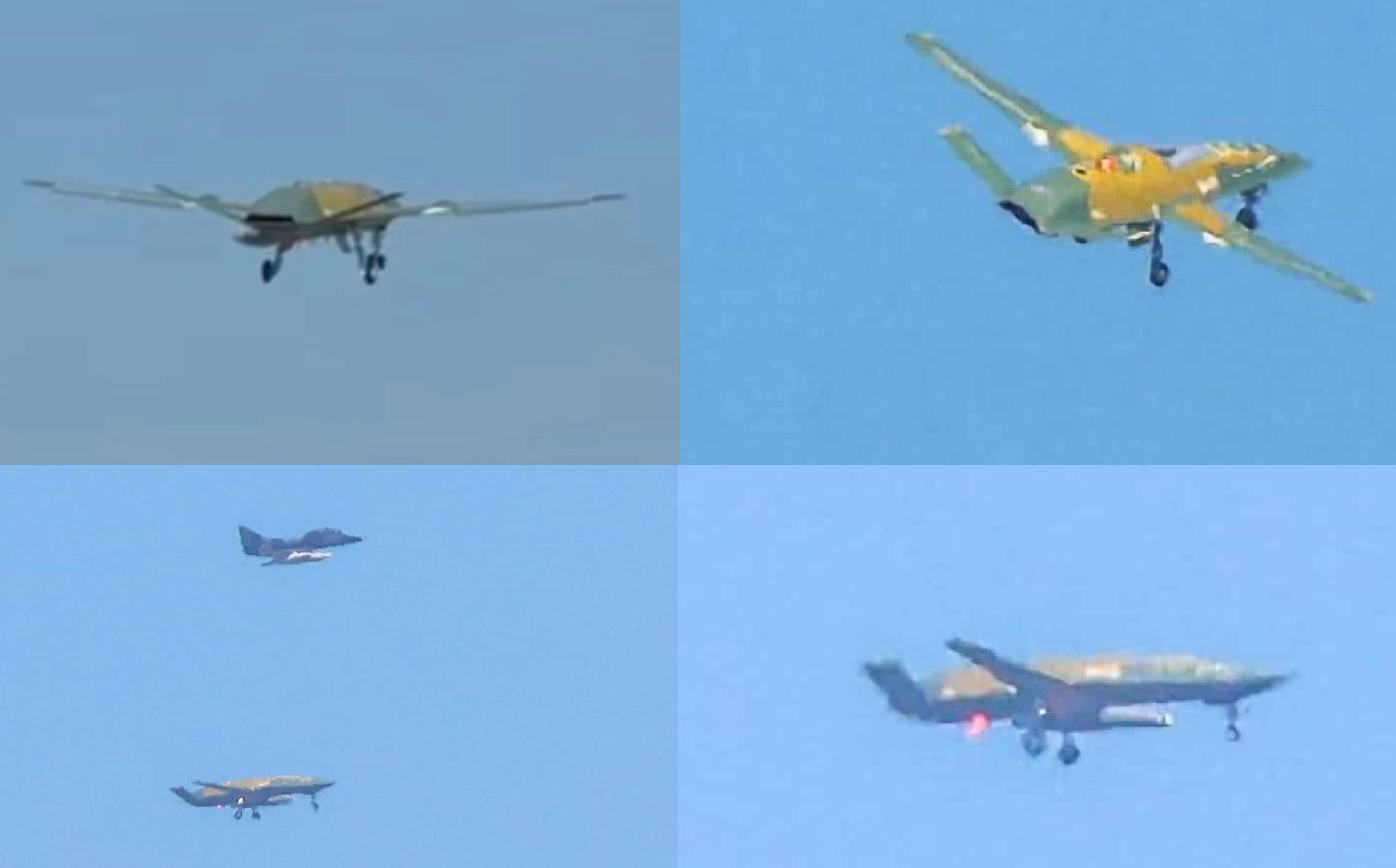
ST. LOUIS — April 26, 2026 : The MQ-25 Stingray program reached a key development milestone as the U.S. Navy’s first production-representative aircraft successfully completed its maiden flight on April 25, 2026, marking the transition of the service’s first carrier-based unmanned tanker from ground testing into full flight-test operations.
Maiden Flight and Test Operations
The aircraft departed from MidAmerica St. Louis Airport, where Boeing operates its MQ-25 production facilities. The sortie followed an aborted takeoff attempt on April 22 for undisclosed reasons.
During the successful flight, the Stingray was accompanied by two chase aircraft: a Boeing-owned TA-4J Skyhawk and a U.S. Navy UC-12M Huron. No additional performance data from the flight has been released.
The milestone comes nearly seven years after the first flight of the MQ-25 T1 demonstrator on September 19, 2019. Compared to the earlier test asset, the production-representative configuration incorporates design updates, including a retractable electro-optical/infrared (EO/IR) sensor turret to support expanded mission roles.
Transition to Flight Testing Phase
The successful maiden flight formally transitions the program from ground-based testing into sustained flight-test operations. Earlier in January 2026, the aircraft completed low- and high-speed autonomous taxi trials conducted by Air Test and Evaluation Squadron 23 (VX-23) and Air Test and Evaluation Squadron 24 (UX-24). UX-24, which specializes in unmanned systems development, will continue to support the program alongside VX-23 throughout the flight-test campaign.
Following initial flight testing, the Navy plans to conduct envelope expansion flights to validate the aircraft’s performance limits. Data gathered during this phase will be used to certify the updated configuration ahead of carrier-based flight testing. Previous trials involving the T1 asset focused on deck handling and carrier suitability without launch operations.
The program is overseen by Naval Air Systems Command, which will coordinate continued developmental and operational testing. A total of nine aircraft are currently under construction to support these efforts.
Operational Role and Capabilities
The MQ-25 Stingray is designed primarily to perform carrier-based aerial refueling using the Cobham Aerial Refueling Store, the same system employed by F/A-18E/F Super Hornet tanker variants. The aircraft is capable of transferring between 14,000 and 16,000 pounds of fuel at a radius of 500 nautical miles.
This capability is intended to reduce reliance on Super Hornets for “buddy tanker” missions, which currently account for up to one-third of their sorties. By shifting this workload to the MQ-25, the Navy aims to increase the availability of crewed strike fighters for operational missions while extending the reach of carrier air wings aboard Nimitz- and Ford-class aircraft carriers.
In addition to refueling, the MQ-25 will support intelligence, surveillance, and reconnaissance (ISR) missions. Its onboard systems include the EO/IR turret, along with signals intelligence (SIGINT) and Automatic Identification System (AIS) capabilities, enabling persistent maritime surveillance and operational support functions such as recovery tanking.
Vice Adm. Daniel Cheever has described the MQ-25 as a foundational platform for future carrier aviation, emphasizing its role in enabling manned-unmanned teaming concepts and supporting the development of collaborative combat aircraft within carrier air wings.
Technical Specifications
The MQ-25 employs a straight-wing design optimized for endurance and subsonic cruise operations. Key specifications include:
- Length: 51.0 ft (15.5 m)
- Wingspan (extended): 75.0 ft (22.9 m)
- Wingspan (folded): 31.3 ft (9.5 m)
- Height (extended): 9.8 ft (3.0 m)
- Height (folded): 15.7 ft (4.8 m)
- Powerplant: 1 × Rolls-Royce AE 3007N turbofan engine producing over 10,000 lbf of thrust
- Maximum takeoff weight: approximately 44,000 lb (20,000 kg)
- Top speed: approximately 620 km/h (subsonic)
The aircraft is built under a Boeing-led industrial team, with Rolls-Royce supplying the engine and multiple partners contributing subsystems, including vehicle management and mission systems.
Mission Control and Manned-Unmanned Teaming
A central component of the MQ-25 program is the development of the Unmanned Carrier Aviation Mission Control System (UMCS), led in partnership with Lockheed Martin. Between 2024 and 2025, UMCS installations were completed at shore facilities and aboard the USS George H.W. Bush (CVN-77).
Through UMCS, Navy operators have demonstrated the ability to control the MQ-25 and other unmanned platforms, including the MQ-20 Avenger. Boeing has also tested concepts enabling pilots of crewed aircraft, such as the F/A-18, to directly interact with and control MQ-25 systems during aerial refueling operations.
Budget, Production, and Schedule
Despite progress, the MQ-25 program has experienced schedule adjustments. Pentagon Selected Acquisition Reports and Government Accountability Office (GAO) assessments cited in August 2025 indicated that key milestones, including the first flight of engineering and manufacturing development aircraft and initial operational capability (IOC), have been delayed by approximately two years.
The Navy now targets IOC in fiscal year 2027. To support testing and future low-rate initial production (LRIP), Boeing opened a $200 million, 300,000-square-foot production facility at MidAmerica Airport in 2024.
The Navy’s FY2026 budget request includes approximately $1.04 billion for procurement and research, development, test, and evaluation (RDT&E), covering continued program development and the first three LRIP aircraft. The GAO has cautioned that initiating LRIP before sufficient completion of developmental testing could introduce additional cost risks.
Program Trajectory
Following completion of early flight testing, the MQ-25 program will proceed with envelope expansion and carrier-based flight trials. These steps are intended to validate the aircraft’s operational suitability for deployment aboard U.S. Navy aircraft carriers.
The Navy plans to acquire up to 76 MQ-25 aircraft as part of its long-term strategy to integrate unmanned systems into carrier air wings, with the Stingray serving as the first operational step in that transition.
——— End of Article ———