WASHINGTON, D.C., July 15, 2026 — The U.S. Navy has launched a new effort to develop advanced carrier-based unmanned aircraft as part of its long-term modernization plans, seeking industry proposals for autonomous drones capable of conducting a wide range of combat and support missions from aircraft carriers.
On July 14, 2026, the Portfolio Acquisition Executive for Aviation within Naval Air Systems Command (NAVAIR) issued a Sources Sought notice, also known as a Request for Information (RFI), inviting defense companies to submit concepts for a new family of carrier-based unmanned aircraft. The notice is intended to gather information on available technologies and industry capabilities before any formal acquisition program begins. Companies have until August 13, 2026, to submit their responses.
The initiative is part of the Navy's Air Wing of the Future program, which aims to reshape carrier aviation by integrating advanced autonomous aircraft alongside manned fighters. The effort also supports the broader Golden Fleet modernization initiative under the Trump administration, which focuses on accelerating the development and fielding of new naval platforms.
Eight Mission Requirements
The Navy is seeking either a single multi-role unmanned aircraft or a modular family of systems capable of performing multiple missions from aircraft carriers. According to the RFI, the proposed platforms should be able to carry out:
- Strikes against land targets
- Strikes against surface ships
- Air-to-air combat against enemy aircraft and missiles
- Anti-submarine warfare (ASW)
- Electronic warfare (EW)
- Intelligence, surveillance, and reconnaissance (ISR)
- Aerial refueling
- Resupply missions for naval task forces
For strike missions, the aircraft must have a minimum combat radius of 1,000 nautical miles (approximately 1,852 kilometers or 1,151 miles) without requiring aerial refueling. The requirement reflects the Navy's need to operate carriers farther from hostile coastlines due to the increasing range of modern anti-ship missile systems.
High Level of Autonomy Required
The Navy expects the new aircraft to perform complex flight and mission tasks with a high degree of autonomy. Proposed systems should be capable of independently handling carrier landing patterns, deck taxiing, dynamic mission retasking, threat avoidance, and automated aerial refueling.
The aircraft must also integrate with the Navy's existing Unmanned Carrier Aviation control architecture rather than requiring a separate command system, allowing future platforms to operate within the current infrastructure.
Compatible with Existing Aircraft Carriers
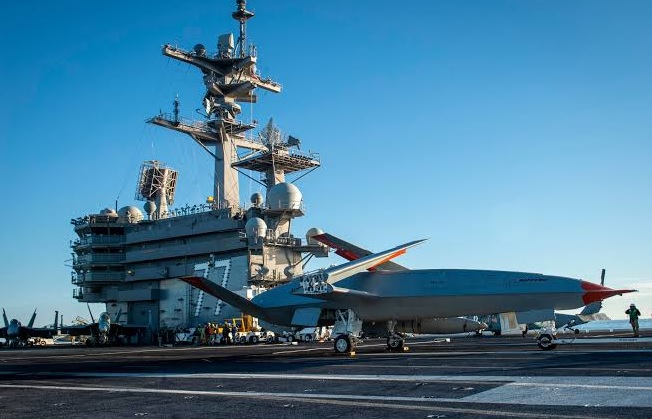
The new unmanned aircraft must be fully compatible with the launch and recovery systems used aboard both Nimitz-class and Ford-class nuclear-powered aircraft carriers, including catapults and arresting gear.
At the same time, the Navy expressed interest in Vertical Takeoff and Landing (VTOL) concepts. Such designs could expand operations beyond aircraft carriers to other naval platforms, including guided missile destroyers (DDGs) and Expeditionary Sea Bases (ESBs), increasing operational flexibility.
Flight Deck Space Remains a Key Consideration
Carrier flight decks have limited space, making aircraft size and storage an important factor. The Navy is asking companies to explain the "spot factor" of their designs, which measures how much deck space an aircraft occupies compared with the combat capability it provides.
Proposals are expected to demonstrate greater combat effectiveness than current fourth-generation aircraft, such as the F/A-18 Super Hornet, while making efficient use of available carrier deck space.
Focus on Cost and Production Capacity
In addition to operational performance, the Navy is placing significant emphasis on affordability and manufacturing capability.
Companies responding to the RFI must describe how they would rapidly increase production during a conflict, provide plans to control unit recurring flyaway costs and long-term sustainment expenses, reduce maintenance requirements, and ensure compatibility with existing Navy logistics and supply chains.
The Navy also requested information on planned capital investments, internal research and development efforts, and realistic development schedules. Respondents are expected to outline timelines from initial design through first flight, the first successful arrested carrier landing, and eventual initial operational capability.
Building on Existing Unmanned Programs
The new effort builds on experience gained through several ongoing Navy unmanned aviation programs.
One of them is the MQ-25A Stingray, developed by Boeing, which serves as an unmanned aerial refueling tanker. The aircraft completed its first operational test flight in April 2026 and is progressing toward deployment aboard Nimitz-class and Ford-class carriers.
The Navy is also drawing lessons from the Collaborative Combat Aircraft (CCA) program, which is developing lower-cost autonomous "loyal wingman" aircraft designed to operate alongside crewed fighters. Companies including Anduril, Boeing, General Atomics, and Northrop Grumman are developing carrier-capable concepts, while Lockheed Martin is responsible for software architecture that enables a single operator to coordinate multiple unmanned aircraft.
Supporting the Future Carrier Air Wing
The Sources Sought notice highlights the Navy's long-term objective of reducing reliance on fourth-generation aircraft by introducing a more balanced mix of fifth-generation, sixth-generation, and autonomous unmanned platforms.
At this stage, the notice does not represent a contract award or procurement commitment. Instead, it is intended to help the Navy assess available technologies, industry readiness, production capacity, and cost before deciding on the next phase of the program.
The information collected through this market survey will help shape future acquisition decisions for the next generation of carrier-based unmanned aircraft designed to support U.S. Navy operations in the coming decades.
Source : sam.gov
——— End of Article ———