ALDERSHOT, UK — The British Army has completed its first autonomous HX convoy following a two-week training programme conducted in partnership with Rheinmetall and the UK Ministry of Defence (MoD). The milestone marks another step in evaluating autonomous technologies for future military logistics operations.
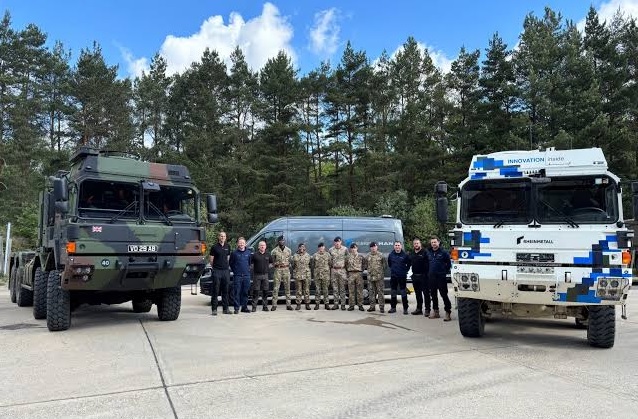
The training was held at the Combat Service Support Trials and Development Unit (CSS TDU) in Aldershot and involved personnel from 8 Squadron, 27 Regiment Royal Logistic Corps (RLC). The programme aimed to develop the skills needed to plan, manage, and operate autonomous supply vehicles, helping reduce the need to place personnel in high-risk environments while maintaining military logistics.
Two Weeks of Practical Training
The course was delivered by Rheinmetall specialists from the United Kingdom, Austria, and Canada. During the programme, soldiers trained in key roles including Convoy Commander, Lead Vehicle Driver, and Safety Driver.
The exercises progressed from basic vehicle operations to complex convoy missions on both roads and off-road terrain. Training scenarios included blocked routes, simulated disabled vehicles, and dynamic convoy management, reflecting conditions that could be encountered during future operations.
The programme concluded with British soldiers successfully operating the UK's first HX autonomous convoy.
HX2 "White Pony" Equipped with PATH Autonomous Kit
Training was conducted using Rheinmetall's HX2 development vehicle, known as "White Pony." The vehicle was equipped with the PATH Autonomous Kit (A-Kit), developed through the UK Advanced Land Autonomy Centre of Excellence (ALACoE).
The platform-agnostic PATH A-Kit can be integrated into existing military vehicle fleets, allowing conventional vehicles to operate autonomously. It combines advanced sensors, AI-enabled navigation, and robotic control software.
Unlike systems that rely entirely on satellite navigation, the PATH A-Kit uses LiDAR, cameras, and onboard sensors to map its surroundings in real time, allowing the vehicle to continue operating even in GPS-denied environments where signals are unavailable, jammed, or blocked.
Preparing for Project Convergence Capstone 6
The Aldershot training forms part of Project MAIA, the British Army's programme to evaluate autonomous systems for future logistics missions. The experience gained will support the Army's participation in Project Convergence Capstone 6 (PCC6), a multinational military exercise scheduled to take place at Fort Irwin, California.
The exercise will provide an opportunity to further assess how autonomous technologies can support military supply operations in realistic operational environments.
Rheinmetall on the Training
Christoph Müller, CEO of Rheinmetall MAN Military Vehicles, said:
"Autonomous technologies are transforming the future of military logistics. Through our collaboration with the UK Ministry of Defence and colleagues across Rheinmetall, we are helping British Army personnel develop the skills and confidence to operate next-generation autonomous capabilities."
He added that the milestone demonstrates the value of collaboration between industry and the military and said Rheinmetall looks forward to supporting the British Army during Project Convergence Capstone 6.
Broader Focus on Military Autonomy
The training reflects a wider effort to explore autonomous logistics across European armed forces. These systems are intended to improve supply operations while reducing the exposure of personnel to hazardous areas.
Rheinmetall recently demonstrated the capability of its autonomous logistics technology by securing first place in the "Convoy Scenarios" category at the 2026 European Land Robot Trial (ELROB) in Switzerland.
The successful completion of the UK's first HX autonomous convoy provides the British Army with practical experience as it continues evaluating autonomous logistics systems for future military operations.
Source : rheinmetall
——— End of Article ———