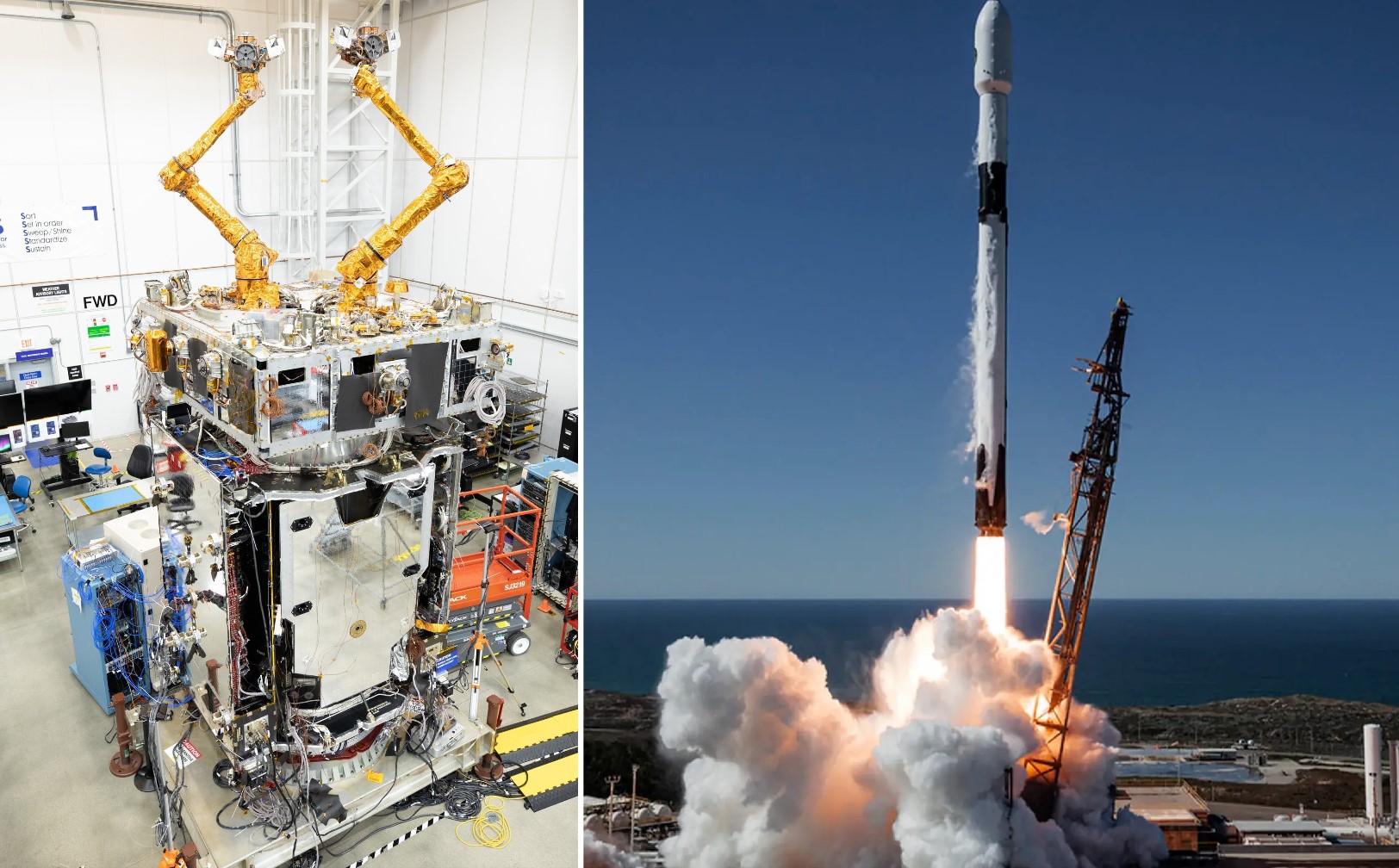
WASHINGTON, D.C. — Northrop Grumman's SpaceLogistics subsidiary is preparing to launch its Mission Robotic Vehicle (MRV) and three Mission Extension Pods (MEPs) aboard a SpaceX Falcon 9 rocket no earlier than 5:15 p.m. ET on Tuesday, July 21, 2026.
The mission will lift off from Space Launch Complex 40 (SLC-40) at Cape Canaveral Space Force Station, Florida. SpaceX has scheduled a four-hour launch window for the mission, with a backup launch opportunity available on Wednesday, July 22, at the same opening time if weather or technical conditions require a delay.
The Mission Robotic Vehicle (MRV) is being developed through a collaboration between Northrop Grumman's SpaceLogistics, the Defense Advanced Research Projects Agency (DARPA), and the U.S. Naval Research Laboratory (USNRL). It is designed as the nation's first privately owned multi-mission robotic spacecraft capable of servicing satellites already operating in space.
Robotic Servicing for Geosynchronous Satellites
The centerpiece of the spacecraft is the Robotic Servicing of Geosynchronous Satellites (RSGS) payload. The U.S. Naval Research Laboratory (USNRL) designed and built the spacecraft's two highly maneuverable robotic arms, while DARPA funded the development of the RSGS Integrated Robotic Payload.
Once the MRV reaches geosynchronous Earth orbit (GEO), approximately 22,236 miles (35,786 kilometers) above Earth, it will be able to perform a range of on-orbit servicing tasks. These include detailed satellite inspections, mechanical repairs, hardware upgrades, and resolving certain anomalies affecting commercial and government spacecraft.
Satellites operating in GEO have traditionally been difficult to service after launch. When they run out of fuel or experience minor mechanical issues, they are often retired even though many of their onboard systems remain operational. The MRV is intended to provide a new option by allowing these satellites to receive maintenance while remaining in orbit.
Mission Extension Pods to Increase Satellite Lifespan
In addition to the robotic servicer, the Falcon 9 will carry three Mission Extension Pods (MEPs), commonly described by project engineers as "satellite jetpacks."
After deployment from the launch vehicle, the MRV and each of the three MEPs will independently travel to geosynchronous orbit using onboard solar-electric propulsion systems. Once in position, the MRV will use its robotic arms to capture each Mission Extension Pod and attach it to client satellites that are running low on propellant.
The attached pods provide additional propulsion, allowing satellites to continue operating without relying solely on their original fuel supply. Each Mission Extension Pod is designed to support satellites weighing up to about 4,400 pounds (2,000 kilograms) and can extend their operational life by up to eight years.
Building on Previous Satellite Servicing Missions
The Mission Robotic Vehicle builds on Northrop Grumman's Mission Extension Vehicle (MEV) program, which demonstrated that servicing satellites in orbit is technically feasible. Unlike the MEV, the MRV adds robotic servicing capabilities that can support inspection, maintenance, repairs, and hardware upgrades in addition to mission extension.
The spacecraft is also refuelable and includes available data and power interfaces that can support future payloads, providing additional flexibility for future in-space servicing missions.
Before launch, the robotic arms underwent extensive testing, including operations inside a cryogenic thermal vacuum chamber, to verify their performance under the extreme temperatures and vacuum conditions found in space.
Launch Configuration
Because the mission requires placing a heavy payload on a trajectory toward geosynchronous transfer orbit, the Falcon 9 will fly in an expendable configuration, meaning the first-stage booster will not attempt a landing after launch. According to mission officials, this will be the 32nd and final flight for the booster supporting the mission.
The MRV mission is expected to demonstrate new capabilities for on-orbit satellite servicing and life extension, supporting commercial, civil, and national security spacecraft while reducing the need to replace satellites that remain functional but have exhausted their onboard propellant or require limited maintenance. Mission updates, including any changes to the launch schedule, are expected as final preparations continue ahead of the July 21 launch.
Source : Northrop Grumman
——— End of Article ———