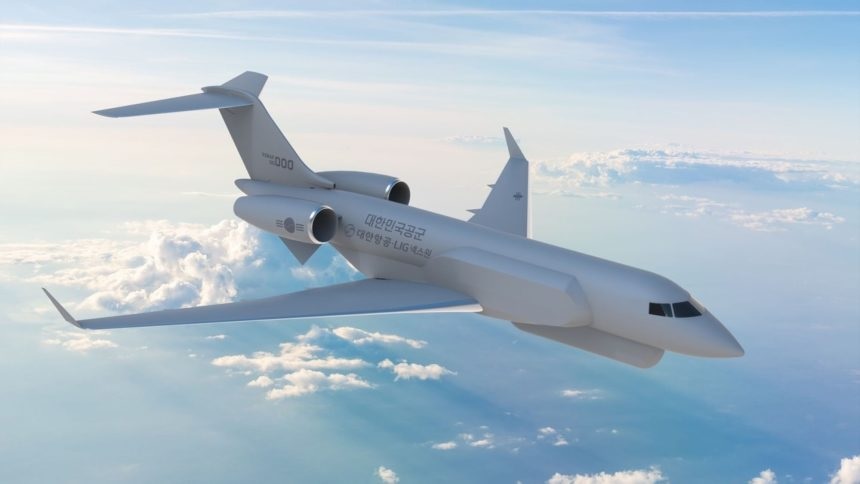
Seoul, South Korea — South Korea is expanding its airborne electronic warfare capabilities with the procurement of two Bombardier Global 6500 aircraft that will be converted into dedicated electronic warfare platforms for the Republic of Korea Air Force (ROKAF).
Bombardier Defense announced on July 14, 2026, that Korean Air has formalized the purchase of the Canadian-built business jets. The aircraft will be extensively modified to carry advanced electronic warfare systems for Stand-Off Jammer (SOJ) missions, allowing them to disrupt enemy radar, communications, and other electromagnetic systems while operating outside hostile airspace.
Part of South Korea's Block-I Electronic Warfare Program
The acquisition is a key element of South Korea's Defense Acquisition Program Administration (DAPA) Block-I Electronic Warfare System Development Project, which aims to introduce the new electronic warfare aircraft into service by 2034.
In wartime operations, the aircraft will support air missions by suppressing or disrupting adversary air-defense networks, creating safer operating conditions for friendly aircraft entering defended airspace.
South Korean defense company LIG Nex1 is serving as the program's prime contractor and system integrator under a contract worth approximately 1.56 trillion won (about $1.1 billion). The company will develop and integrate the aircraft's specialized electronic warfare mission systems, including high-performance antennas capable of transmitting powerful radio-frequency jamming signals.
According to program details, the jamming systems are expected to provide an operational range of at least 200 kilometers (124 miles), allowing coverage across the Korean Peninsula during missions.
Korean Air will carry out the structural modifications to the Global 6500 aircraft and oversee the installation of LIG Nex1's mission equipment before delivery to the Republic of Korea Air Force.
Selection Followed Competitive Evaluation
The Global 6500 was selected after a competitive bidding process. The Bombardier Defense team, working with Korean Air and LIG Nex1, was chosen over a competing proposal submitted by Korea Aerospace Industries (KAI) and Hanwha Systems.
Following the selection, Korean Air became responsible for purchasing the aircraft from Bombardier and managing their conversion into operational electronic warfare platforms.
Global 6500 Selected for Special Mission Operations
Bombardier Defense says the Global 6500 is well suited for military special mission roles because of its combination of range, endurance, speed, and operating altitude.
The aircraft can fly above normal commercial airline traffic while maintaining high cruising speeds and an endurance exceeding 10 hours, making it suitable for long-duration electronic warfare operations.
Its airframe is also designed to accommodate major structural modifications required for installing large mission systems, external sensors, antennas, and specialized electronic equipment.
Michael Anckner, Vice-President of Worldwide Sales at Bombardier Defense, said:
"The Global 6500 aircraft is in demand around the world because of its performance and versatility, and we're extremely proud that it was chosen for two very advanced, yet different defense missions in South Korea."
He added that the aircraft's structure is highly adaptable for integrating advanced external sensors required for specialized military missions.
Beyond electronic warfare, the Global 6500 family has been adapted for a range of defense roles, including airborne early warning and control (AEW&C), intelligence, surveillance and reconnaissance (ISR), multi-role special missions, medical evacuation, and head-of-state transport. The aircraft platform has also been used as the basis for systems such as Saab's GlobalEye airborne surveillance aircraft.
Common Platform with AEW&C Fleet
The latest procurement builds on South Korea's earlier decision to select the Global 6500 for its Airborne Early Warning & Control (AEW&C) program in October 2025.
That separate program involves four Global 6500 aircraft being modified by an international team led by L3Harris Technologies, with participation from Israel Aerospace Industries (IAI) ELTA Systems, Bombardier, and Korean Air.
With both the AEW&C and electronic warfare programs using the same aircraft platform, the Republic of Korea Air Force is expected to benefit from greater fleet commonality. Operating a common airframe can simplify pilot training, maintenance training, reduce logistical requirements, and improve long-term sustainment compared with maintaining different aircraft types for separate missions.
Expanding South Korea's Airborne Electronic Warfare Capability
The addition of the two Global 6500 electronic warfare aircraft represents another step in South Korea's broader military modernization efforts.
Once operational, the aircraft will provide the Republic of Korea Air Force with dedicated stand-off electronic attack capabilities designed to disrupt enemy radar and communication networks while remaining outside heavily defended airspace. Combined with the upcoming AEW&C fleet based on the same platform, the Global 6500 will become an important part of South Korea's growing special mission aircraft capability.
Further details regarding the modification schedule and delivery timeline have not been publicly released, although the Block-I Electronic Warfare Project is expected to field the aircraft by 2034.
Source : bombardier
——— End of Article ———