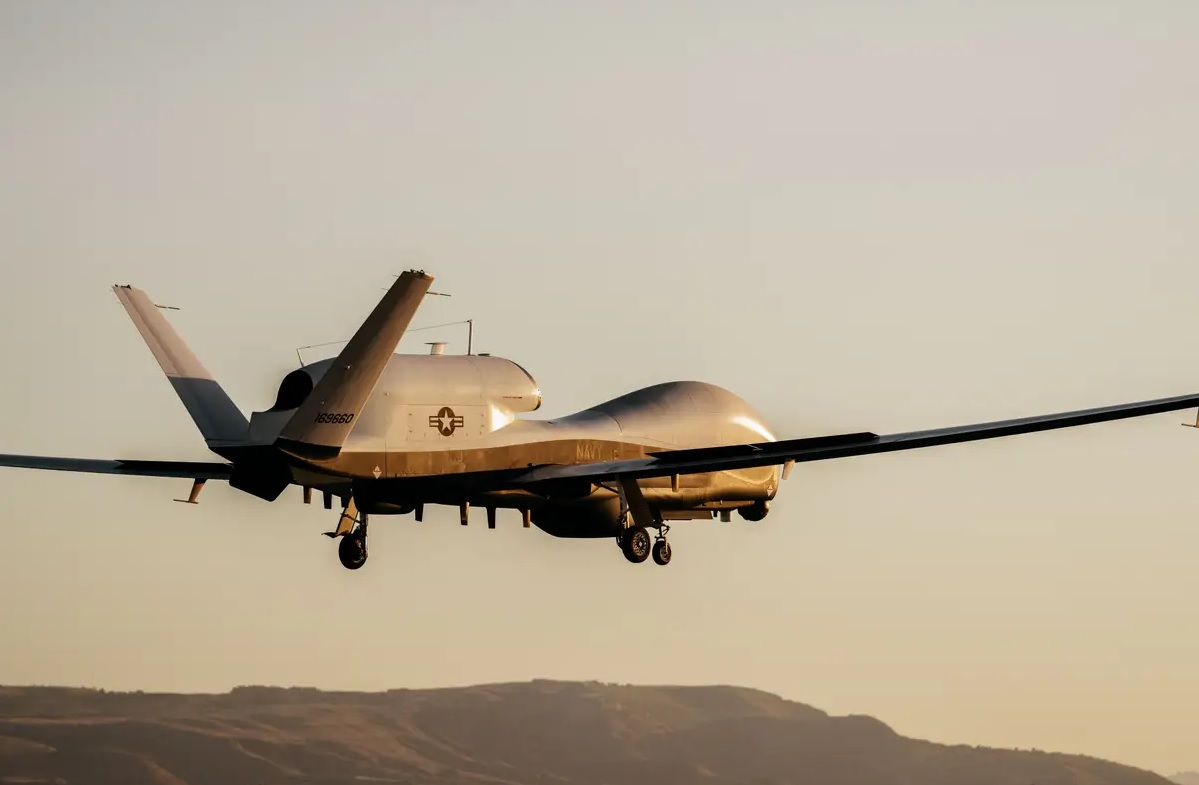
WASHINGTON — April 30, 2026 : A United States Navy MQ-4C Triton unmanned aerial vehicle sustained damage while operating over the Persian Gulf on April 27, 2026, but completed its assigned mission and landed safely without injuries, according to information released by the Naval Safety Command.
The incident involved airframe 169661, operating under the callsign OVRLD01 from Muwaffaq Salti Air Base in Jordan. During the flight, the aircraft experienced unspecified damage classified by the Navy as a “damaged-in-flight” occurrence. Despite the issue, the drone maintained sufficient operational capability to return to base without further incident. The Navy has not disclosed the precise location of the event, citing operational security, and no official cause has been identified.
Operational Context and Mission Details
Available flight data and operational reporting indicate the aircraft was conducting a standard maritime intelligence, surveillance, and reconnaissance (ISR) mission over the Persian Gulf. The MQ-4C Triton platform is routinely deployed in the region to monitor shipping lanes, maritime traffic, and broader security activity, including operations near the Strait of Hormuz.
The April 27 aircraft had been deployed as a replacement asset following the earlier loss of another Triton in the same region earlier in the month. No indications of external involvement or hostile action have been publicly confirmed in connection with the damage event.
Earlier April 9 Triton Crash
The April 27 incident occurred less than three weeks after a separate MQ-4C Triton, identified as airframe 169804, was lost on April 9, 2026, during operations over the Persian Gulf and the Strait of Hormuz. That event was classified as a Class A mishap by the Naval Safety Command, a designation used for incidents involving total aircraft loss or damage exceeding $2.5 million.
Open-source flight tracking data showed the April 9 aircraft transmitting transponder code 7400 (indicating a loss of communication) followed by code 7700 (signaling a general in-flight emergency). The drone descended rapidly from its normal operating altitude above 50,000 feet to below 10,000 feet before disappearing from tracking systems.
The Navy confirmed the crash on April 14 through its official mishap summary but did not release the exact crash location. The aircraft had been operating as part of missions flown from Naval Air Station Sigonella in Italy by Unmanned Patrol Squadron 19. No personnel were injured in that incident.
Analysts reviewing the April 9 event have considered multiple possible causes, including mechanical failure, mission system malfunction, and electronic warfare effects such as GPS interference or satellite communication disruption. No official findings have been released, and no confirmation of hostile engagement has been provided by U.S. Central Command.
Platform Capabilities and Fleet Overview
The MQ-4C Triton is a high-altitude, long-endurance unmanned aircraft developed by Northrop Grumman for maritime surveillance operations. It is derived from the RQ-4 Global Hawk and is optimized for persistent intelligence gathering over ocean regions.
The aircraft features a wingspan of approximately 130 feet 11 inches and a length of 47 feet 7 inches. It is capable of operating at altitudes above 50,000 feet for more than 24 hours. Its sensor suite includes a 360-degree Multi-Function Active Sensor (MFAS) radar, electro-optical and infrared systems, electronic support measures, and automatic identification system (AIS) capabilities, allowing it to track vessels and maritime patterns across large areas.
The Triton is typically operated by a four-person ground control crew and is designed to complement manned maritime patrol aircraft such as the P-8A Poseidon. Unit costs are estimated between $230 million and $240 million per aircraft. The U.S. Navy currently operates approximately 20 airframes, with earlier plans to expand the fleet to 27.
Ongoing Investigations
Both the April 9 crash and the April 27 damage incident occurred within the U.S. Central Command area of responsibility, where persistent aerial surveillance operations are routinely conducted. These incidents represent the first reported operational loss and damage events involving the MQ-4C Triton fleet during active service.
The Naval Safety Command continues to investigate both events under standard mishap protocols. The April 9 crash has been listed among seven Class A aviation mishaps recorded for the fiscal year to date. The Navy has not attributed either incident to mechanical failure, environmental conditions, or external interference, and no final determinations have been announced.
The April 27 aircraft remains accounted for following its safe recovery, while the earlier loss and subsequent reduction in available airframes represent a measurable impact on deployed maritime surveillance capacity in the region.
——— End of Article ———