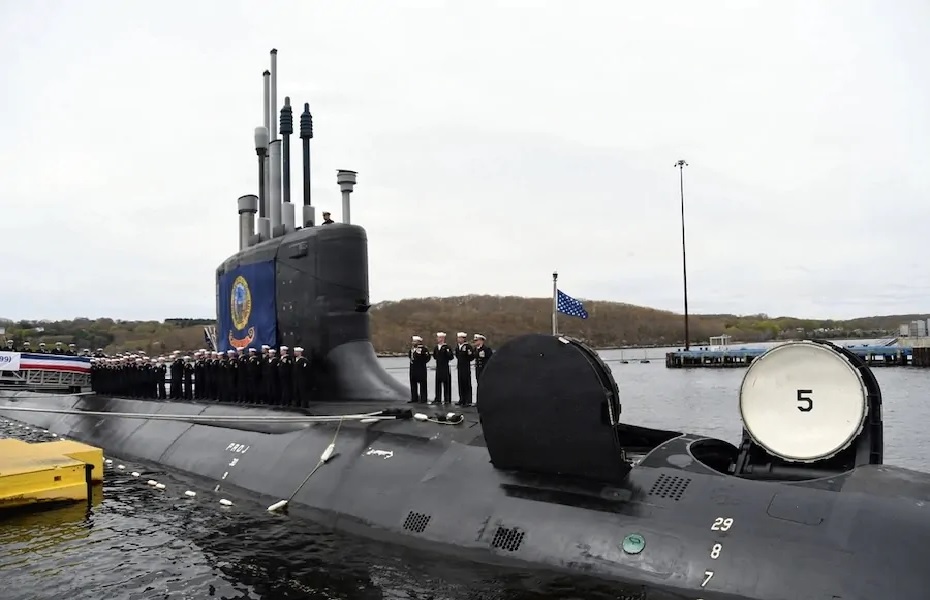
GROTON, Connecticut — April 26, 2026 : The United States Navy commissioned the Virginia-class fast-attack submarine USS Idaho (SSN 799) into active service during a formal ceremony held at Naval Submarine Base New London. The event marked the submarine’s official entry into operational status as the 26th vessel in the Virginia-class program and the eighth constructed under the Block IV configuration.
Commissioning Ceremony and Leadership Remarks
The ceremony featured remarks from several senior officials and political leaders. U.S. Senator James Risch delivered the keynote address. Acting Secretary of the Navy Hung Cao emphasized the strategic importance of maintaining secure maritime routes, stating that U.S. naval forces remain focused on ensuring safe sea lines of communication under current national defense priorities.
Additional speakers included Idaho Governor Brad Little, U.S. Senator Richard Blumenthal, Representatives Joe Courtney and Michael Simpson, and Admiral William Houston. Mark Rayha, president of General Dynamics Electric Boat, also addressed attendees.
The submarine’s sponsor, Teresa Stackley, issued the traditional order to “man our ship and bring her to life,” prompting the crew to board the vessel in a ceremonial activation.
Commanding Officer Cmdr. Chad J. Guillerault noted the historical continuity associated with the vessel’s name and acknowledged the contributions of the crew, which includes Executive Officer Lt. Cmdr. John Whitaker, 15 officers, and approximately 120 enlisted sailors.
Construction Timeline and Industrial Partnership
USS Idaho was built through a long-standing teaming agreement between General Dynamics Electric Boat and HII Newport News Shipbuilding. Construction began with the keel laying on August 24, 2020, at the Quonset Point facility in Rhode Island.
The submarine was christened on March 16, 2024, at the Electric Boat shipyard in Groton. Following construction, the vessel underwent alpha sea trials in November 2025 and was formally delivered to the Navy on December 15, 2025. The total program cost for the submarine is estimated at approximately $2.6 billion.
Historical Lineage of the Name “Idaho”
The SSN 799 is the fifth U.S. Navy vessel to carry the name Idaho. Its most recent predecessor, USS Idaho (BB-42), was a New Mexico-class battleship commissioned in 1919. That vessel earned seven battle stars for service during World War II, including operations at the Battle of Iwo Jima and the Battle of Okinawa.
Technical Specifications and Capabilities
USS Idaho incorporates the Block IV design, which focuses on reducing maintenance intervals and increasing deployment availability. The submarine displaces approximately 7,800 tons and measures 377 feet in length, with a 34-foot beam and a 32-foot draft.
The vessel is powered by an S9G nuclear reactor, designed to operate for the full service life of the submarine without refueling, supplemented by an auxiliary diesel engine. It can achieve submerged speeds exceeding 25 knots and sustain underwater operations for extended durations, typically up to three months depending on mission requirements.
Its armament includes two Virginia Payload Tubes capable of launching a combined total of 12 Tomahawk land-attack cruise missiles, along with four 21-inch torpedo tubes for Mk-48 Advanced Capability torpedoes. The submarine also features advanced acoustic stealth systems, some of which were developed and tested at the Navy’s Acoustic Research Detachment in Bayview, Idaho, located on Lake Pend Oreille.
The platform is equipped for a range of missions, including anti-submarine warfare, anti-surface warfare, intelligence collection, surveillance, reconnaissance, and special operations support.
Operational Assignment and Program Context
USS Idaho will be assigned to Submarine Squadron Four and homeported in Groton, Connecticut. The commissioning completes a multi-year process involving design, construction, testing, and delivery, and represents the 14th Virginia-class submarine delivered by General Dynamics Electric Boat.
Block IV submarines are designed to reduce the number of major maintenance periods over their lifecycle, allowing for more deployments compared to earlier variants. This design approach supports the Navy’s broader objective of maintaining consistent undersea presence and operational readiness.
The commissioning ceremony also included a musical performance by students and faculty from the University of Idaho’s Lionel Hampton School of Music, with additional watch events held across Idaho to coincide with the ceremony.
No further details regarding future deployment schedules or mission assignments were disclosed during the event.
——— End of Article ———