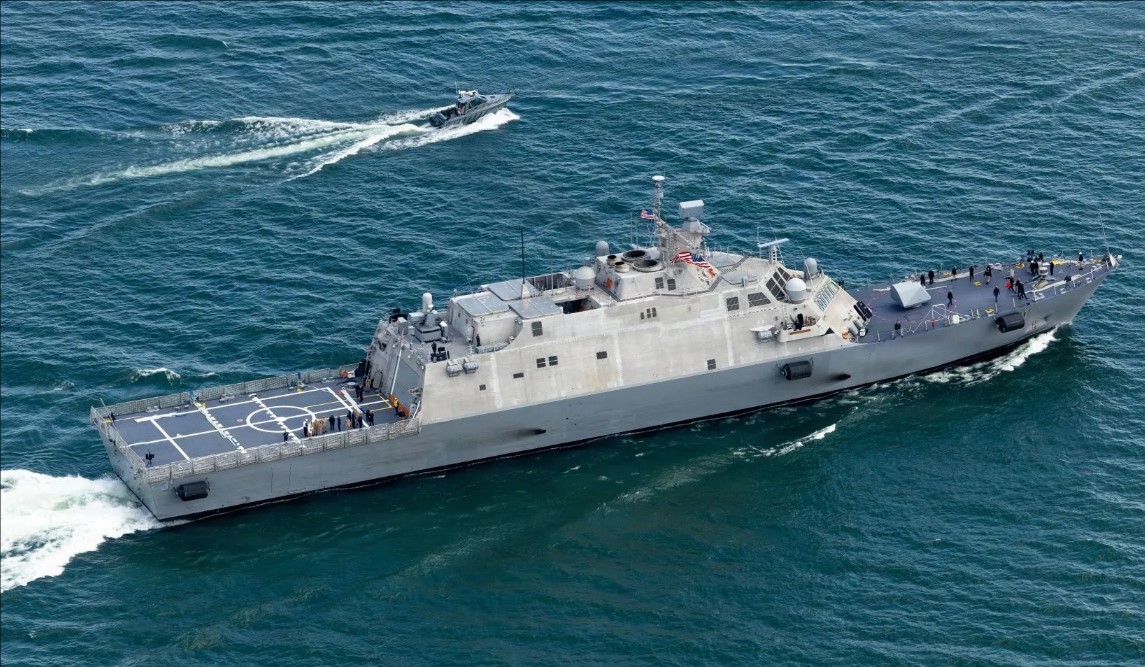
CLEVELAND, Ohio — May 17, 2026 : The U.S. Navy officially commissioned USS Cleveland (LCS 31), the 16th and final Freedom-variant littoral combat ship, during a ceremony held May 16 at the North Coast Yard in Cleveland, Ohio, marking the completion of the Freedom-class Littoral Combat Ship production program.
The event also marked the first time in the U.S. Navy’s 250-year history that a warship has been commissioned within the state of Ohio.
Acting Secretary of the Navy Hung Cao delivered the principal address and formally placed the ship into active service by hoisting the commissioning pennant and national colors. During the ceremony, Cao emphasized the role of the crew in bringing the vessel into operational service.
“Today we celebrate the sailors who breathe life into this ship. To the officers and crew of USS Cleveland, today is your day,” Cao said.
The ship’s sponsor, Robyn Modly, a Cleveland native and wife of former Acting Secretary of the Navy Thomas Modly, delivered the traditional order to the crew to “man our ship and bring her to life,” prompting sailors to ceremonially board the vessel.
In the week leading up to the commissioning, the crew participated in public tours, community engagements, and local events alongside the sponsor to strengthen ties with the ship’s namesake city. USS Cleveland arrived in the city on May 9 ahead of the ceremony.
Built by Lockheed Martin in partnership with Fincantieri Marinette Marine at the Marinette, Wisconsin, shipyard, USS Cleveland was launched on April 15, 2023, and delivered to the Navy on Nov. 26, 2025. Following commissioning, the ship will transit to its assigned homeport at Naval Station Mayport, Florida.
USS Cleveland is the fourth U.S. Navy vessel named after Ohio’s second-largest city. Previous ships carrying the name include the protected cruiser USS Cleveland (C-19), commissioned in 1903 and later serving during World War I; the Cleveland-class light cruiser USS Cleveland (CL-55), which earned 13 battle stars during World War II; and the Austin-class amphibious transport dock USS Cleveland (LPD 7), which served from 1967 to 2011 and participated in operations including the Vietnam War, Operation Desert Storm, and humanitarian missions.
The Freedom-variant Littoral Combat Ship was designed as a fast, mission-focused surface combatant optimized for operations in near-shore and contested maritime environments. The class features a steel monohull design and can operate independently or alongside larger multi-mission surface combatants such as cruisers and destroyers.
USS Cleveland measures approximately 388 feet (118 meters) in length with a beam of 58 feet (18 meters) and a full-load displacement of around 3,500 metric tons. Powered by a combined diesel and gas turbine propulsion system driving four waterjets, the ship can exceed 40 knots and reportedly reach a top speed of approximately 47 knots.
The vessel has an operational range of approximately 3,500 nautical miles at 18 knots and an endurance of up to 21 days. Its core crew consists of about 50 sailors, including nine officers and 41 enlisted personnel, with accommodations available for nearly 100 personnel depending on mission requirements.
USS Cleveland is equipped with a flight deck and hangar capable of supporting two MH-60 helicopters or one MH-60 Seahawk helicopter alongside one MQ-8 Fire Scout unmanned aerial vehicle. Armament includes the BAE Systems Mk 110 57 mm naval gun, a Rolling Airframe Missile launcher for close-range air defense, and .50-caliber machine guns.
Like other Littoral Combat Ships, USS Cleveland can be configured with interchangeable mission packages tailored for surface warfare, mine countermeasures, or anti-submarine warfare operations.
The commissioning of USS Cleveland marks the conclusion of the Freedom-variant construction program as the Navy continues efforts to modernize its surface fleet and sustain forward-deployed naval operations. Commander, Naval Surface Force, U.S. Pacific Fleet remains responsible for manning, training, and equipping the Surface Force to provide fleet commanders with operational naval capabilities worldwide.
The commissioning ceremony was livestreamed through the Defense Visual Information Distribution Service and included remarks from Cleveland Mayor Justin Bibb and the ship’s commanding officer, Cmdr. Bruce.
——— End of Article ———