WASHINGTON — April 25, 2026 : The U.S. Navy has awarded California-based defense startup Castelion a $105 million contract to integrate its Blackbeard hypersonic strike weapon onto the Navy’s carrier-based F/A-18E/F Super Hornet fleet, advancing the system toward Early Operational Capability (EOC) by 2027. The award reflects an accelerated effort to field air-launched hypersonic weapons within existing carrier air wings.
Integration and Certification Scope
The contract funds both hardware and software integration of the Blackbeard missile with the F/A-18 platform. Work includes a full series of flight tests, system validation, and the safety and airworthiness certification processes required before a new munition can be cleared for storage, handling, and carriage aboard aircraft carriers.
These activities represent the final phase before a production decision, allowing the Navy to evaluate operational readiness of the system within deployed squadrons. The effort builds on an earlier $49.998 million firm-fixed-price contract issued on February 25, 2026, under the Multi-mission Affordable Capacity Effector (MACE) program, which supported prototype development, testing, and initial fielding preparations.
Work under both contracts is being conducted primarily in Torrance, California, with completion scheduled for November 2027.
System Role and Design Characteristics
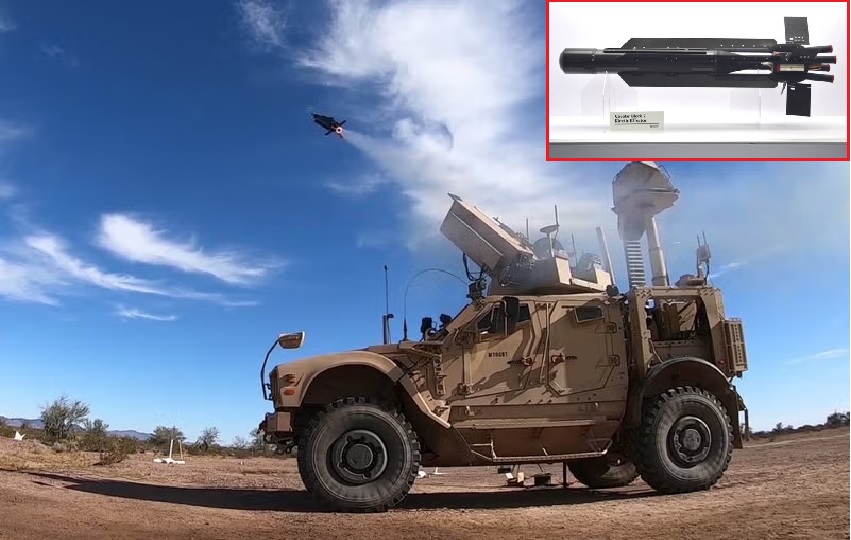
Blackbeard is Castelion’s first long-range hypersonic strike weapon, designed to engage time-sensitive and hardened naval or land-based targets. The missile is engineered to exceed five times the speed of sound and carries a 95-pound warhead.
The system has been selected as the primary munition for the Navy’s MACE program, which emphasizes affordable, scalable weapons procurement to maintain sufficient magazine depth during sustained operations. The program prioritizes reducing per-unit cost while maintaining operational effectiveness.
According to Pentagon budget documents, the projected average unit cost of a Blackbeard missile is approximately $384,000. This is significantly lower than legacy systems such as the AGM-158C Long Range Anti-Ship Missile (LRASM), which can exceed $3 million per unit.
Castelion’s approach relies on automotive-grade electronics and vertically integrated propulsion and guidance subsystems, reducing reliance on space-rated components and shortening manufacturing lead times compared with traditional missile programs.
Platform Integration and Future Compatibility
The F/A-18E/F Super Hornet serves as the threshold integration platform under the current contract. Future MACE requirements include potential compatibility with the F-35A Lightning II and F-35C Lightning II, with provisions for internal carriage of up to four all-up rounds.
The integration enables carrier-based aircraft to deploy hypersonic weapons without reliance on land-based launch systems, expanding operational flexibility for naval forces. Hypersonic glide vehicles and similar systems are characterized by high speed and maneuverability, making them difficult to intercept using existing air defense systems.
Industrial Expansion and Production Plans
To support anticipated demand, Castelion is scaling its manufacturing capacity through “Project Ranger,” a 1,000-acre production facility under development in Sandoval County, New Mexico. The project is backed by approximately $250 million in private investment and is intended to produce thousands of hypersonic missiles annually once operational.
The Navy’s Fiscal Year 2027 budget request outlines an initial procurement of 353 all-up rounds, funded at $156 million. Over a five-year period, the service plans to acquire approximately 4,500 air-launched hypersonic missiles, positioning Blackbeard as a high-volume strike option within naval aviation inventories.
Program Context
Castelion, founded in 2022, has conducted multiple developmental tests of the Blackbeard system, including ground-launched variants evaluated for potential U.S. Army applications. The company’s development model emphasizes rapid iteration and cost control through commercial manufacturing practices.
A statement issued alongside the contract award noted that the Navy’s approach reflects a focus on “fielding affordable, innovative hypersonic capability” with an emphasis on speed of deployment.
The current integration effort is expected to determine the timeline for broader operational deployment and large-scale production decisions as the Navy advances its hypersonic weapons portfolio.
——— End of Article ———