WASHINGTON — May 13, 2026 : The U.S. Navy is accelerating procurement of its Medium Unmanned Surface Vessel (MUSV) program under a long-term strategy aimed at expanding distributed naval operations and strengthening force presence in the Indo-Pacific region amid growing maritime competition with China.
According to the Navy’s May 2026 Shipbuilding Plan, the service has allocated $171 million in Fiscal Year 2027 for the procurement of three MUSVs, while planning a broader acquisition effort valued at $3.11 billion through FY31. The procurement program will add 47 new unmanned surface vessels during the Future Years Defense Program period following FY26.
The latest shipbuilding plan formally places the MUSV alongside traditional battle force and auxiliary ships for the first time, reflecting the Navy’s assessment that the platform has progressed beyond the experimental phase and is now suitable for operational fleet integration.
Procurement Timeline and Fleet Expansion
The Navy’s acquisition schedule outlines a rapid increase in procurement over the next several fiscal years. Current planning includes:
- FY26: 36 MUSVs funded through the One Big Beautiful Bill Act
- FY27: 3 vessels
- FY28: 10 vessels
- FY29: 10 vessels
- FY30: 12 vessels
- FY31: 12 vessels
Under the projected inventory plan, the Navy expects the MUSV fleet to expand from 39 vessels in FY27 to 49 in FY28, 59 in FY29, 71 in FY30, 83 in FY31, and 95 vessels by FY32 before stabilizing at an estimated long-term operational inventory of approximately 72 vessels following initial retirement cycles.
Unlike traditional warship procurement, the MUSV program is funded through the “Other Procurement, Navy” account rather than standard shipbuilding accounts. The budget structure reflects an acquisition strategy focused on rapid procurement, shorter upgrade cycles, iterative development, and faster integration of emerging technologies.
Modular Payload Architecture
The MUSV is being developed around a modular and containerized payload system intended to support multiple mission profiles without requiring permanent ship redesigns.
Planned mission packages include:
- Anti-Submarine Warfare (ASW) sensors and effectors
- Anti-Surface Warfare (ASuW) systems
- Missile strike modules
- C4I command-and-control systems
- Electronic warfare payloads
- Communications relay systems
- Distributed sensing and surveillance packages
The Navy intends for the same payload containers to be compatible across several vessel classes, including frigates, Littoral Combat Ships (LCS), and MUSVs. Standardized interfaces for power, cooling, and data integration are intended to allow naval commanders to rapidly configure force packages based on operational requirements.
Officials say the concept will enable a single frigate or Littoral Combat Ship to control multiple unmanned vessels equipped with different mission modules during forward deployments.
Operational Role in Distributed Maritime Operations
The MUSV program forms part of the Navy’s broader Distributed Maritime Operations doctrine, which emphasizes dispersing combat capability across a larger number of platforms rather than concentrating capabilities on a limited number of crewed warships.
Under this concept, MUSVs can operate ahead of carrier strike groups or expeditionary strike groups as:
- Radar pickets
- Acoustic surveillance nodes
- Electronic emitters
- Decoys
- Communications relays
- Armed extensions of crewed surface combatants
In contested environments, the vessels are expected to support reconnaissance and sensing missions without immediately exposing destroyers, amphibious assault ships, or other high-value crewed platforms to risk.
Navy planners also view the MUSV as a method of increasing operational pressure on adversaries by forcing them to identify, track, and potentially engage a larger number of distributed autonomous platforms across wide maritime areas.
Origins of the MUSV Program
The Navy’s unmanned surface vessel development effort is based on several years of operational testing and prototype development.
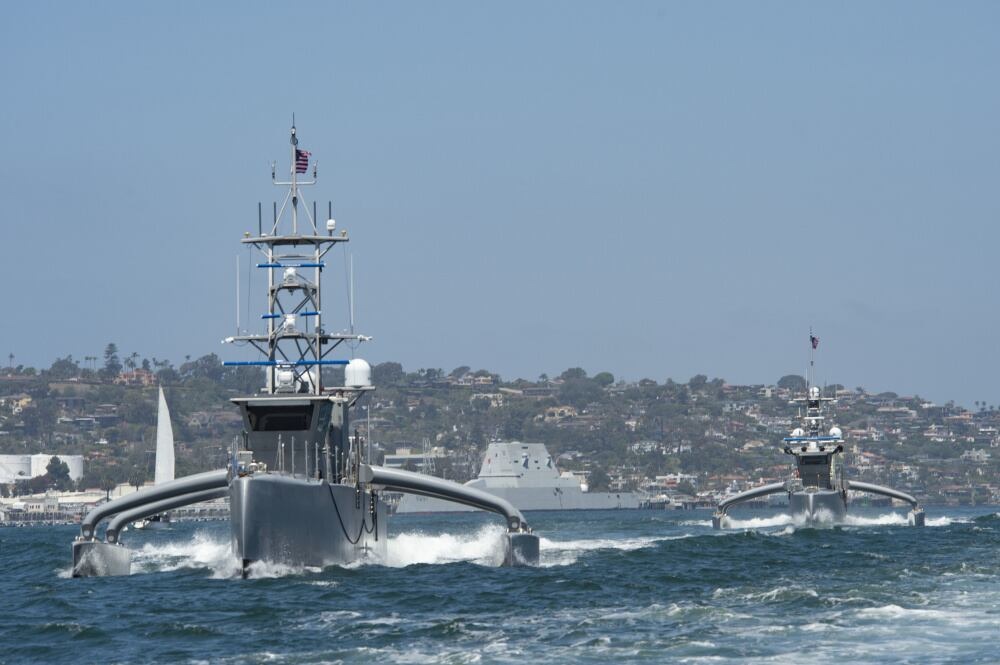
The earliest operational prototypes were the Sea Hunter and Seahawk autonomous vessels originally developed through DARPA’s Anti-Submarine Warfare Continuous Trail Unmanned Vessel (ACTUV) program in partnership with the Office of Naval Research.
Built by Leidos, the vessels measure approximately 41 meters in length and displace around 142 metric tons at full load. Both are based in San Diego and have participated in exercises including Integrated Battle Problem 23.1, Integrated Battle Problem 23.2, and RIMPAC 2022, where they operated as distributed maritime sensing platforms in support of anti-submarine warfare and maritime domain awareness missions.
A separate acquisition effort began in July 2020 when Naval Sea Systems Command awarded L3Harris Technologies a contract valued at approximately $35 million for a new MUSV prototype. Contract options could raise the total value to more than $281 million for up to eight additional vessels.
The prototype design used a commercially derived 195-foot hull developed by Gibbs & Cox and Incat Crowther, constructed by Swiftships, and integrated with L3Harris’ ASView autonomous navigation system. Program requirements focused on endurance, modularity, self-deployment capability, autonomous navigation, and open-architecture mission integration.
Acquisition Strategy and Industrial Base Expansion
The Navy is pursuing the MUSV through an acquisition strategy using Other Transaction Authority (OTA) agreements and a marketplace-based procurement model for the MUSV Family of Systems program.
The approach is intended to accelerate prototyping and operational testing while allowing participation from smaller shipbuilders and non-traditional defense contractors alongside established naval industry firms.
According to Navy planning documents, the service intends to evaluate commercially mature technologies capable of operational testing by September 2026, with potential production deliveries beginning in FY27.
The MUSV expansion is also linked to the Navy’s broader Golden Fleet Initiative and its long-term 30-year shipbuilding strategy focused on increasing fleet size, expanding operational flexibility, and strengthening the U.S. maritime industrial base.
The Department of the Navy’s FY27 budget request includes approximately $65.8 billion allocated for shipbuilding and related maritime programs.
——— End of Article ———