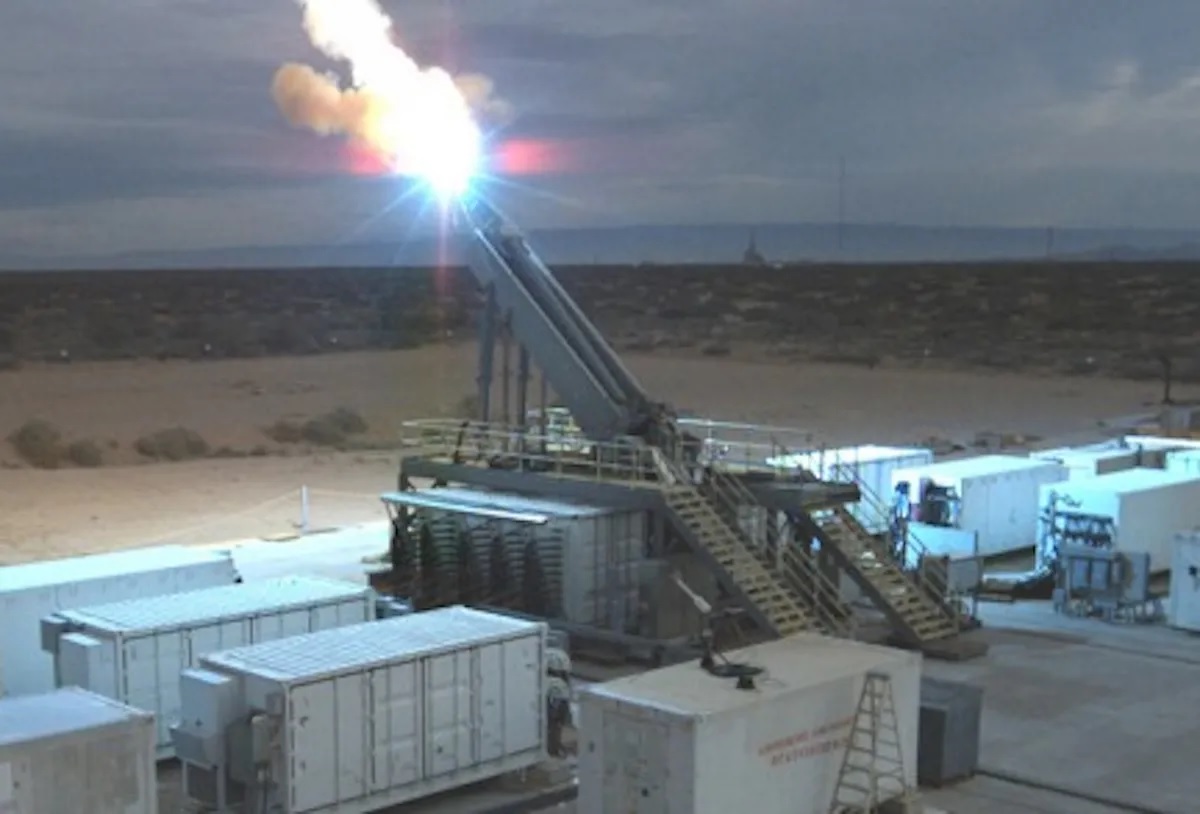
WASHINGTON — June 02, 2026 : Supply chain constraints affecting missile interceptor production are increasing U.S. interest in alternative missile defense technologies that could reduce dependence on traditional rocket-powered systems.
Recent operational demands following the Iran conflict exposed pressure on American interceptor stockpiles. According to an analysis by the Center for Strategic and International Studies (CSIS), the U.S. military fired more than 1,000 Patriot interceptor missiles during operations linked to the conflict but received only 172 replacement units. The resulting shortfall is expected to continue until at least 2029, highlighting concerns about interceptor sustainability.
A key challenge in replenishment efforts lies in missile propulsion production. Current air defense interceptors, including the Patriot PAC-3 and Terminal High Altitude Area Defense (THAAD), rely on solid rocket motors powered by ammonium perchlorate, a chemical oxidizer used in missile propellant.
The United States currently depends on a single domestic producer of ammonium perchlorate, creating a supply chain bottleneck that limits rapid interceptor production. As a result, increasing manufacturing output remains difficult even with additional government funding or rising military demand.
To address this issue, defense planners and private contractors are examining alternative launch methods that reduce reliance on chemical propulsion. Among the companies developing such technology is California-based startup Auriga Space, founded in 2022 by former SpinLaunch vice president Winnie Lai.
How Auriga’s Electromagnetic Launch System Works
Auriga is developing a linear electromagnetic accelerator designed to launch missile interceptors without relying on conventional rocket propulsion during the initial launch phase.
Instead of generating thrust through chemical combustion, the system uses magnetic fields to levitate and accelerate a projectile along a launch track. Electricity stored in industrial batteries or capacitors is discharged rapidly to propel the interceptor to hypersonic speed.
Once the required velocity and altitude are achieved, the payload separates from the launcher. For missile defense applications, the interceptor continues toward its target using the kinetic energy generated during launch. In space-related missions, a secondary motor can activate after separation to support ascent requirements.
The system draws on concepts similar to magnetic levitation transport, electromagnetic launch catapults, and railgun research, while replacing expendable propulsion hardware with reusable electrical infrastructure.
Potential Operational and Cost Benefits
Auriga’s concept could introduce operational and economic advantages for missile defense systems.
A Patriot PAC-3 interceptor costs approximately $4 million per round, and each launch consumes the propulsion system, guidance seeker, and warhead. This cost structure becomes increasingly difficult when intercepting lower-cost threats such as drones or one-way attack unmanned systems.
Because the electromagnetic launcher itself is reusable, interception costs could be reduced by limiting expendable components primarily to payload systems, including guidance and warheads.
The removal of chemical propellants may also improve storage safety and increase inventory capacity by allowing military units to maintain larger interceptor stocks without storing volatile rocket fuel. In addition, the system is intended to support repeated high-frequency launches during swarm attacks or saturation strike scenarios.
Auriga is also developing the launcher to fit inside standard shipping containers, enabling deployment aboard naval vessels, at forward operating bases, or across distributed missile-defense networks without requiring permanent infrastructure.
Development Roadmap and Defense Support
Auriga is advancing the technology through a phased development program.
The first stage, Prometheus, is a laboratory-scale accelerator designed for ballistic testing and recoverable hypersonic subsystem validation. The second stage, Thor, is a full-scale outdoor track scheduled to begin hypersonic field testing later in 2026 under operational conditions.
The company’s long-term objective is Zeus, a proposed orbital launch complex aimed at supporting commercial and defense-related space launch requirements.
The technology has received early support from U.S. defense agencies. The Missile Defense Agency (MDA) awarded Auriga a Phase I Small Business Technology Transfer (STTR) contract, supported by researchers from Purdue University and Texas A&M University, to study electromagnetic accelerator applications for missile defense.
Separately, the Air Force Research Laboratory’s AFWERX program granted the company a $1.25 million Direct-to-Phase II Small Business Innovation Research (SBIR) contract to support development of the Prometheus system.
Auriga has raised approximately $12.2 million through venture capital investment and government grants. Funding was led by OTB Ventures, with participation from Seraphim Space, Trucks Venture Capital, and Automotive Ventures.
The company’s advisory board includes retired Army Lieutenant General Neil Thurgood, former Director of Hypersonics. In March 2026, Auriga also signed a Memorandum of Understanding with the University of North Dakota to jointly advance research in hypersonics, counter-unmanned aerial systems (counter-UAS), and space applications.
——— End of Article ———