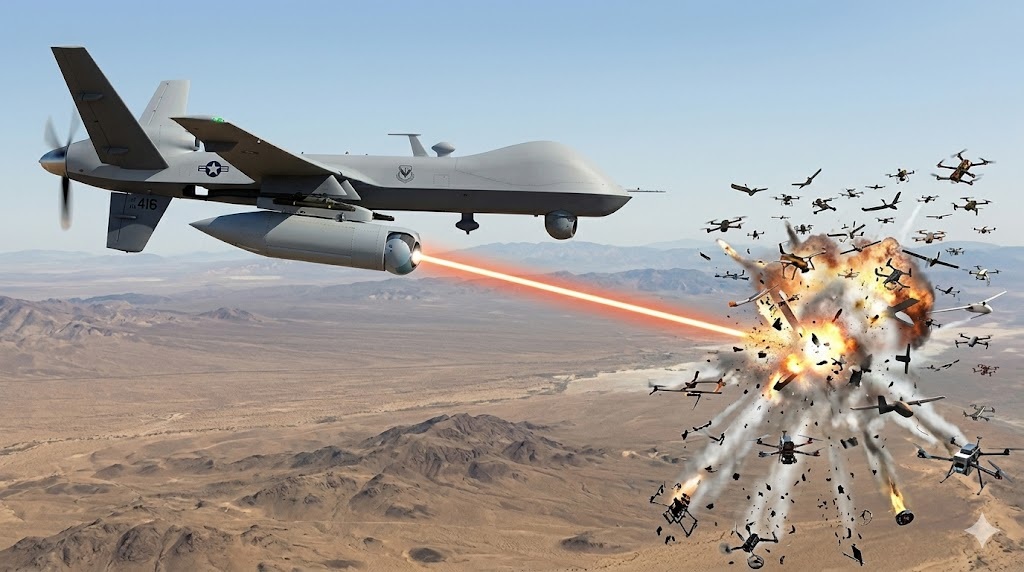
WASHINGTON — April 25, 2026 : The U.S. Missile Defense Agency (MDA) is renewing its push to develop airborne directed energy weapons, with a primary focus on integrating high-energy laser systems onto unmanned aerial platforms for air and missile defense missions.
The effort was outlined by Air Force Lt. Gen. Heath Collins, director of the MDA, during testimony before the House Armed Services Subcommittee on Strategic Forces on April 15, 2026. Collins stated that the agency is “all in” on directed energy capabilities and is prioritizing unmanned aircraft to extend defensive coverage against drones and other airborne threats.
He told lawmakers that an airborne platform would allow the military to deploy laser systems closer to operational environments, improving the ability to counter unmanned aerial systems and similar targets. In written testimony, Collins added that the MDA is accelerating efforts to field high-energy lasers as a “critical, non-kinetic layer” within the United States’ broader missile defense architecture.
Budget Framework and Program Alignment
The initiative is linked to the Pentagon’s fiscal year 2027 budget request and the broader Golden Dome for America program. Early budget documents indicate increased funding for directed energy research and development, including approximately $452 million allocated for high-energy laser and high-powered microwave technologies within the Golden Dome framework.
Overall funding for the Golden Dome effort is estimated between $17.1 billion and $17.9 billion, while total MDA-related activities for fiscal year 2027 are projected in the range of $24 billion to $26 billion. Public documents do not specify the exact portion of funding dedicated exclusively to airborne directed energy integration.
Operational Rationale
Directed energy systems are being pursued as a cost-effective complement to traditional kinetic interceptors. Existing missile defense systems, such as the Patriot missile system and SM-6 missile, rely on expensive interceptors to destroy relatively low-cost threats like drones.
In contrast, solid-state laser systems offer significantly lower cost per engagement, near-instantaneous targeting at the speed of light, and a deep magazine limited primarily by onboard power generation. The MDA is also advancing sensor support, including the Hypersonic and Ballistic Tracking Space Sensor (HBTSS), to improve detection and tracking of fast-moving targets required for effective laser engagement.
Technical Constraints and Historical Programs
Previous U.S. efforts to deploy airborne laser systems have faced challenges related to size, weight, power, and atmospheric interference. Programs dating back decades illustrate these constraints.
The Airborne Laser Laboratory in the 1970s explored early airborne laser concepts. More recently, the YAL-1 Airborne Laser Test Bed successfully demonstrated the interception of ballistic missiles in 2010 but was canceled in 2011 due to cost and technical limitations.
Other initiatives included the High Energy Liquid Laser Area Defense System (HELLADS), launched in 2003 to develop a 150-kilowatt-class laser, and the Low Power Laser Demonstrator (LPLD), which focused on integrating lasers onto unmanned systems. Both programs encountered limitations in power generation and beam control.
In 2020, Michael Griffin, then Undersecretary of Defense for Research and Engineering, highlighted the difficulty of powering airborne lasers and mitigating atmospheric turbulence, which can degrade beam quality.
Recent Air Force efforts, including the Airborne High Energy Laser (AHEL) and the Self-Protect High-Energy Laser Demonstrator (SHiELD), also faced integration challenges that limited their progression to operational testing.
Industry and Future Development
The MDA established a roadmap in 2024 that begins with lower-power laser systems for tracking and progresses toward higher-energy weapons capable of target destruction. The agency is continuing prototyping and demonstration efforts as part of this phased approach.
Defense industry activity reflects growing alignment with these objectives. General Atomics has released concept designs showing laser-equipped MQ-9B SkyGuardian and MQ-20 Avenger unmanned aircraft, although these are not yet tied to a specific government program. Elbit Systems has also reported progress in miniaturizing airborne laser systems.
In parallel, the U.S. Navy has outlined concepts for autonomous drone wingmen equipped with directed energy weapons to support manned aircraft.
Current Status
The MDA is continuing to evaluate airborne directed energy systems as part of a layered defense approach against drones, cruise missiles, hypersonic threats, and ballistic missiles. While Collins’ testimony confirms renewed emphasis on unmanned airborne platforms, specific system configurations, power levels, and deployment timelines were not disclosed.
The agency’s fiscal year 2027 plans indicate continued investment in directed energy technologies, with a focus on integrating them into operational missile defense architectures through incremental development and testing.
——— End of Article ———