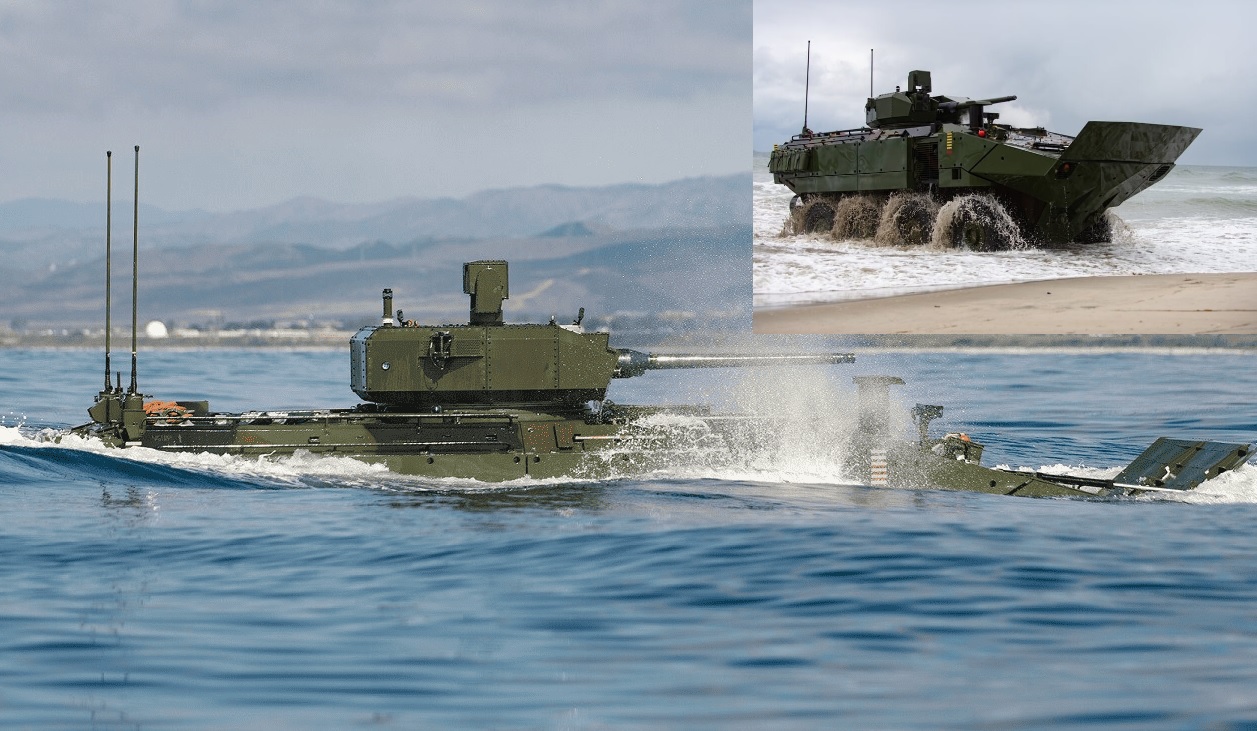
WASHINGTON — May 29, 2026 : The U.S. Marine Corps has officially begun the operational fielding of the Amphibious Combat Vehicle 30mm (ACV-30), marking the introduction of a dedicated direct-fire infantry fighting variant to Marine amphibious units, according to a May 28, 2026 announcement by prime contractor BAE Systems.
The ACV-30 is designed to transport Marines from ship to shore while providing organic medium-caliber fire support against light armored vehicles, fortified positions, and dismounted infantry during amphibious and littoral operations. The platform introduces a new level of protected firepower to Marine formations, enabling forces to transition from amphibious assault to sustained inland maneuver while maintaining combat support capability.
Platform and Armament
The ACV-30 is based on the baseline 8x8 Amphibious Combat Vehicle chassis developed by BAE Systems in partnership with Iveco Defence Vehicles and builds upon the ACV Personnel variant (ACV-P). The platform retains the amphibious and mobility characteristics of the standard vehicle while integrating a dedicated combat system designed for direct-fire support missions.
A defining feature of the vehicle is the Medium Caliber Turret (MCT-30), manufactured by Kongsberg Defence & Aerospace in Johnstown, Pennsylvania. The stabilized, remotely operated turret is equipped with a 30mm Mk.44 Bushmaster II automatic cannon and a coaxial 7.62mm machine gun, enabling the vehicle to engage infantry positions, light armored threats, and fortified targets while crews remain protected inside the hull.
Because the MCT-30 is unmanned and remotely operated, the three-person crew remains under the protection of the vehicle’s modular composite armor. Unlike traditional turret systems that extend into the crew compartment, the turret architecture preserves internal hull space for embarked Marines and mission equipment. The vehicle can transport up to 8–10 Marines depending on mission configuration while carrying approximately 300 ready rounds for the 30mm cannon and up to 800 rounds for the coaxial machine gun.
Technical Specifications and Mobility
The ACV-30 combines amphibious capability with high mobility on land. It is powered by an Iveco Cursor 16 turbocharged diesel engine generating 700 horsepower, allowing road speeds of up to 105 kilometers per hour (65 mph). In water, the platform operates at speeds between 6 and 8 knots and is capable of conducting ship-to-shore operations at distances of up to 12 nautical miles (22 kilometers).
The vehicle has an operational range of approximately 523 kilometers (325 miles), with the ability to continue inland operations for more than 250 miles after amphibious insertion. Weighing approximately 35 tonnes, the ACV-30 incorporates a blast-resistant V-hull design for improved survivability and provides a payload capacity of approximately 3.3 tonnes.
Procurement and Development Timeline
The operational fielding follows a structured testing and procurement effort that began in 2022, when the Marine Corps awarded BAE Systems a contract to produce production representative test vehicles (PRTVs) for the ACV-30 program. The first test vehicle was delivered in February 2024 to support operational evaluation and systems integration.
In November 2024, Kongsberg received a $51 million contract for long-lead turret components to prepare for broader production of the MCT-30 system. Following successful testing, BAE Systems was awarded a $188.5 million full-rate production contract in April 2025 covering 30 ACV-30 vehicles, spare parts, fielding support, and test equipment.
A subsequent August 2025 contract valued at up to $330 million was awarded to Kongsberg for full-rate production of MCT-30 turrets. Manufacturing activities are conducted in York and Johnstown, Pennsylvania, while final integration takes place in Charleston, South Carolina.
Fleet Structure and Strategic Role
The ACV-30 forms part of the broader Amphibious Combat Vehicle family, which includes the ACV-P personnel carrier, ACV-C command-and-control variant, and the upcoming ACV-R recovery vehicle. The Marine Corps plans to acquire a total of 608 ACVs, including 152 ACV-30 variants, as part of the replacement of the legacy Assault Amphibious Vehicle (AAV), which primarily served as a troop transport platform since the Vietnam era.
The deployment aligns with the Marine Corps’ Force Design 2030 modernization initiative, which emphasizes distributed maritime operations across contested littoral and island environments. In operational scenarios such as the Indo-Pacific, the ACV-30 is expected to provide Marine units with independent direct-fire support during early amphibious assaults and inland maneuver operations, reducing reliance on external artillery and close air support while improving tactical flexibility in coastal combat environments.
——— End of Article ———