CAMP COURTNEY, Okinawa, Japan : June 23, 2026 — The U.S. Marine Corps has completed the fielding of two key weapons systems to the 12th Marine Littoral Regiment (MLR) on Okinawa, marking a significant milestone in the service's Force Design modernization initiative. The regiment formally received the Navy-Marine Expeditionary Ship Interdiction System (NMESIS) and the Marine Air Defense Integrated System (MADIS) during June 2026, providing enhanced anti-ship and air defense capabilities for operations across the Indo-Pacific.
The 12th MLR, which was redesignated from the 12th Marine Regiment in November 2023, is now fully equipped to operate as a distributed, low-signature force focused on sea denial and littoral warfare within the First Island Chain. Operating under the III Marine Expeditionary Force (III MEF), the regiment is positioned on Okinawa, less than 400 kilometers from the Taiwan Strait, a location considered strategically important for regional security operations.
NMESIS Adds Long-Range Anti-Ship Capability
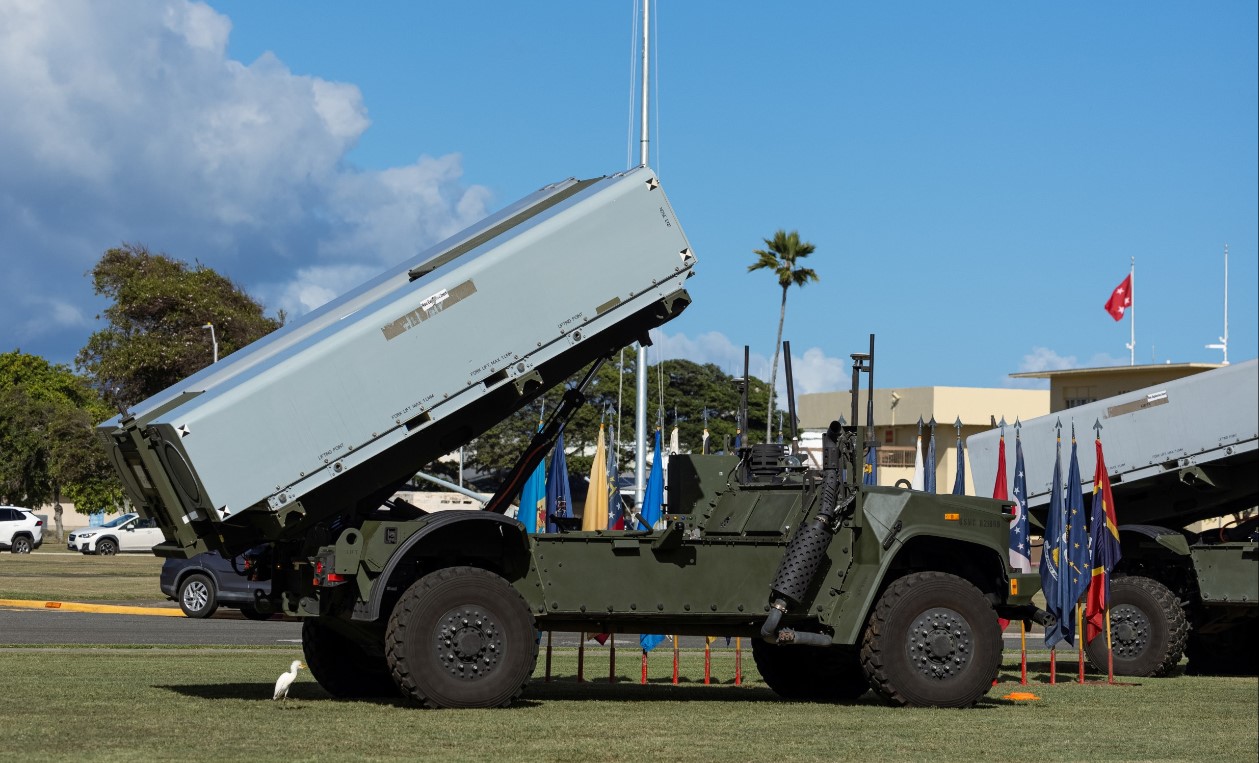
The Navy-Marine Expeditionary Ship Interdiction System (NMESIS) provides the regiment with a mobile ground-based anti-ship strike capability. The system consists of an unmanned Joint Light Tactical Vehicle (JLTV) carrying two Naval Strike Missiles (NSMs) in ready-to-fire launch canisters.
Developed by Norwegian defense company Kongsberg Defence & Aerospace and produced in the United States, the Naval Strike Missile (NSM) is a low-observable cruise missile designed to engage maritime targets at ranges of approximately 185 kilometers (115 miles). The missile employs a sea-skimming flight profile to reduce radar detection and uses an imaging infrared seeker for target identification and precision engagement.
Because the launcher is remotely operated, Marines can position NMESIS in exposed coastal areas while maintaining operators at safer locations. Multiple launchers can be connected through secure communications networks, enabling dispersed operations across island terrain and expanding the Marine Corps' ability to threaten hostile surface vessels operating in the region.
MADIS Strengthens Air and Counter-Drone Defense
Alongside NMESIS, the regiment received the Marine Air Defense Integrated System (MADIS), a mobile air defense platform designed to protect forces against unmanned aerial systems and other low-altitude threats.
MADIS is mounted on JLTV vehicles and operates as a two-vehicle system. One vehicle carries 360-degree radar and electronic warfare equipment for target detection and tracking, while the second vehicle is armed with a 30 mm cannon, a 7.62 mm machine gun, and Stinger surface-to-air missiles. The weapon system is capable of engaging aerial targets while moving, providing protection for maneuvering units and high-value assets.
The Marine Corps introduced the first production MADIS systems in September 2025 and delivered an initial batch of 20 units by the end of that year. Service plans call for approximately 190 MADIS platforms to be fielded across Marine Littoral Regiments and Littoral Anti-Air Battalions by 2035.
Second Marine Littoral Regiment Equipped With Both Systems
The 12th MLR becomes the second active Marine Littoral Regiment to field both NMESIS and MADIS. The 3rd Marine Littoral Regiment, based in Oahu, Hawaii, received NMESIS in November 2024 and MADIS in December 2024.
The 3rd MLR has since employed the systems during multinational exercises including Resolute Dragon in Japan and Balikatan 25 and Balikatan 26 in the Philippines. Those exercises demonstrated the systems' mobility, interoperability, and effectiveness in distributed island environments.
Regiment Structured for Distributed Operations
The 12th Marine Littoral Regiment consists of approximately 2,000 Marines organized into three primary subordinate elements.
The Littoral Combat Team, built on the lineage of the 1st Battalion, 4th Marines—historically known as the "China Marines" for service in Shanghai before World War II—now operates NMESIS anti-ship missile batteries.
The Littoral Anti-Air Battalion provides short-range air defense and counter-drone protection through MADIS platforms.
Supporting both units is the Littoral Logistics Battalion, which sustains operations through distributed logistics networks designed for island-based operations and contested environments.
Supporting Marine Corps Force Design Objectives
The fielding of NMESIS and MADIS reflects the Marine Corps' broader transition from large-scale amphibious assault formations toward smaller, highly mobile units capable of operating across dispersed island chains.
According to Col. Peter Eltringham, commanding officer of the 12th Marine Littoral Regiment, the deployment strengthens the regiment's ability to contribute combat power alongside regional allies.
"We bring this combat power to Okinawa to be able to deliver it in the eyes of our adversaries and ensure we can bring it to the decisive point on the battlefield," Eltringham said. "We do this alongside our Japanese ground, air, and maritime Self-Defense Force partners, because there is nothing more powerful than this alliance in this theater."
With the arrival of NMESIS and MADIS, the 12th Marine Littoral Regiment now possesses an integrated combination of anti-ship, air defense, counter-drone, and logistics capabilities designed to support distributed operations throughout the Western Pacific. The systems are intended to improve the regiment's ability to conduct sea denial missions while maintaining survivability against modern aerial threats in the waters surrounding Japan's southwestern islands.
——— End of Article ———