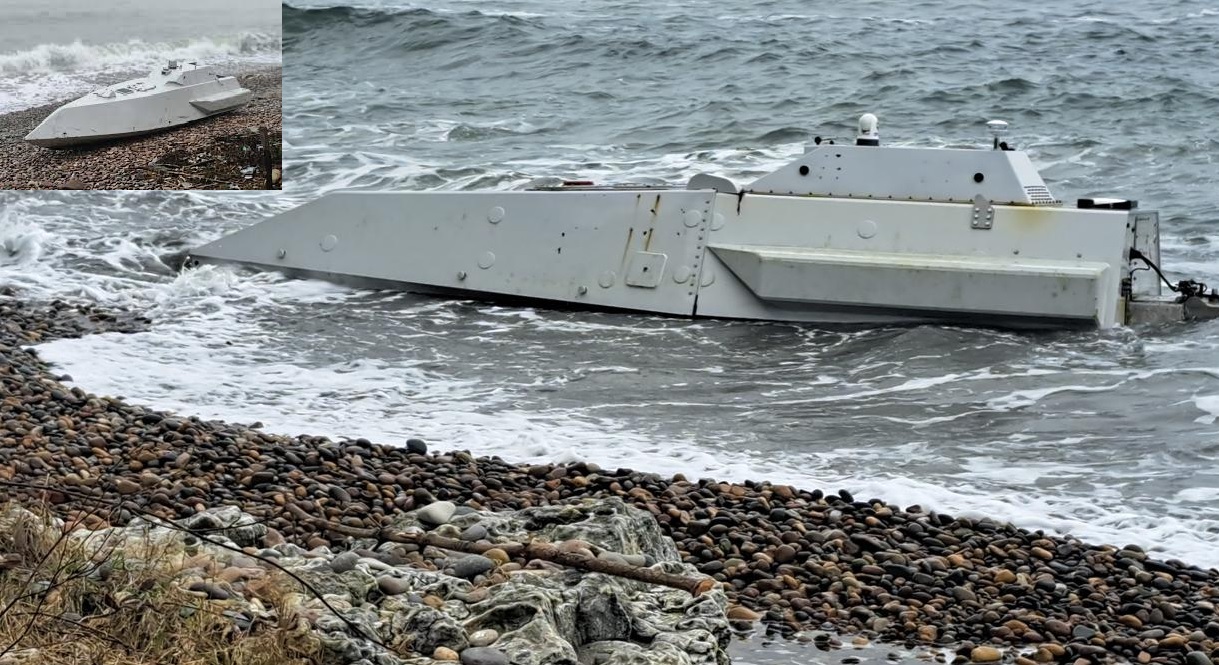
ORDU, TÜRKİYE, — March 21, 2026 : A U.S.-manufactured AEGIR-W unmanned surface vessel (USV) was discovered washed ashore in the Yüceler neighborhood of Ünye district in Ordu province along Türkiye’s Black Sea coast. The vessel was reported by local civilians on Friday afternoon, prompting a response from Turkish security forces.
Following the discovery, gendarmerie units secured the area and conducted an initial inspection. In accordance with standard procedures for unidentified military hardware, authorities established a perimeter and later carried out a controlled detonation of the vessel after assessment. An investigation is ongoing to determine the circumstances that led to the drone reaching the coastline.
Vessel Identification and Technical Characteristics
The recovered platform was identified as an AEGIR-W variant, part of the AEGIR family of unmanned maritime systems developed by U.S.-based defense company Sierra Nevada Corporation (SNC).
The vessel measures under 10 meters in length and is capable of speeds exceeding 25 knots, with an operational range of approximately 500 nautical miles (around 900 kilometers). It is constructed using high-density polyethylene (HDPE) and powered by a diesel combustion engine.
The AEGIR-W is designed to carry a payload of up to 300 kilograms and can operate either autonomously or under remote control. It is classified as an attritable system, meaning it is designed for cost-effective deployment with reduced reliance on complex supply chains and scalable manufacturing.
Operational Role and Capabilities
The AEGIR family is intended for use in high-threat and contested maritime environments. Its mission profiles include intelligence, surveillance, and reconnaissance (ISR), electronic warfare, offensive operations, and autonomous resupply missions.
The platform incorporates a modular design, allowing integration of various sensor packages and electronic systems. It is also compatible with SNC’s Digital Grid architecture, which enables real-time data sharing and coordination with other assets.
The AEGIR-W variant is optimized for long-endurance operations, combining speed, payload capacity, and flexibility for both littoral and open-water missions.
Context and Possible Origin
While Turkish authorities have not issued an official explanation regarding the vessel’s origin or trajectory, regional media and defense assessments indicate that the USV was likely operating in the Black Sea in connection with Ukraine-related operations.
Similar unmanned surface vessels developed by Sierra Nevada Corporation have reportedly been used in maritime operations in the region. The appearance of the AEGIR-W on Türkiye’s coastline suggests that the platform may have drifted beyond its intended operational area.
Security Response and Investigation
After securing the site, Turkish authorities conducted a technical assessment of the vessel. Following inspection, the USV was neutralized through controlled detonation to eliminate any potential risk associated with onboard systems or payload.
Officials have not released further technical findings at this stage. The investigation is focused on determining the origin, operational status, and circumstances that resulted in the vessel reaching the Turkish coast.
Broader Context
The incident reflects the increasing deployment of autonomous maritime systems in the Black Sea region, where unmanned platforms are being used for a range of military and surveillance operations.
It also highlights the potential for such systems to move beyond designated operational zones, particularly in complex maritime environments. This is not the first instance of unmanned systems being recovered along Türkiye’s Black Sea coastline, although previous incidents involved different types of drones.
Authorities have indicated that further updates will be provided as the investigation progresses.
——— End of Article ———