WASHINGTON — April 28, 2026 : The U.S. fiscal year 2027 defense budget request allocates $16.8 billion under the Land Power pillar to modernize armored combat capabilities across the Army and Marine Corps. The funding focuses on three major programs: the Armored Multi-Purpose Vehicle (AMPV), the M1E3 Abrams main battle tank, and the XM30 Mechanized Infantry Combat Vehicle.
According to the U.S. Department of Defense FY2027 Budget Overview Book, Land Power remains a central component of military modernization planning. The allocation is part of a broader budget strategy that shifts emphasis toward procurement, research and development, and industrial base expansion rather than sustaining legacy systems.
Land Power Modernization Framework
The $16.8 billion investment supports the restructuring of heavy ground forces to operate in high-intensity conflict environments characterized by drones, precision-guided munitions, electronic warfare, persistent intelligence-surveillance-reconnaissance (ISR), and contested logistics. Defense planners aim to enhance survivability, digital connectivity, and adaptability of armored formations through the 2030s.
The funding aligns with wider Department priorities that include rebuilding combat capability, reforming acquisition processes, and increasing production capacity for ground systems.
Armored Multi-Purpose Vehicle (AMPV)
The AMPV program replaces the M113 family of tracked vehicles, which currently account for approximately 30 percent of tracked platforms in Armored Brigade Combat Teams. Designed and produced by BAE Systems, the AMPV addresses critical limitations in survivability, mobility, force protection, and onboard power generation.
The platform is fielded in five variants: general-purpose transport, mission command, medical treatment, medical evacuation, and mortar carrier. It provides protected command-and-control capability, casualty evacuation, and indirect-fire support within contested environments.
To improve logistical efficiency, the AMPV shares a common powertrain and suspension system with the M2 Bradley Infantry Fighting Vehicle and the M109A7 Paladin self-propelled howitzer. Full-rate production is ongoing, with recent orders including 50 additional vehicles funded through reconciliation spending to replenish stocks following M113 transfers. Planned production rates support brigade-level fielding.
M1E3 Abrams Main Battle Tank
The M1E3 Abrams program represents a redesign of the Army’s main battle tank. Initiated in September 2023, it replaces the previously planned M1A2 SEPv4 configuration. The redesign prioritizes reduced weight, improved mobility, and lower sustainment requirements while maintaining survivability.
The platform incorporates selected technologies from the SEPv4 upgrade but is built around a Modular Open Systems Approach (MOSA), enabling faster integration of future technologies. The Army has requested $474 million in FY2027 research, development, test, and evaluation funding.
Prototypes are scheduled for operational testing with the 1st Cavalry Division in 2026, with a transition to production planned for FY2028. Expected design features include improved fuel efficiency, reduced logistical footprint, and compatibility with advanced protection and sensor systems.
XM30 Mechanized Infantry Combat Vehicle
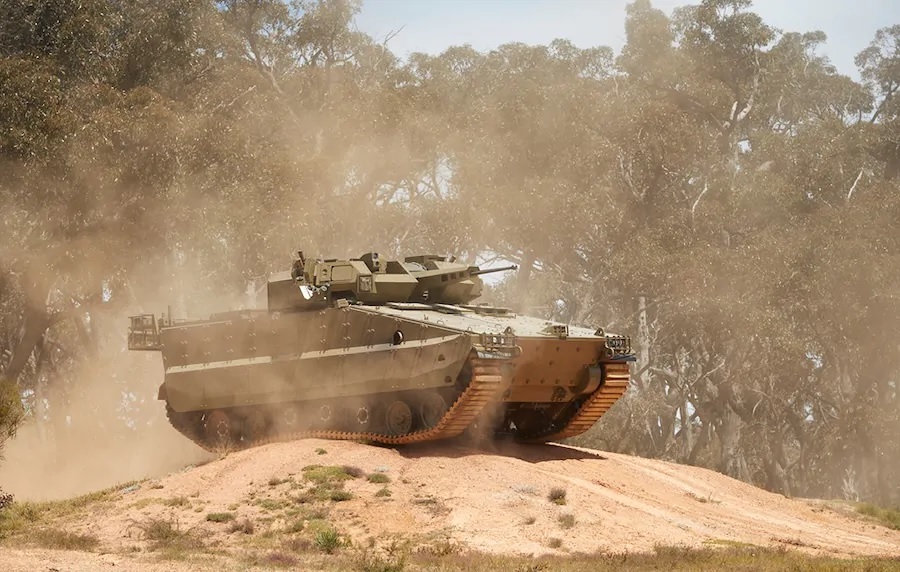
The XM30 program, intended to replace the M2 Bradley, is currently in the prototype development phase. The Army has requested $547 million in FY2027 funding, including procurement of 19 vehicles. The total acquisition objective is 108 XM30 platforms by FY2031.
The program uses a middle-tier acquisition pathway, with prototype development led by General Dynamics Land Systems and American Rheinmetall Vehicles. Milestone B approval was achieved in June 2025, and low-rate initial production is targeted for FY2028.
The XM30 emphasizes lethality, survivability, and digital connectivity, with a focus on network-enabled targeting in electronically contested environments. Its open architecture design supports continuous upgrades to sensors, software, and weapons systems without requiring major structural modifications.
Integrated Armored Force Structure
Together, the AMPV, M1E3 Abrams, and XM30 programs form a coordinated modernization effort across multiple layers of the armored force. The approach integrates command support, heavy armor, and mechanized infantry into a digitally connected ecosystem capable of sustaining combined-arms operations in future conflict scenarios.
The FY2027 request reflects a shift toward maintaining operational credibility in evolving threat environments while ensuring long-term sustainability and adaptability of U.S. ground combat forces.
——— End of Article ———