ARLINGTON, Va., — May 4, 2026 : AeroVironment, Inc. announced it has been awarded a prototype agreement by the United States Army to develop, test, and deliver the Switchblade 400 loitering munition under the service’s Low-Altitude Stalking and Strike Ordnance (LASSO) program. The initiative is aimed at equipping Infantry Brigade Combat Teams (IBCTs) with organic, man-portable precision strike capabilities suited for modern contested environments.
The agreement formally positions the newly introduced Switchblade 400 within the Army’s emerging next-generation loitering munition architecture. According to company officials, the award includes responsibilities spanning development, testing, delivery, and future scalability, aligning with broader Army modernization efforts.
Trace Stevenson, President of Autonomous Systems at AeroVironment, stated that the award reflects the Army’s confidence both in the Switchblade 400 platform and the company’s ability to deliver systems at operational scale. He noted that participation in the LASSO program establishes AeroVironment as a long-term partner supporting lifecycle phases from development through fielding and ongoing capability upgrades.
Bridging Capability Gaps in Loitering Munitions
The Switchblade 400 was unveiled in October 2025 as a medium-range loitering munition designed to bridge the operational gap between the lightweight Switchblade 300 and the larger Switchblade 600. AeroVironment describes the system as a “Lightweight Tank Destroyer,” combining anti-armor lethality with portability suitable for dismounted soldiers.
The system weighs approximately 39 pounds as a complete All-Up Round (AUR), with the munition itself weighing 27 pounds. It is capable of operating at ranges up to 65 kilometers (40 miles) and can loiter for approximately 35 minutes. The platform cruises at speeds near 70 mph and can execute a terminal sprint of up to 90 mph.
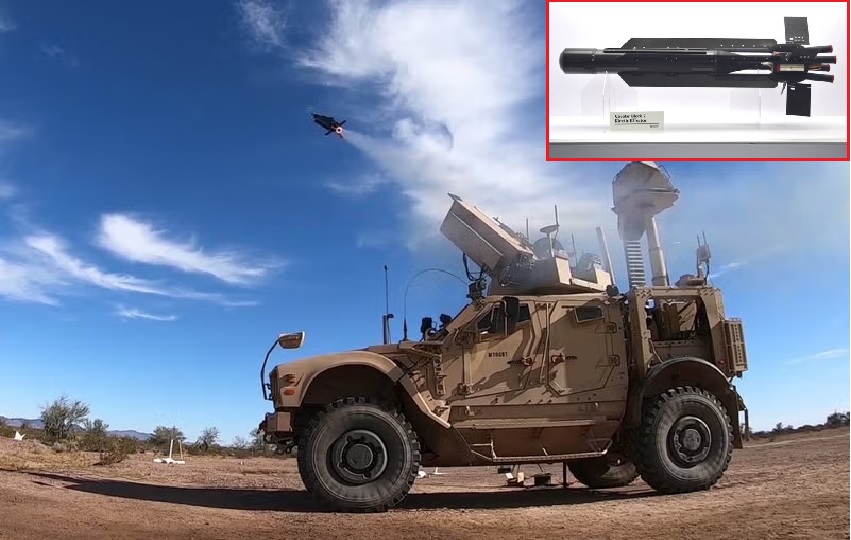
Deployment is enabled through a rocket-assisted take-off (RATO) from a common launch tube, allowing a single operator to prepare and launch the system in under five minutes. This configuration supports a decentralized “sensor-to-shooter” model, enabling ground forces to independently detect, identify, and engage armored targets without reliance on external air or artillery support.
Autonomous Operations in Contested Environments
A defining feature of the Switchblade 400 is its integration within AV_Halo, AeroVironment’s modular command-and-control ecosystem. The system incorporates hybrid Aided Target Recognition (ATR) and edge computing technologies, enabling autonomous detection, classification, and tracking of targets using electro-optical and infrared (EO/IR) sensors.
These capabilities are designed to maintain effectiveness in environments where GPS signals and communications are degraded or denied due to electronic warfare. By reducing reliance on continuous operator input during terminal engagement phases, the system enhances survivability and operational flexibility.
The platform is built using a Modular Open Systems Approach (MOSA), allowing integration with tactical networks such as ATAK and Nett Warrior. This architecture enables future upgrades to sensors, payloads, and communication systems without requiring full system redesign, supporting long-term adaptability.
Brian Young, Senior Vice President of Loitering Munitions at AeroVironment, stated that the system reflects ongoing feedback from operational users and is designed to reduce operational burden while enhancing performance in real-world conditions.
Program Structure and Procurement Outlook
The LASSO prototype agreement is structured under an Other Transaction Authority (OTA), providing a flexible framework for rapid development and testing. The U.S. Army is reportedly seeking approximately $110 million in procurement funding for the LASSO program in its fiscal year 2027 budget.
This development track operates alongside existing production programs. In February 2026, AeroVironment received a $186 million delivery order for Switchblade 600 Block 2 and Switchblade 300 Block 20 systems, including variants equipped with explosively formed penetrator (EFP) payloads. That order was issued under a five-year, $990 million Indefinite Delivery, Indefinite Quantity (IDIQ) contract awarded in August 2024 for Lethal Unmanned Systems.
The Switchblade 400 program is separate from these production efforts but complements the Army’s broader investment in loitering munitions as part of its tactical modernization strategy.
Expanding Operational Role of the Switchblade Family
AeroVironment executives attributed continued Army investment to the operational track record of the Switchblade family, which has been deployed extensively in multiple theaters, including Ukraine. Data and feedback from these deployments have informed iterative improvements across the product line.
Jimmy Jenkins, Executive Vice President of Precision Strike and Defense Systems at AeroVironment, stated that the Army’s continued procurement reflects a sustained operational demand for precision, speed, and adaptability at the tactical level.
The Switchblade 400, alongside earlier and next-generation variants, is intended to provide dismounted forces with immediate precision strike capability against armored threats. Its integration into the LASSO program underscores the Army’s emphasis on decentralizing firepower and reducing reliance on higher-echelon support systems in contested operational environments.
——— End of Article ———