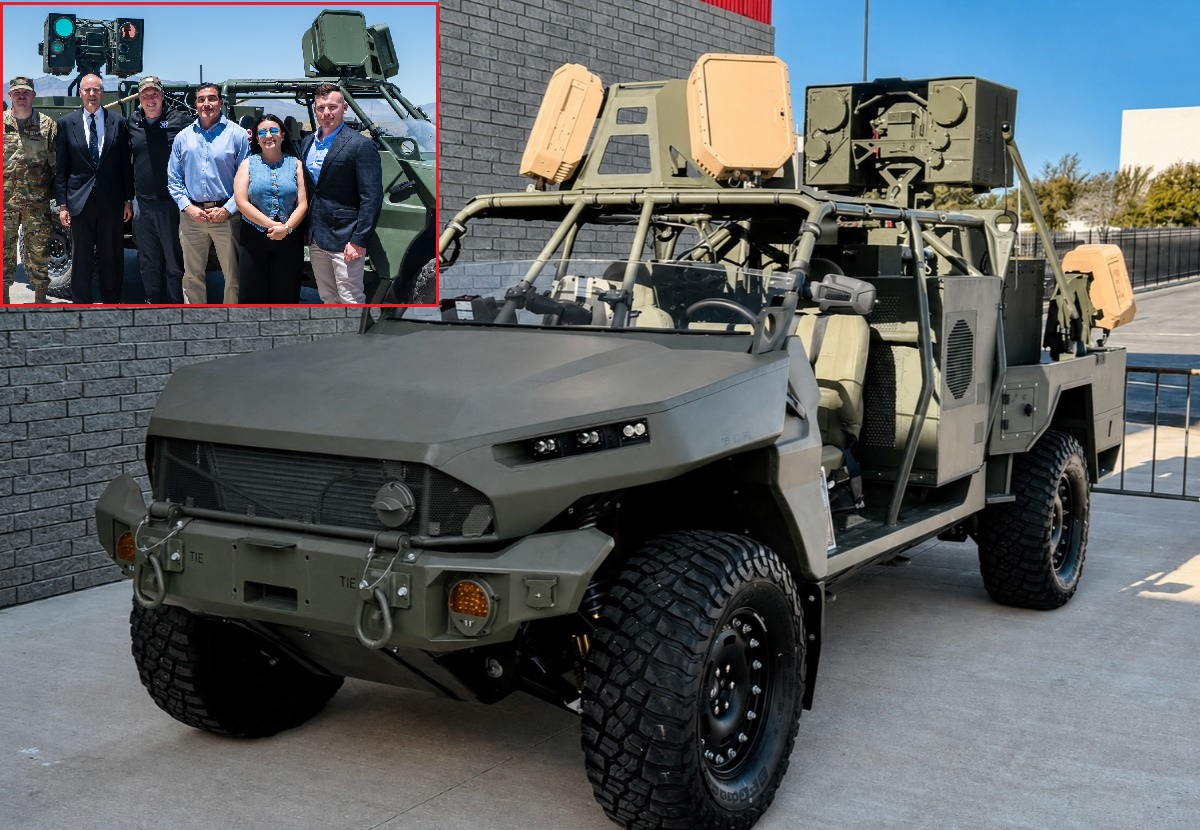
WHITE SANDS MISSILE RANGE, New Mexico — May 31, 2026 : The U.S. Army is expanding testing of directed-energy weapons to strengthen counter-drone defenses, with the Army Multi-Purpose High Energy Laser (AMP-HEL) program moving toward fieldable operational capability through accelerated prototyping and live testing.
On May 27, 2026, Secretary of the Army Dan Driscoll visited White Sands Missile Range and personally operated the AMP-HEL system during a demonstration involving a drone target. Mounted on a General Motors Defense Infantry Squad Vehicle (ISV), the system used AeroVironment’s LOCUST laser weapon system to engage an unmanned aerial system (UAS) target.
Following the demonstration, Driscoll highlighted the role of White Sands Missile Range in evaluating technologies intended to address evolving battlefield threats.
“Today I visited White Sands Missile Range to see firsthand the technologies reshaping modern warfare,” Driscoll stated. “The scale of their airspace allows the U.S. Army to test UAS and counter-UAS capabilities at scale, making this one of the most important proving grounds in the world.”
AMP-HEL Program and Army Testing
The AMP-HEL program is overseen by the Army’s Rapid Capabilities and Critical Technologies Office (RCCTO), which is managing an accelerated prototyping effort designed to shorten traditional acquisition timelines and move directed-energy technologies toward operational use.
The system is intended to provide mobile counter-UAS capability for brigade- and division-level formations, allowing maneuver forces to defend against drone threats using existing tactical vehicle platforms. The program originated through an Other Transaction Authority award issued in 2023.
White Sands Missile Range remains a key testing location due to its large restricted airspace and infrastructure supporting UAS and counter-UAS experimentation. Army evaluations focus on system reliability, mobility, engagement performance, and integration with layered air defense systems.
LOCUST Laser System and Technical Capabilities
The AMP-HEL system integrates AeroVironment’s LOCUST (Laser on Universal Combinable Ultra-light System Technology) laser weapon system, designed to counter small drones through sustained high-energy laser engagement.
The baseline LOCUST system generates approximately 20 kilowatts of continuous laser power, sufficient to heat structural materials on small drones to the point of physical failure within seconds of sustained illumination.
During the demonstration, the laser system was integrated onto a General Motors Defense Infantry Squad Vehicle (ISV), a nine-seat light tactical platform based on the Chevrolet Colorado ZR2 pickup truck.
The Army has also expanded integration to the Oshkosh Joint Light Tactical Vehicle (JLTV), which features a larger beam director aperture intended to improve engagement effectiveness at longer ranges.
AeroVironment delivered the first two ISV-mounted LOCUST systems in September 2025, followed by two JLTV-mounted systems in December 2025 as part of the ongoing prototyping effort.
The upgraded LOCUST X3 system offers a scalable laser output ranging from 20 to more than 35 kilowatts and incorporates artificial intelligence-enabled functions with AV_Halo PINPOINT software to automate target detection, tracking, and engagement.
The system follows a Modular Open Systems Approach (MOSA), allowing compatibility across multiple military vehicle platforms and supporting future upgrades and production requirements.
Mary Clum, Senior Vice President of AeroVironment’s Space and Directed Energy Group, stated in 2025 that the AMP-HEL effort represented a major step toward fieldable directed-energy capabilities and that the LOCUST system demonstrated reliability for counter-UAS missions.
Cost Challenges Driving Directed-Energy Adoption
The Army’s investment in laser weapons is partly driven by the economics of countering low-cost drone threats.
Traditional short-range air defense interceptors can cost between $50,000 and $400,000 per shot, while many adversary drones, including variants derived from Iranian-designed Shahed systems, are estimated to cost between $20,000 and $50,000.
This cost imbalance raises concerns about relying solely on kinetic missile interceptors during large-scale drone attacks.
Speaking during an interview with 60 Minutes, AeroVironment CEO Wahid Nawabi said a Patriot missile battery costs approximately $1 billion to procure, while interceptor launches may cost around $4 million per engagement.
By comparison, LOCUST laser engagements are estimated to cost roughly $3 per shot, while the upgraded LOCUST X3 reportedly operates at under $5 per engagement, depending primarily on available electrical power rather than missile stockpiles.
Safety Testing and Civilian Airspace Validation
In March 2026, the Joint Interagency Task Force 401 (JIATF 401), working with the Federal Aviation Administration (FAA), conducted safety demonstrations involving the AMP-HEL system at White Sands Missile Range.
The evaluations validated whether the laser system could safely operate without endangering civilian aviation or friendly aircraft.
According to program assessments, automated hardware and software safety interlocks prevent the laser from firing if directed toward protected “keep-out” zones or if friendly aircraft are identified within the integrated air picture.
The laser beam is designed to focus energy at a controlled distance, concentrating destructive effects at the engagement point before dispersing and losing intensity beyond the target area to reduce unintended hazards.
Operational Limitations and Layered Defense Role
Despite progress in testing, Army officials describe directed-energy systems as one component of a broader layered counter-drone architecture rather than a replacement for traditional air-defense systems.
Recent naval live-fire exercises involving a palletized version of the laser system reportedly achieved a 100 percent success rate during drone engagements aboard an aircraft carrier.
However, laser weapons face operational limitations. A single laser system can generally engage one target at a time, reducing effectiveness against coordinated drone swarm attacks.
Environmental conditions including dust, smoke, humidity, and rain may reduce effectiveness by degrading beam quality, reducing range, and limiting energy transfer.
Adversaries, including Russia, have reportedly experimented with reflective coatings and aerosol dispersants intended to reduce laser effectiveness.
To address these limitations, the Army is integrating AMP-HEL into a layered air defense framework that includes radar systems, electronic warfare and jamming equipment, kinetic interceptors, proximity-fuzed rocket systems, and other counter-UAS technologies.
Production Outlook
The Army has not announced formal fielding timelines beyond the current prototyping phase, though the Enduring High Energy Laser program is expected to reach a production decision in the fourth quarter of fiscal year 2026.
Army planning identifies an initial requirement for 24 systems, with AeroVironment positioning the LOCUST X3 architecture for scalable production and compatibility across tactical vehicle fleets, including the ISV and JLTV.
The AMP-HEL program continues to support the Army’s effort to expand mobile counter-drone capabilities and integrate directed-energy systems into broader layered air defense operations.
——— End of Article ———