WIESBADEN, Germany — April 22, 2026 : The U.S. Army has procured ten Valinor Condor unmanned aerial systems (UAS) for flight testing and operational evaluation during Exercise Arcane Thunder 26, a multinational training event running from April 6 to April 29, 2026, across Germany, Poland, and the United States.
The systems have been assigned directly to unmanned aircraft system operators within the U.S. Army Multi-Domain Task Force – Europe (MDTF-Europe), also referred to as Multi-Domain Command – Europe (MDC-E). The decision places the drones into active unit-level operations, allowing soldiers to assess performance under realistic field conditions rather than controlled test environments.
Exercise Scope and Operational Context
Arcane Thunder 26 involves U.S. Army Europe and Africa forces alongside NATO allies and is designed to validate the effectiveness of Multi-Domain Company Teams. These formations integrate capabilities across land, air, cyber, space, and electronic warfare domains to deliver coordinated effects in joint and allied operations.
The exercise is organized under Multi-Domain Command – Europe, which is responsible for planning and executing long-range precision fires and synchronized multi-domain operations aimed at countering anti-access/area denial (A2/AD) challenges in the European theater.
By incorporating the Valinor Condor into MDTF-Europe formations, the Army is collecting data on how the system performs when integrated into distributed, multi-domain missions rather than operating as a standalone platform.
Platform Overview and Design Characteristics
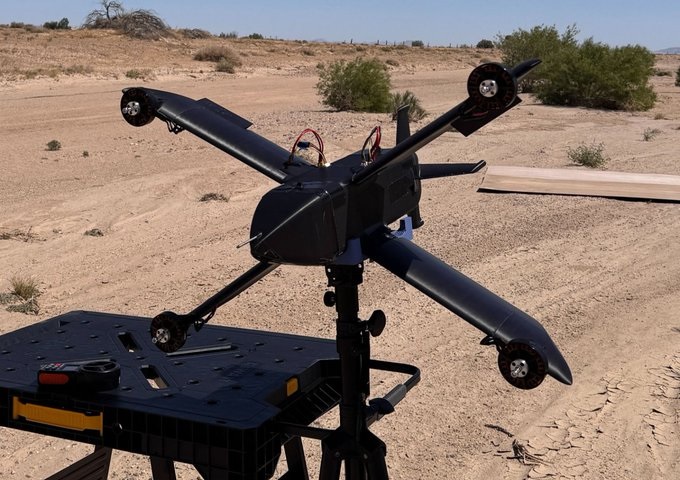
The Valinor Condor is a Group 1 unmanned aircraft system developed by Valinor Enterprises. It is designed as a modular and attritable aerial platform optimized for high-volume production and rapid deployment in contested environments.
The system features an open architecture software framework, enabling compatibility with third-party command-and-control systems. Its modular hardware design allows rapid reconfiguration for different payloads and mission requirements, including reconnaissance and targeting support roles.
A key design feature is its portability. The Condor is backpack-portable and can be carried and deployed by individual soldiers without the need for dedicated ground support equipment. The platform supports both ground-launch and air-launch operations.
Technical Specifications
According to available data, the Valinor Condor has the following performance characteristics:
- Maximum range: 40 kilometers (25 miles)
- Top speed: 161 kilometers per hour (100 miles per hour)
- Endurance: 25 minutes
- Maximum takeoff weight: 22.49 pounds
The drone is also described as high-speed skid steer capable and transitions autonomously into fixed-wing flight after launch.
Deployment Methods and Autonomous Capabilities
During Arcane Thunder 26, operators conducted hands-on testing that included both conventional and alternative deployment methods. One of the primary evaluation areas is high-altitude balloon deployment, in which the drone is released from an elevated platform.
This method extends the system’s effective operational reach and reduces its acoustic and visual signature compared to ground-based launches. Following release, the Condor stabilizes automatically and transitions into controlled flight.
The platform also supports autonomous long-range operations. It can execute pre-programmed mission profiles without continuous operator input, enabling operations in environments where communications may be degraded or denied. This reduces reliance on persistent data links and lowers operator workload.
Modularity, Sustainment, and Field Support
The Condor’s construction emphasizes modularity and maintainability in forward operating environments. The system incorporates commercially available off-the-shelf components where feasible, allowing for rapid field repairs.
Units can replace damaged parts using locally available materials, including 3D-printed components, to maintain operational readiness. This approach is intended to support sustained operations in dispersed formations with limited logistical support.
The platform’s design reflects requirements for low-cost, high-volume attritable systems, consistent with recent operational lessons that highlight the rapid consumption of small unmanned systems in high-intensity environments.
Evaluation Objectives and Next Steps
The ongoing evaluation during Arcane Thunder 26 is focused on assessing the Condor’s integration into multi-domain operations at the unit level. Data collected from the ten deployed systems will inform the Army’s assessment of the platform’s suitability for operational use within formations preparing for contested environments in Europe.
No decision has been announced regarding additional procurement or broader fielding of the system beyond the current evaluation phase.
——— End of Article ———