California, United States — The U.S. Army has signed a three-year Cooperative Research and Development Agreement (CRADA) with California-based startup Auriga Space to explore the use of electromagnetic launch technology for counter-drone defense. The research will be carried out in partnership with the Army's Combat Capabilities Development Command Armaments Center (DEVCOM AC), based in New Jersey, United States, to evaluate whether magnetic propulsion can provide an alternative to conventional chemical-propellant interceptor systems.
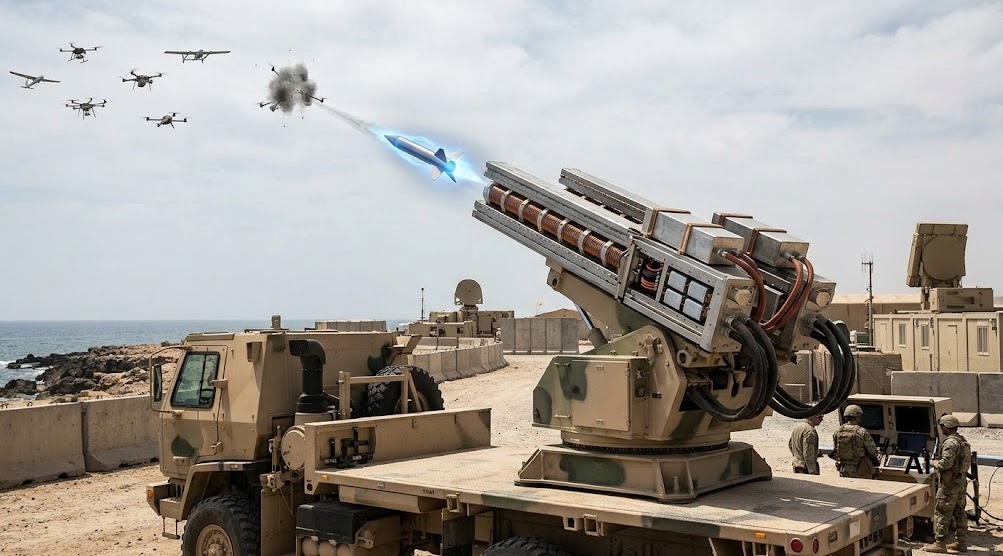
The agreement focuses on developing electromagnetic accelerators capable of launching counter-drone interceptors without relying on traditional rocket motors. The effort comes as the U.S. military looks for more affordable and rapidly deployable solutions to counter the growing threat posed by large numbers of low-cost unmanned aerial systems.
Addressing the Cost of Countering Drone Swarms
Modern air defense systems rely heavily on conventional interceptors that are effective but costly and time-consuming to manufacture. In contrast, many drones can be produced at a much lower cost, creating an economic challenge for air defense operations.
The issue was highlighted during recent U.S. military operations involving Iran, where American forces reportedly fired more than 1,000 Patriot interceptors. According to an analysis by the Center for Strategic and International Studies (CSIS) in Washington, D.C., only 172 interceptors were replenished during the same period. With each PAC-3 Patriot interceptor costing about $4 million, CSIS estimates that U.S. stockpiles may not fully recover from the deficit until at least 2029.
Production of conventional missiles also faces supply chain constraints. Many U.S. interceptor systems, including the Patriot and Terminal High Altitude Area Defense (THAAD), use solid rocket motors that depend on ammonium perchlorate, the primary oxidizer for these motors. The United States currently relies on a single domestic producer of this material, limiting the ability to rapidly increase missile production regardless of additional funding.
Electromagnetic Launch Technology
Auriga Space's approach eliminates the need for solid rocket motors by using electromagnetic propulsion. The technology accelerates projectiles along a launch track using electricity and precisely controlled magnetic fields, based on principles similar to those used in magnetic levitation (maglev) trains.
Because the launch process does not rely on chemical propellants or explosions, it reduces mechanical wear on the launcher and removes the dependence on ammonium perchlorate. This allows the launcher to be reused for thousands of engagements while enabling operators to reload and fire again within seconds.
The company says the lower operating cost means that, after the launcher is deployed, each engagement primarily involves the cost of the interceptor's warhead and guidance components rather than an entire rocket propulsion system. This rapid reloading capability is intended to provide what the defense industry refers to as a "deep magazine," allowing continuous engagement of multiple aerial targets.
Hermes Counter-Drone Platform
Auriga's primary counter-drone system, known as Hermes, is a transportable, containerized electromagnetic launch platform designed for deployment in a variety of operational environments. The modular system is intended for use at forward operating bases, aboard naval vessels, and at fixed infrastructure sites requiring protection against drone attacks.
Following laboratory validation, Auriga plans to conduct the first outdoor flight test of the Hermes platform later this summer. The demonstration is expected to evaluate the system's performance under operational field conditions.
Winnie Lai, founder and CEO of Auriga Space, said the partnership addresses one of the most significant challenges in modern air defense.
"Attritable drones cost adversaries far less and are far easier to deploy and replenish than present interceptors, and it's one of the most timely and urgent challenges in modern warfare," Lai said. "Electromagnetic propulsion solves for the structural issues with economics and cadence. It's a working technology we at Auriga are already actively testing, and partnering with DEVCOM AC on further research will bring it that much closer to a deployable capability."
Role of the CRADA
The collaboration is being conducted under a Cooperative Research and Development Agreement (CRADA), a framework that allows U.S. government laboratories and private companies to share technical expertise, facilities, and research without exchanging funding. Such agreements are commonly used by the Department of Defense, headquartered in Arlington, Virginia, to evaluate emerging technologies before considering future procurement programs.
Auriga's Ongoing Defense Programs
In addition to the Army partnership, Auriga Space is involved in several U.S. defense research efforts. The company has received a research award from the Missile Defense Agency and a $1.25 million Small Business Innovation Research (SBIR) grant through the U.S. Air Force's innovation organization, AFWERX.
Auriga also operates two hypersonic ground-testing systems: Thor, an outdoor electromagnetic test track, and Prometheus, an indoor accelerator. These facilities are used to evaluate how materials and components perform under extremely high-speed conditions.
Founded in 2022 by Winnie Lai, formerly a vice president at launch company SpinLaunch, Auriga Space operates a vertically integrated research and development facility in Southern California, where it designs and manufactures its own hardware. The company has raised more than $12 million through venture capital investment and defense-related grants to support the development of its electromagnetic propulsion technologies.
Source : interestingengineering
——— End of Article ———