MOSCOW — Russia's state-owned defense and technology corporation Rostec has unveiled a new modular protection system called "Pautina" (Web), designed to help protect critical industrial and energy infrastructure from unmanned aerial vehicle (UAV) attacks.
The system was developed by RT-Project Technologies, a subsidiary of Rostec, in partnership with Standard Electric. It was presented during a regional mission of the state corporation in the Tver Region.
According to the developers, the Pautina system is currently undergoing trial operation at several facilities in Russia's fuel and energy sector to evaluate its performance under real-world conditions.
Designed to Protect Critical Infrastructure
Rostec said the Pautina system is intended to protect a wide range of facilities, including oil storage sites, fuel terminals, electrical substations, warehouses, and other critical industrial infrastructure.
The modular design allows the system to protect facilities of any surface area and structures more than 25 meters high, enabling it to be adapted for different industrial sites.
Structure and Installation
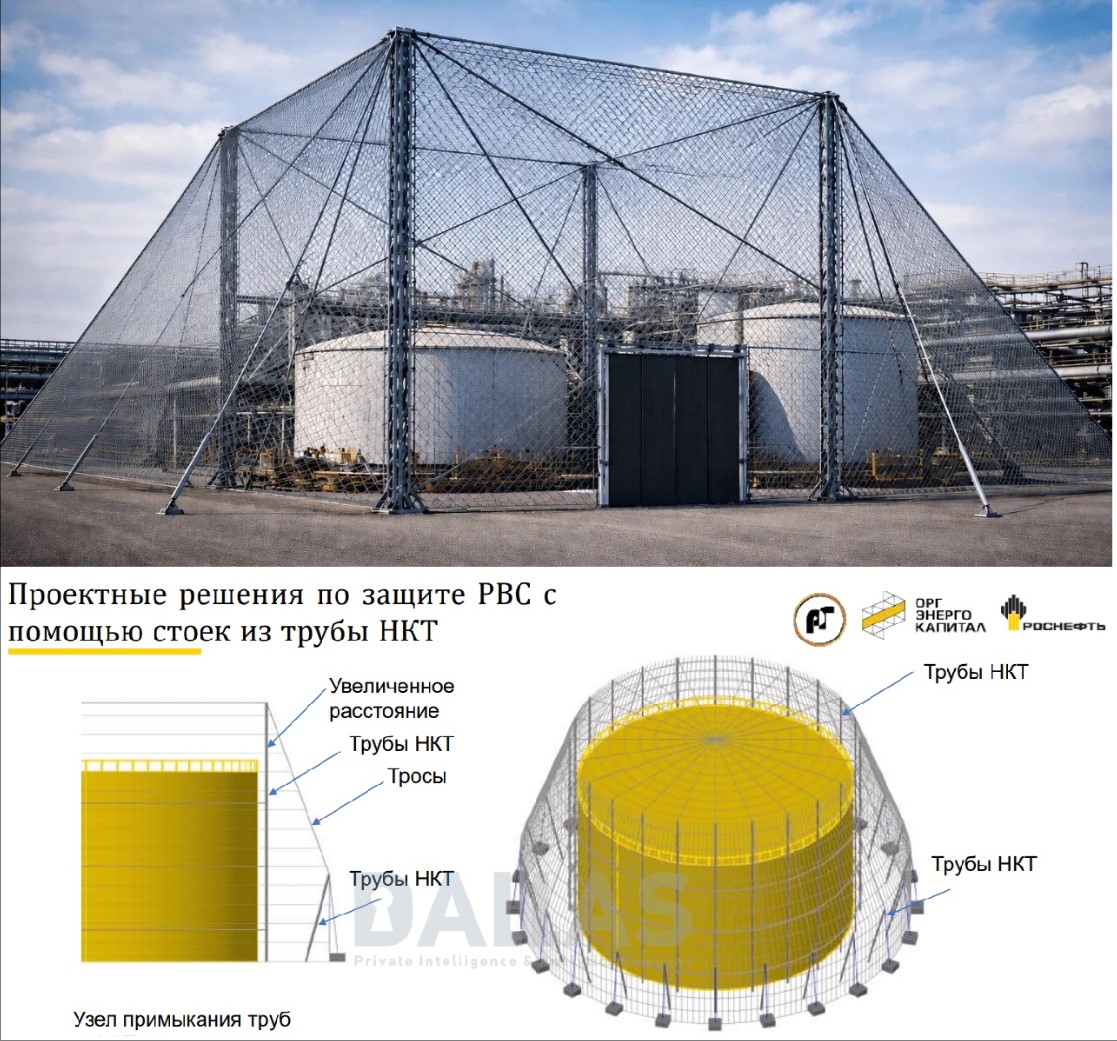
The Pautina system consists of load-bearing columns, a high-strength mesh, and support structures that together form a continuous protective barrier around a facility.
According to Rostec, the structure is assembled entirely using bolted connections, eliminating the need for on-site welding. This installation method allows the system to be deployed in confined spaces and high-fire-risk environments, such as fuel storage facilities.
The company said the approach improves installation safety while reducing construction time and overall project costs.
All metal components receive factory-applied hot-dip galvanizing, providing long-term protection against corrosion and increasing the durability of the structure.
Protection Capabilities
According to Rostec, the standard configuration of the Pautina system creates a continuous high-strength protective mesh around a facility that is designed to intercept incoming drones.
The company states that the basic version can withstand the impact of a drone weighing up to 200 kilograms traveling at speeds of up to 250 kilometers per hour.
Rostec also said the system's protective capabilities can be further enhanced without requiring a complete redesign, although the company did not provide additional technical details.
Testing and Deployment
The company said the structure has successfully completed field tests for seismic stability. Testing to evaluate its effectiveness against different types of drones is continuing as part of ongoing trial operations at several fuel and energy facilities.
Rostec has not released detailed performance data or disclosed how many sites are currently participating in the trial program.
Integrated Counter-Drone Protection
Alexander Nazarov, Deputy Chief Executive Officer of Rostec State Corporation, said the Pautina system is designed to create a continuous protective barrier capable of stopping many long-range drones used against industrial facilities.
He added that the system is intended to operate alongside other Rostec counter-drone technologies, including electronic jamming systems and kinetic interception systems, providing an additional layer of protection for critical civilian infrastructure.
Broader Infrastructure Protection Efforts
The introduction of the Pautina system comes as Russia continues efforts to strengthen the physical protection of key energy and industrial infrastructure against long-range drone attacks.
Earlier this year, leaked confidential documents from the Russian energy company Rosneft highlighted the engineering challenges involved in protecting large industrial facilities from long-range, GPS-guided drones. The documents described the limitations of conventional passive protective measures, including steel cable nets, scaffolding, and shipping containers, which can face structural constraints and regulatory requirements associated with permanent construction.
The modular design of Pautina offers an alternative approach by allowing protective structures to be installed more quickly and adapted to different industrial sites without extensive permanent construction.
As trial operations continue, the system may see wider deployment across Russia's fuel, energy, and other critical infrastructure sectors if it meets operational requirements during ongoing evaluations.
Source : Rostec
——— End of Article ———