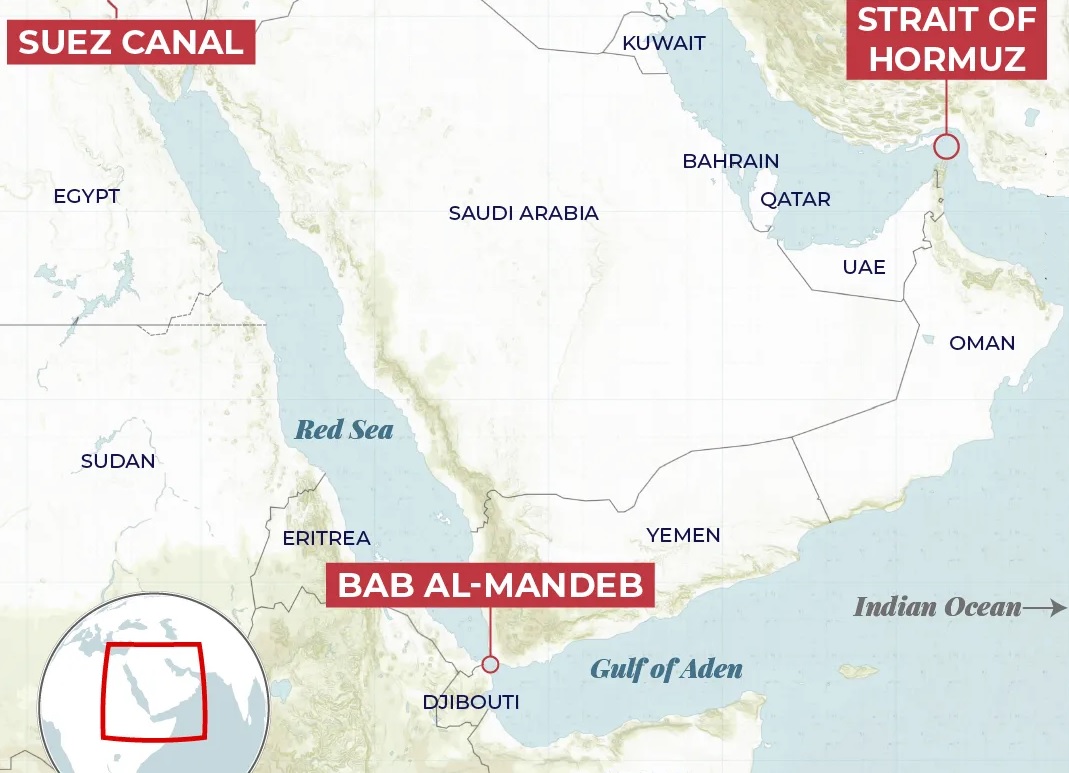
DUBAI — Iran has asked Yemen's Houthi movement to prepare to close the Bab el-Mandeb strait, the southern gateway to the Red Sea, if the United States launches strikes on Iranian power infrastructure, according to three regional sources familiar with the matter.
The request comes as tensions between Tehran and Washington continue to rise. According to two senior Iranian sources and one regional official, Iran's leadership has discussed the plan internally and recently informed the Houthis to remain ready for possible action. The sources spoke on condition of anonymity because of the sensitivity of the issue.
The reported move follows U.S. President Donald Trump's warning earlier this week that the United States could target Iran's power grid. Regional sources said Iran is treating the possibility seriously and views the threat of disrupting another major global shipping route as a potential deterrent.
Iran's Foreign Ministry and Houthi representatives did not immediately respond to requests for comment.
Houthis Reportedly Ready to Act
A source close to the Houthis said the group has already positioned drones and missiles in Yemen near the Gulf of Aden and around areas overlooking the Bab el-Mandeb strait, including the vicinity of the port of Hodeidah. According to the source, the weapons are ready and the group is awaiting further instructions before targeting commercial shipping.
The same source said representatives of Iran's Islamic Revolutionary Guard Corps (IRGC) currently in Yemen would decide when any operation should begin.
Risk of Disruption at Two Major Maritime Chokepoints
The latest development comes after Iran's closure of the Strait of Hormuz earlier this year during the ongoing regional conflict. Before the conflict, the Strait of Hormuz handled about 20% of global energy supplies, making it one of the world's most important oil transit routes.
Since the Hormuz closure, Saudi Arabia has redirected a significant portion of its oil exports through pipelines to the Red Sea port of Yanbu. Regional sources estimate that around 70% of Saudi energy exports are now moving through the Red Sea, which currently carries approximately 7% of global energy supplies.
If the Bab el-Mandeb strait were also blocked, two of the Middle East's most important oil export routes would be disrupted at the same time, creating additional pressure on global energy markets.
Global Trade Could Face Major Disruptions
The Bab el-Mandeb strait connects the Gulf of Aden with the Red Sea and serves as a critical gateway to the Suez Canal. Under normal conditions, the Red Sea route carries between 12% and 15% of global maritime trade and approximately 30% of the world's container shipping traffic.
A simultaneous disruption of both the Strait of Hormuz and the Bab el-Mandeb would force many commercial vessels to avoid the Red Sea and instead sail around the Cape of Good Hope at the southern tip of Africa. The alternative route typically adds 10 to 15 days to shipping times while increasing fuel costs, freight rates, and marine insurance premiums.
Europe would likely face delays in imports of manufactured goods from Asia as well as higher transportation costs for energy supplies from the Gulf. Egypt could also experience significant economic losses because of reduced traffic through the Suez Canal, an important source of foreign currency revenue.
Major Asian economies, including India and China, could also experience longer delivery times and higher shipping costs for trade with Europe. Countries in East Africa that depend heavily on imported grain from Europe and the Black Sea region could face additional supply challenges.
Saudi Arabia Monitoring Situation
Regional sources said Saudi Arabia is taking the reported Iranian-Houthi coordination seriously, particularly after recent Houthi missile attacks on Saudi territory ended a four-year truce. The Houthis said those attacks followed Saudi airstrikes on an airport under their control.
Analysts say any expansion of the conflict into Red Sea shipping would increase pressure on energy markets and international trade.
Torbjorn Solvedt, Principal Middle East Analyst at Verisk Maplecroft, said that if the conflict spreads to Red Sea export infrastructure and commercial shipping, it would threaten the region's main alternative route for oil exports following the closure of the Strait of Hormuz.
One Iranian source said disrupting shipping through the Bab el-Mandeb would not necessarily require advanced military capabilities, adding that even relatively simple attacks could interrupt commercial maritime traffic.
Wider Regional Implications
The Houthis have not formally entered the current Iran-U.S. conflict but remain closely aligned with Tehran as part of the "Axis of Resistance," a regional network that also includes Lebanon's Hezbollah and Iraqi Shi'ite armed groups.
The United States has repeatedly accused Iran of supplying the Houthis with weapons, funding and military training, including support through Hezbollah. Tehran has consistently denied those allegations, saying Washington continues to destabilize the region.
Analysts note that any attempt to block both the Strait of Hormuz and the Bab el-Mandeb would significantly affect global energy supplies and international trade. Such a move could increase pressure for coordinated international efforts to secure the two strategic waterways while also raising concerns over further escalation across the Middle East.
The situation remains fluid, and there has been no official confirmation from either Iran or the Houthis regarding the reported plan.
Source : reuters
——— End of Article ———