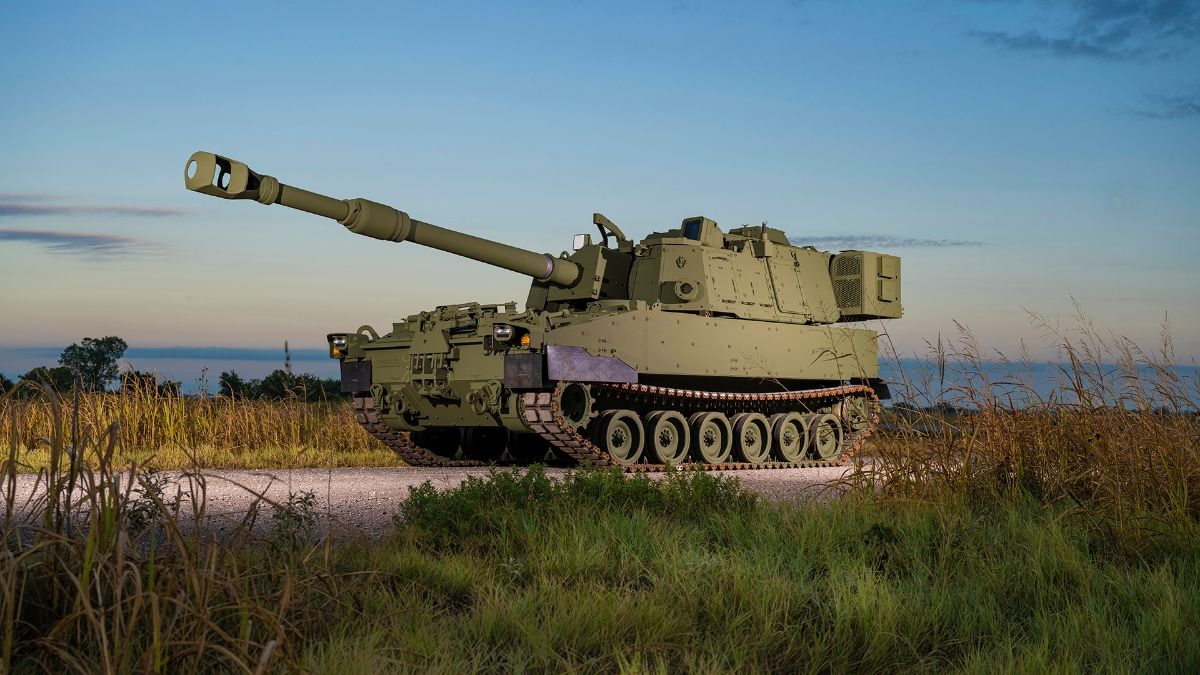
DETROIT ARSENAL, Michigan — May 15, 2026 : BAE Systems Land and Armaments has received a $535.6 million fixed-price-incentive contract from the U.S. Army for the production of self-propelled howitzer systems, tracked support vehicles, and total package fielding kits, according to a Department of Defense announcement released on May 14, 2026.
The contract was awarded through Army Contracting Command at Detroit Arsenal, Michigan, and is scheduled to continue through December 31, 2029. The award supports continued production and sustainment of the Army’s tracked artillery fleet assigned to armored brigade combat teams.
Although the Department of Defense did not specifically identify the vehicle variant in the contract notice, the award aligns with ongoing procurement of the M109A7 Paladin Integrated Management self-propelled howitzer and the M992A3 Carrier Ammunition Tracked vehicle. BAE Systems remains the Army’s sole domestic producer of the Paladin family of vehicles, with primary manufacturing operations located in York, Pennsylvania.
The latest award follows a separate $473 million contract issued in January 2026 for 40 Paladin sets. Unlike a standard vehicle procurement contract, the May 2026 award includes broader fielding support packages intended to transition the systems into operational service. The package includes spare parts, specialized tools, technical manuals, training equipment, and other sustainment materials required for unit deployment and long-term operational readiness.
M109A7 Modernization and Technical Specifications
The M109A7 represents the latest modernization of the Army’s long-serving Paladin artillery platform. While retaining the 155 mm, 39-caliber M284/M284A2 cannon mounted on the M182A1 gun mount, the system integrates a redesigned chassis using common components from the Bradley Fighting Vehicle family, including the engine, transmission, and track systems.
The self-propelled howitzer weighs approximately 84,000 pounds (38,101 kilograms) and operates with a four-person crew consisting of a commander, driver, gunner, and loader. The vehicle is powered by a 675-horsepower V903 engine and carries a 145-gallon fuel capacity.
According to Army specifications, the M109A7 can achieve road speeds of approximately 38 miles per hour and has an operational range of about 186 miles. Mobility capabilities allow the vehicle to climb 60 percent longitudinal slopes, traverse 40 percent side slopes, cross trenches up to 72 inches wide, and ford water obstacles up to 42 inches deep.
These mobility characteristics allow artillery units to maneuver alongside tanks and mechanized infantry during high-tempo combat operations while maintaining protected fire support capability.
Firepower and Battlefield Role
The M109A7 is designed to provide mobile long-range fire support under modern battlefield conditions. Standard 155 mm high-explosive projectiles allow engagement of targets at ranges between 22 and 24 kilometers, depending on ammunition type and propellant configuration. Rocket-assisted projectiles extend the range to approximately 30 kilometers.
The system is also compatible with precision-guided munitions such as Excalibur, enabling accurate strikes against point targets while reducing collateral damage and ammunition expenditure.
Modern battlefield conditions, including persistent unmanned aerial vehicle surveillance, counter-battery radar detection, and electronic warfare threats, have increased the importance of rapid displacement after firing missions. The M109A7 uses digital fire-control systems and onboard navigation equipment to conduct “shoot-and-scoot” operations, allowing crews to receive fire missions digitally, fire multiple rounds, and relocate before enemy targeting cycles can respond.
M992A3 Ammunition Carrier Support
Supporting the howitzer is the M992A3 Carrier Ammunition Tracked vehicle, which typically operates as part of a two-vehicle Paladin set. The armored ammunition carrier uses a related tracked chassis and can transport up to 98 artillery rounds or approximately 12,000 pounds of ammunition and supplies, depending on configuration.
The vehicle enables artillery batteries to conduct resupply operations closer to frontline positions while reducing reliance on unarmored logistics vehicles operating in contested environments. This capability is considered increasingly important in conflicts involving drone surveillance and long-range precision fires.
Strategic and Budgetary Context
Continued procurement of the M109A7 follows the Army’s decision to terminate the Extended Range Cannon Artillery (ERCA) program, which had aimed to integrate a 58-caliber cannon onto the Paladin chassis to achieve significantly greater firing ranges. The ERCA effort was ended after testing revealed excessive barrel wear and technical limitations.
While the Army evaluates future domestic and foreign artillery platforms under its Mobile Tactical Cannon requirement, the M109A7 continues to provide armored brigades with a fielded and operationally proven 155 mm artillery capability compatible with existing ammunition stocks, training systems, and maintenance infrastructure.
The contract also reflects continued congressional support for the defense industrial base. The Army’s fiscal year 2026 budget request originally sought $250.2 million for 10 Paladin Integrated Management sets. Subsequent congressional appropriations increased available funding, with House appropriators identifying approximately $715 million for the program and the Senate FY2026 Defense Appropriations bill including an additional $464.8 million increase for Paladin Integrated Management procurement.
Army procurement plans continue to target a total acquisition objective of 689 Paladin Integrated Management weapon systems, with estimated program costs exceeding $7.6 billion.
Production of the vehicles and support systems at BAE Systems facilities in Pennsylvania, Oklahoma, and Alabama also sustains skilled labor, tracked vehicle manufacturing capacity, turret integration work, and artillery sustainment infrastructure while the Army develops future long-range cannon artillery systems.
——— End of Article ———