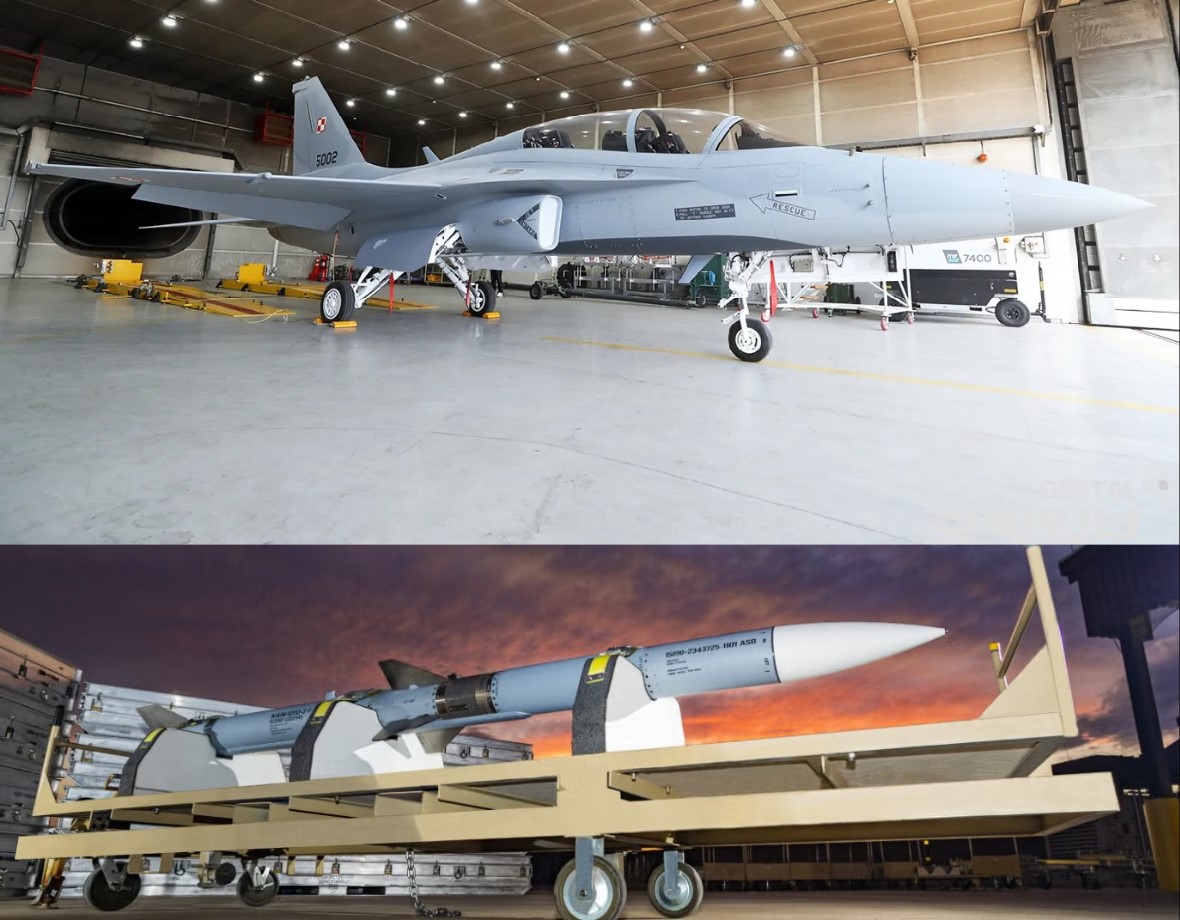
WARSAW, — April 10, 2026 : The United States administration has approved the integration of AIM-120C Advanced Medium-Range Air-to-Air Missiles (AMRAAM) with Poland’s FA-50PL light combat aircraft, enabling the platform to field beyond-visual-range (BVR) air combat capabilities. The approval was confirmed by Deputy Commander of the Polish Armed Forces, General Ireneusz Nowak, in a recent interview.
The decision resolves prior uncertainty surrounding the operational scope of the FA-50PL variant, particularly its ability to employ medium-range air-to-air weapons. Earlier constraints were linked to U.S. export control requirements under the International Traffic in Arms Regulations (ITAR), which govern the transfer and integration of U.S.-origin defense systems. With authorization now granted, integration work involving U.S. and South Korean industry partners can proceed under Foreign Military Sales (FMS) arrangements.
Program Background and Fleet Composition
Poland signed a contract with Korea Aerospace Industries (KAI) in July 2022 for a total of 48 FA-50 aircraft, valued at approximately $3 billion. The procurement is divided into two configurations: 12 FA-50GF (Gap Filler) aircraft and 36 FA-50PL (Block 20) aircraft.
The FA-50GF aircraft, delivered beginning in 2023 and currently operated from the 23rd Tactical Air Base in Mińsk Mazowiecki, serve as an interim solution and lack advanced radar systems and BVR missile capability. In contrast, the FA-50PL represents a significantly enhanced configuration designed for multirole operations.
Deliveries of the 36 FA-50PL aircraft, initially expected earlier, have been postponed to mid-2027 due to supply chain constraints and the complexity associated with integrating U.S.-origin avionics and weapon systems. Current projections place full delivery between 2027 and 2029.
Technical Configuration and Integration Scope
The FA-50PL is based on the South Korean FA-50 Block 20 standard and incorporates a range of upgraded systems. Central to the AIM-120C integration is the Raytheon PhantomStrike active electronically scanned array (AESA) radar, a compact and air-cooled radar designed for light combat aircraft. The approval allows the radar’s fire-control and data-link systems to interface with the AMRAAM missile.
Additional features of the FA-50PL include a probe-and-drogue aerial refueling system, expanded external or conformal fuel tanks to extend operational range, a helmet-mounted display (HMD), and compatibility with precision-guided munitions such as the GBU-12 laser-guided bomb. The aircraft is also equipped with the AN/AAQ-33 Sniper Advanced Targeting Pod for enhanced targeting and surveillance functions.
The AIM-120C AMRAAM is an active radar-guided, fire-and-forget missile designed for engagements against aircraft and cruise missile targets at medium ranges. Its integration enables the FA-50PL to conduct air defense and air superiority missions alongside its existing training and light attack roles.
Air-to-Air Armament Standardization
The AMRAAM approval complements a separate agreement signed in January 2026 between Poland and the United States for the integration of the AIM-9X Sidewinder short-range air-to-air missile on the FA-50PL. Together, the AIM-9X and AIM-120C establish a complete air-to-air weapons suite for the aircraft.
Poland already operates earlier AIM-120 variants on its F-16 fleet and has procured newer AIM-120D-3 missiles for both its F-16 and incoming F-35A aircraft. The inclusion of the AIM-120C on the FA-50PL aligns the platform with existing munitions inventories, supporting logistical commonality and operational flexibility across the Polish Air Force.
Role in Force Modernization
The FA-50PL is intended to replace aging Soviet-era MiG-29 and Su-22 aircraft in selected roles. The platform is positioned as a cost-effective multirole asset within Poland’s broader air force structure, complementing higher-end platforms such as the F-16 and F-35A.
The integration of BVR capability significantly expands the operational utility of the FA-50PL, allowing it to participate in national and NATO air defense missions. The Polish Armament Agency continues to oversee the program, including training, logistics, and sustainment elements. No additional changes to contract value or delivery timelines beyond previously announced adjustments have been disclosed.
Industrial Cooperation and Next Steps
KAI is responsible for executing the integration work, with technical support from U.S. defense contractors. The approval permits both software and hardware modifications required to link the aircraft’s avionics and radar systems with the AIM-120C missile.
No official timeline has been released for completion of integration activities or initial live-fire testing. The authorization applies specifically to Poland’s FA-50PL configuration and does not automatically extend to other FA-50 operators.
Broader Implications
The U.S. decision establishes a regulatory precedent that may influence other FA-50 Block 20 customers. Countries such as Malaysia, which are evaluating or operating similar variants, have closely monitored Poland’s procurement and integration process. The clearance of AMRAAM integration could facilitate comparable approvals for allied nations seeking to equip light combat aircraft with BVR capabilities.
The development supports Poland’s ongoing defense modernization efforts and contributes to strengthening NATO’s air defense posture on the eastern flank.
——— End of Article ———