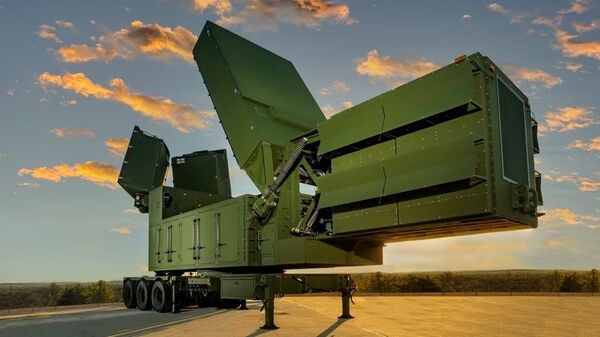
WASHINGTON, — March 21, 2026 : The United States government has approved a potential $8 billion Foreign Military Sale (FMS) to Kuwait for the procurement of advanced Lower Tier Air and Missile Defense Sensor (LTAMDS) radars, according to an official notification issued on March 19. The decision, authorized under emergency provisions, bypassed the standard Congressional review process and forms part of a broader $16.5 billion package of defense approvals for Middle Eastern partners.
The proposed sale centers on enhancing Kuwait’s existing Patriot air and missile defense network by upgrading its sensing and tracking capabilities rather than introducing a separate system architecture.
Kuwait LTAMDS Package and Components
The Government of Kuwait has requested up to eight LTAMDS radars, along with five Large Tactical Power Systems and eight frequency converters. The package also includes an extensive set of supporting systems and services designed to ensure long-term operational integration and sustainment.
Non-major defense equipment and support elements include Identification Friend or Foe (IFF) KIV-77 encryptors, AN/PYQ-10 simple key loaders, ancillary cryptographic devices, LTAMDS simulators, and Heavy Expanded Mobility Tactical Truck (HEMTT) M983A4 transporters equipped with high-temperature modification kits. Additional components cover battery maintenance center shelters, tool and test equipment sets, small repair parts trailers, and prime movers for shelters and trailers.
The agreement further provides for training programs, technical assistance field teams, field service representatives, software development, spare parts, publications, and ongoing engineering, logistics, and program support from both U.S. government and contractor personnel.
RTX Corporation, the defense company formerly known as Raytheon, has been identified as the principal contractor. Implementation of the program will require the deployment of 12 U.S. government personnel and 12 contractor representatives to Kuwait for a period of up to 20 years to support maintenance, training, and sustainment.
Integration with Patriot and Technical Capabilities
The LTAMDS system is designed to replace or complement legacy AN/MPQ-65 radars currently used within Kuwait’s Patriot batteries. Unlike earlier systems that operate with a sector-based coverage of approximately 120 degrees, LTAMDS employs active electronically scanned array (AESA) technology to deliver full 360-degree surveillance.
This expanded coverage is intended to eliminate radar blind spots and improve the detection, classification, and tracking of a range of aerial threats, including ballistic missiles, cruise missiles, and one-way attack drones.
By strengthening the sensing layer of the air defense network, the system is expected to improve target discrimination, engagement sequencing, and interceptor allocation, particularly in complex scenarios involving simultaneous or mixed attack profiles.
The upgrade aligns with a broader operational approach in which advanced sensor performance plays a central role in layered air and missile defense architectures, enabling more efficient use of interceptor systems rather than relying solely on increased missile inventories.
Emergency Approval and Legal Framework
The sale was approved under an emergency determination issued by U.S. Secretary of State Marco Rubio, citing national security interests. This determination waived the Congressional review requirements typically mandated under Section 36(b) of the Arms Export Control Act.
According to the State Department, the emergency provision was invoked to ensure the rapid transfer of capabilities in response to evolving regional security conditions, including recent threats to critical infrastructure in the Gulf.
The department stated that the sale supports U.S. foreign policy objectives by strengthening the defense capabilities of Kuwait, which is designated as a major non-NATO ally. The improved systems are intended to enhance the protection of Kuwaiti territory and allied forces operating in the region, while contributing to a wider Integrated Air and Missile Defense (IAMD) framework.
Officials also noted that Kuwait is expected to absorb the systems without difficulty and that the sale will not alter the fundamental military balance in the region.
Part of Broader Regional Defense Approvals
The Kuwait LTAMDS package is one component of a larger set of defense approvals totaling more than $16.5 billion for Middle Eastern partners.
Alongside the Kuwait deal, the United Arab Emirates (UAE) has been approved for an estimated $8.46 billion in defense acquisitions. This includes long-range radar systems, munitions for F-16 aircraft, air-to-air missiles, and approximately $2.1 billion allocated for FS-LIDS counter-drone systems.
Jordan has been authorized a smaller package valued at $70.5 million, focused on aircraft maintenance, repair, and munitions support for its existing fleets of F-16, C-130, and F-5 aircraft.
Major U.S. defense contractors involved across these approvals include RTX Corporation, Northrop Grumman, and Lockheed Martin.
Strategic Context
The LTAMDS approval reflects a continuing shift in regional defense planning toward sensor-centric and integrated air and missile defense systems. By modernizing radar and detection capabilities within existing frameworks such as Patriot, partner nations are seeking to improve response efficiency against increasingly complex and diverse aerial threats.
The U.S. government indicated that the Kuwait sale strengthens interoperability with U.S. forces and supports long-term security cooperation objectives in the Middle East.
——— End of Article ———