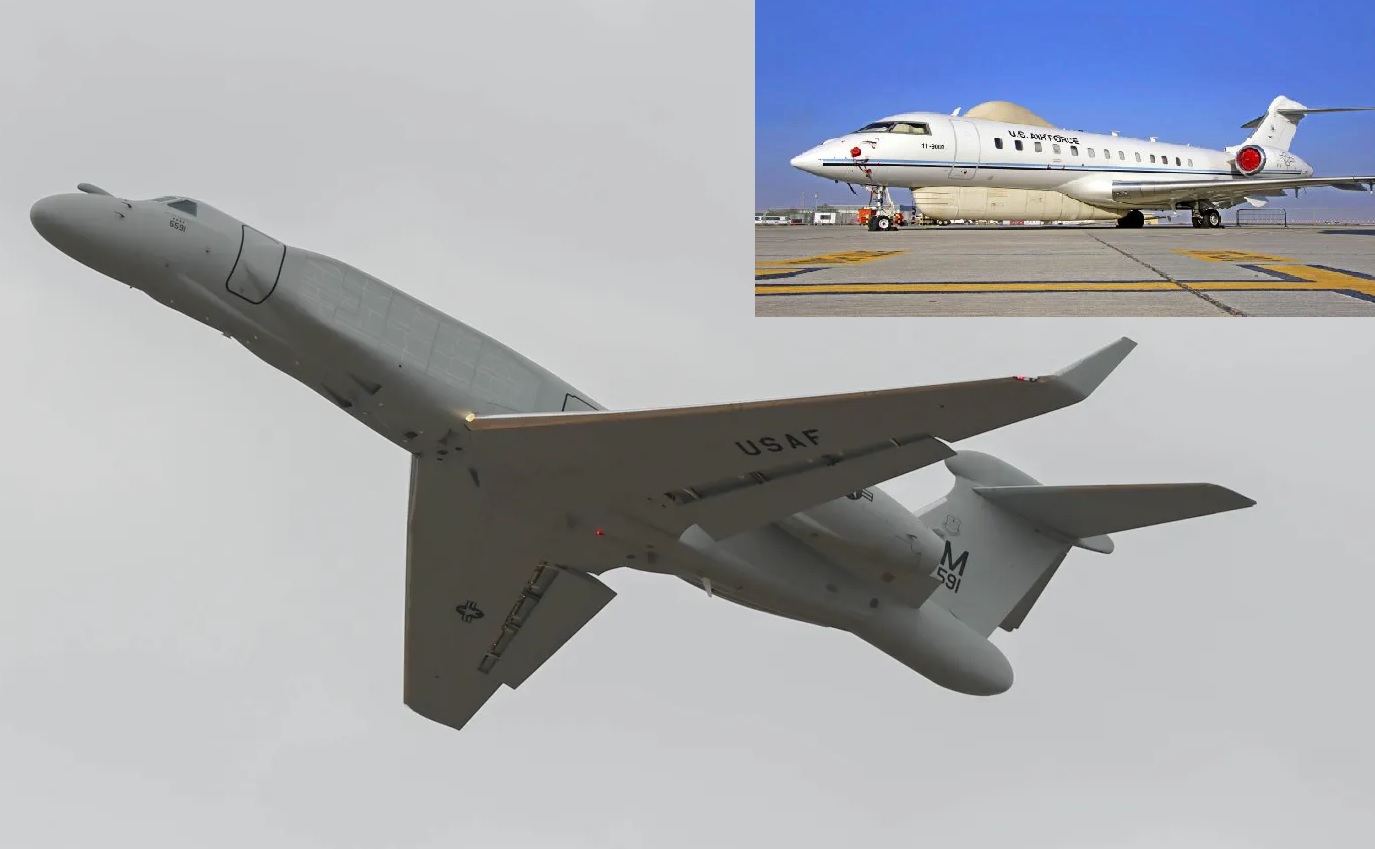
WASHINGTON — April 30, 2026 : The U.S. Air Force has outlined a restructuring of its airborne communications and electronic warfare fleets, proposing an increase in planned procurement of the EA-37B Compass Call aircraft while phasing out the E-11A Battlefield Airborne Communications Node (BACN) platform by fiscal year 2028. The proposal was detailed in documents submitted to Congress, including the service’s fiscal year 2027 posture statement.
Expansion of EA-37B Electronic Attack Fleet
The Air Force plans to expand its EA-37B fleet from an originally projected 12 aircraft to 22. The EA-37B, derived from the Gulfstream G550 business jet, is replacing the aging EC-130H Compass Call fleet and is intended to provide enhanced electronic attack capabilities in contested environments.
Initial deliveries of the EA-37B began in August 2024 at Davis-Monthan Air Force Base, followed by the commencement of training missions in May 2025. The platform transitioned rapidly from training to operational deployment. By April 2026, it had been deployed to the Middle East as part of Operation Epic Fury. Open-source flight tracking data indicated transit activity through RAF Mildenhall en route to the operational theater.
The accelerated deployment timeline followed reports that legacy EC-130H aircraft sustained damage during Iranian attacks, prompting the need for earlier operational use of the EA-37B.
The aircraft is equipped with systems designed to disrupt adversary communications networks, degrade early warning radar systems, and interfere with navigation signals. It is also capable of integrating with RC-135 Rivet Joint platforms to leverage electronic intelligence (ELINT) data, enabling more precise targeting of hostile emitters and networks. The proposed fleet size of 22 aircraft would exceed the maximum number previously fielded for the EC-130H, reflecting the increasing role of electronic warfare in high-intensity operations.
Planned Retirement of E-11A BACN Fleet
Alongside the EA-37B expansion, the Air Force intends to retire its fleet of E-11A BACN aircraft by fiscal year 2028. The E-11A, based on the Bombardier Global 6000 business jet, serves as a high-altitude communications gateway.
The BACN payload enables the aircraft to act as an airborne relay, translating and connecting disparate communication systems and frequencies. This capability allows coordination among aircraft, ground forces, and command elements operating on otherwise incompatible networks. While often informally described as “Wi-Fi in the sky,” operators emphasize that its functionality extends significantly beyond basic connectivity.
The platform was initially fielded to support operations in Afghanistan, where mountainous terrain limited line-of-sight communications for VHF and UHF radios. It replaced earlier efforts using NASA WB-57F Canberra aircraft equipped with prototype BACN payloads. Operating at altitude, the E-11A enabled persistent communication coverage in complex terrain while reducing reliance on costly and bulky satellite communications systems.
The E-11A fleet has been extensively employed in the Middle East, including during Operation Inherent Resolve and more recently in Operation Epic Fury. Flight tracking data indicated a notable increase in E-11A deployments to the region ahead of the latter operation.
The fleet expanded to nine aircraft, with the most recent addition—tail number 24-9049—manufactured in 2024 and delivered in 2025. Despite significant operational use, these aircraft retain substantial remaining service life.
Rationale for Divestment
The Air Force cited advancements in satellite communications as a primary factor in the decision to retire the E-11A fleet. The increasing availability and performance of low Earth orbit (LEO) satellite constellations have improved connectivity, reducing the need for a dedicated airborne communications relay platform.
Additionally, the BACN payload has been adapted into podded configurations that can be integrated onto multiple aircraft types. This approach allows the Air Force to maintain the capability without sustaining a specialized fleet, offering greater flexibility in deployment and force structure.
Outstanding Questions on Future Disposition
The planned retirement by fiscal year 2028 raises questions regarding the future use of relatively new airframes. The aircraft’s remaining service life and advanced capabilities could make them candidates for foreign military sales. However, the Air Force has not clarified whether the BACN technology—considered sensitive—would be approved for export or whether the aircraft would be transferred without their full mission systems.
Broader Force Structure Context
The proposed changes form part of a broader effort by the Department of the Air Force to modernize capabilities in electronic warfare and communications while aligning resources with evolving operational requirements. The expansion of the EA-37B fleet and the retirement of the E-11A reflect a shift toward distributed, multi-platform solutions supported by advancements in space-based communications.
The proposals remain subject to congressional review, and no final procurement quantities or retirement timelines have been formally approved beyond the plans submitted in the fiscal year 2027 budget documentation.
——— End of Article ———